Medieval & Templars

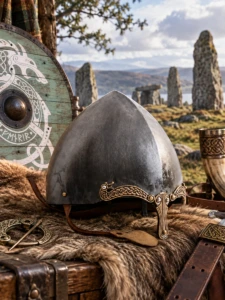
CAS-004 Medieval Celtic Helmet – Blackened Steel and Engraved Brass
Medieval Celtic Helmet – Blackened Steel and Engraved Brass
92,40 €
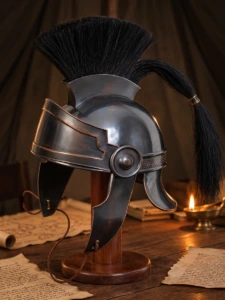
CAS-006 Black Roman Centurion Helmet with Horsehair Crest
Black Roman Centurion Helmet with Horsehair Crest
84,00 €
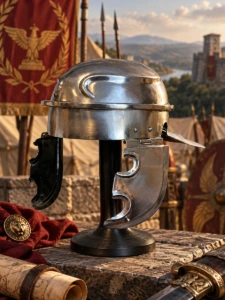
CAS-007 Roman Galea-Type Helmet in Polished Steel
Roman Galea-Type Helmet in Polished Steel
128,40 €
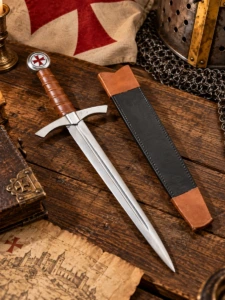
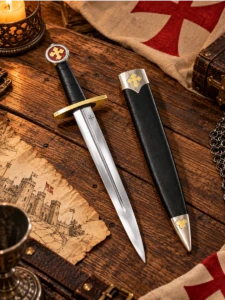
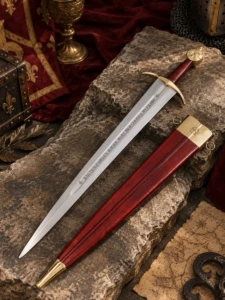
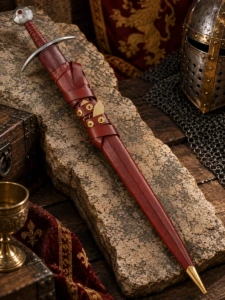
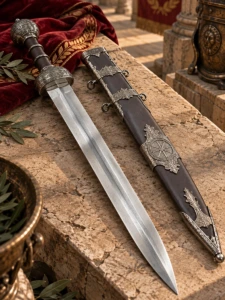
DAG-001 Forged Templar Dagger with Red Cross on the Pommel and Leather Sheath
Forged Templar Dagger with Red Cross on the Pommel and Leather Sheath
72,00 €
DAG-002 Templar Dagger Veritas Crucis with Golden Cross
Templar Dagger Veritas Crucis with Golden Cross
82,80 €
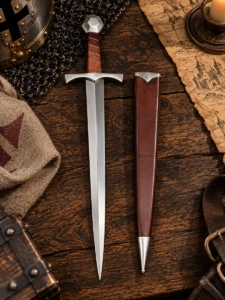
DAG-006 Forged Medieval Dagger with Thick Unsharpened Blade and Leather Sheath
Forged Medieval Dagger with Thick Unsharpened Blade and Leather Sheath
66,00 €
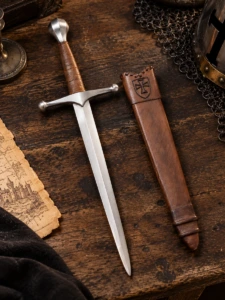
DAG-008 Forged German Combat Dagger with Engraved Leather Sheath
Forged German Combat Dagger with Engraved Leather Sheath
72,00 €
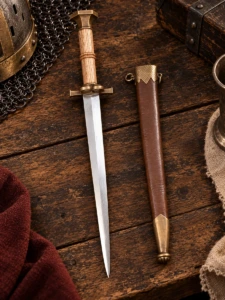
DAG-009 Forged German Dagger with Wooden Handle and Bronze-Tone Fittings
Forged German Dagger with Wooden Handle and Bronze-Tone Fittings
87,60 €
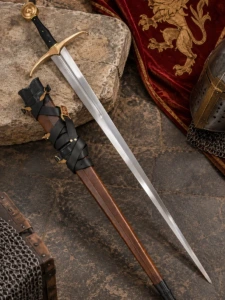
ESP-006 Medieval Type XIV Sword with Engraved Blade
Medieval Type XIV Sword with Engraved Blade
200,40 €
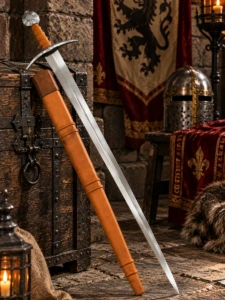
ESP-007 Medieval Knight's Sword with Wheel Pommel and Curved Guard
Medieval Knight's Sword with Wheel Pommel and Curved Guard
224,40 €
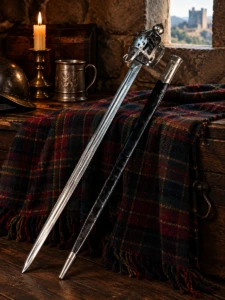
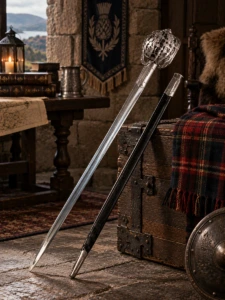
ESP-011 Jacobite Sword with Gilded Basket Hilt
Jacobite Sword with Gilded Basket Hilt
262,80 €
ESP-012 Scottish Officer's Basket-Hilted Sword
Scottish Officer's Basket-Hilted Sword
262,80 €
ESP-018 80 cm Roman Gladius with Medallion Scabbard
80 cm Roman Gladius with Medallion Scabbard
140,40 €
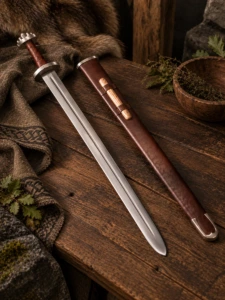
ESP-020 Viking Sword with Five-Lobed Pommel and Leather Scabbard
Viking Sword with Five-Lobed Pommel and Leather Scabbard
162,00 €
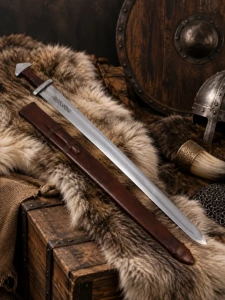
ESP-022 Viking Type H/I Sword with Engraved Blade and Leather Scabbard
Viking Type H/I Sword with Engraved Blade and Leather Scabbard
159,60 €
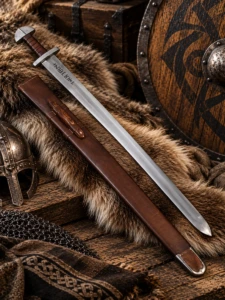
ESP-023 Petersen Type X Viking Sword with Ulfberht Inscription
Petersen Type X Viking Sword with Ulfberht Inscription
150,00 €
ESP-026 Medieval Type XIV Sword from the 13th Century with Garnet Leather Scabbard
Medieval Type XIV Sword from the 13th Century with Garnet Leather Scabbard
219,60 €
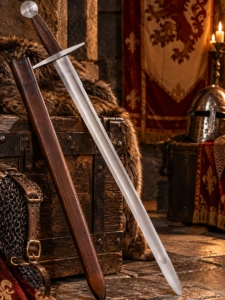
ESP-027 Medieval Sword Type XV from the 14th Century with Wheel Pommel and Curved Crossguard
Medieval Sword Type XV from the 14th Century with Wheel Pommel and Curved Crossguard
176,40 €
ESP-028 Medieval Combat Sword "William the Marshal" from the 12th Century
Medieval Combat Sword "William the Marshal" from the 12th Century
176,40 €
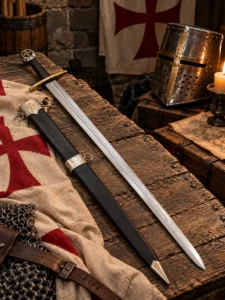
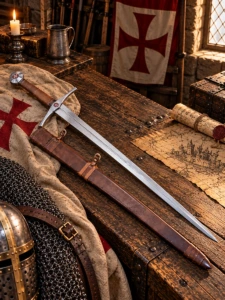
ESP-031 "Militia Templi" sword of the Order of the Temple with Templar Cross and Black Sheath
"Militia Templi" sword of the Order of the Temple with Templar Cross and Black Sheath
200,40 €
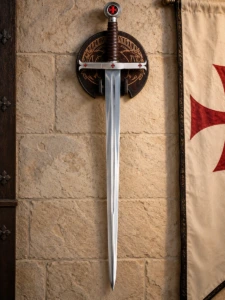
ESP-048 Templar sword of Jacques de Molay
Templar sword of Jacques de Molay
140,40 €
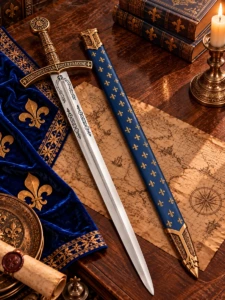
ESP-051 French medieval sword from the 14th century with fleur-de-lis and blue scabbard, 109 cm
French medieval sword from the 14th century with fleur-de-lis and blue scabbard, 109 cm
120,96 €
ESP-052 Medieval two-handed greatsword - Forged steel and leather
Medieval two-handed greatsword - Forged steel and leather
152,40 €
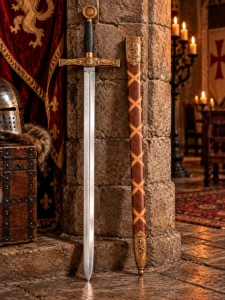
ESP-053 Excalibur sword with braided brown scabbard, 111 cm
Excalibur sword with braided brown scabbard, 111 cm
149,94 €
HAC-002 Viking Bearded Axe with Dragon-Head Handle – 50 cm
Viking Bearded Axe with Dragon-Head Handle – 50 cm
170,40 €
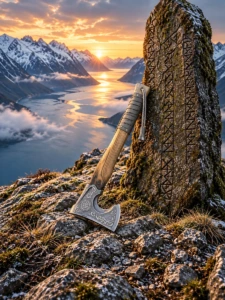
HAC-003 Brown Bearded Viking Axe with Engraved Valknut – 48 cm
Brown Bearded Viking Axe with Engraved Valknut – 48 cm
70,80 €
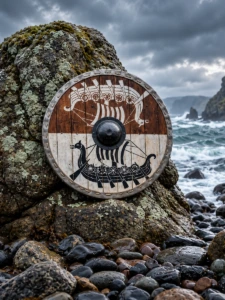
SCU-002 Viking Drakkar Shield – Fleet of the Conquerors
Viking Drakkar Shield – Fleet of the Conquerors
110,40 €
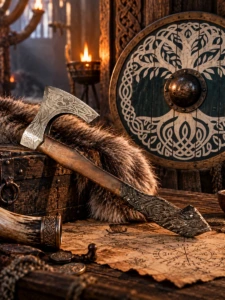
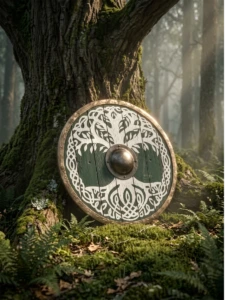
SCU-003 Viking Shield Yggdrasil – Power of the Ancestral Roots
Viking Shield Yggdrasil – Power of the Ancestral Roots
110,40 €
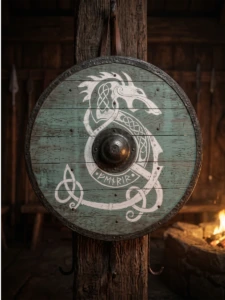
SCU-004 Fenrir Viking Shield – The Legend of the Giant Wolf
Fenrir Viking Shield – The Legend of the Giant Wolf
142,80 €
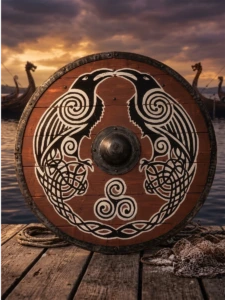
SCU-005 Huginn and Muninn Viking Shield – Odin's Ravens
Huginn and Muninn Viking Shield – Odin's Ravens
142,80 €
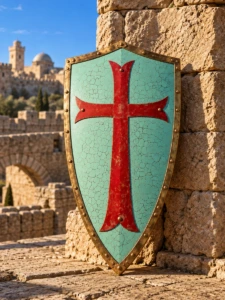
SCU-006 Templar Steel Shield – Red Cross on White
Templar Steel Shield – Red Cross on White
126,00 €

Roman, Viking, medieval and Templar swords

Almost two thousand years of history in steel: from the Roman gladius to the sword of the Templars. Here we bring together replicas of swords, daggers, helmets and shields from Europe's great warrior eras.

  • Rome: Pompeii and Fulham type gladii, daggers, and centurion and legionary helmets.
  • Vikings: Petersen type swords, bearded axes and shields painted with Odin, Fenrir or Yggdrasil.
  • Middle Ages and the Crusades: knightly swords from the 11th to the 14th century, combat daggers, crusader and Teutonic helmets and heraldic shields.
  • Templars: swords, daggers and shields bearing the cross of the Order of the Temple.
  • Later centuries: fencing rapiers and Scottish basket-hilted swords.

They are steel pieces with leather, wooden or metal scabbards, made for collecting, display or historical re-enactment. Each product page gives the dimensions, weight and materials.

In the History tab we trace how swords and armour changed, from Bronze Age Greece to the Templar legend.

1. Greece — The bronze warrior is born

Around the 7th century BC, a Greek warrior prepares for battle. He places a bronze helmet on his head, covering his cheeks and nose. The eye openings are narrow, and he can barely see what's happening to the sides. The metal is heavy, heats up, and limits his senses, but when the time comes, it won't matter. The helmet isn't made for comfort. It's made to keep him alive.

He is a hoplite.

His equipment forms a set designed for fighting alongside other men. He carries a spear, a short sword as a secondary weapon, greaves, a breastplate, and an enormous circular shield: the aspis, popularly known as the hoplon.

But that shield has something peculiar about it.

Its design allows it to be held firmly with the arm while covering a good part of the body. It protects the left side especially well, but leaves the right more exposed. One man alone has a problem. Two men together have a solution.

One man's shield partially protects the other.

And so, almost without realising it, the weapon begins to dictate how the men who wield it should fight.

The hoplites advance in tight ranks. Each one protects the comrade next to him and expects his comrade to do exactly the same. Spears protrude from the front of the formation while shields create a continuous wall of wood and bronze.

The phalanx is born.

It is not simply a way of positioning soldiers. It is a consequence of their equipment. The hoplite does not need to be the fastest or strongest warrior. He needs to hold his position.

For generations, this form of combat became one of the great military forces of the Greek world.

In 480 BC, this discipline would find one of its most famous stages.

A huge Persian army advances towards Greece. In its path appears a narrow pass between the mountains and the sea: Thermopylae.

There, the Spartan king Leonidas and his men manage to take advantage of the terrain to face an enemy vastly superior in numbers for days. The phalanx works because the space prevents the Persians from easily outflanking it.

But no formation remains perfect forever.

More than a century later, in Macedonia, a king would understand that if the shield and spear could change the way battles were fought, they could also be taken much further.

His name was Philip II.

His answer was a gigantic spear: the sarissa, a pike that could exceed six metres in length. The soldier wielding it was protected by a veritable barrier of points even before the enemy could approach.

The Macedonian phalanx had taken the original idea to another level.

Philip used that army to impose his dominance over Greece. And when he died in 336 BC, he left his son something far more valuable than a kingdom.

He left him an army.

His son was Alexander.

Two years later, he would begin a campaign that would take those long sarissas much further than their creator had probably imagined. Macedonia crossed into Asia, and in a few years, Alexander defeated the Persian Empire and extended his dominion to the borders of India.

History had demonstrated something that would be repeated time and again in the following centuries:

when the weapon changes, the way of waging war can also change.

But while the Greek armies evolved, another Greece was also born. A Greece that centuries later would be reconstructed by artists, writers, filmmakers, and designers until it became an image that almost no one questions any more.

The Spartan warrior of our imagination wears a large vertical crest on his helmet.

The reality was different.

On ancient pottery and reliefs, both longitudinal and transverse crests appear, made of horsehair, and some representations suggest that the transverse crest distinguished officers. The image of an entire Spartan army crowned with large, spectacular crests belongs, to a large extent, to the way in which popular culture has reinvented Antiquity.

Cinema did not invent Greek warriors.

But it did make them easier to recognise.

And perhaps that's the most interesting part of this whole journey: gradually separating the warrior who actually existed from the one we've constructed since.

Because beneath all those images lies something much simpler.

A man.

A bronze helmet.

A shield that forces him to trust the man marching beside him.

And a spear that, with the passage of time, will eventually become a six-metre pike and carry an army to the ends of the known world.

Greece didn't invent all the weapons it used.

But it learned something that other peoples would later perfect: a good weapon doesn't just change the way you fight. It can change the way you organise an entire army.

And Rome was about to learn that same lesson.

But in its own way.

2. Rome — The weapon they copied and perfected

Rome did not invent the weapon that would make it famous.

It found it far from Italy, in Hispania.

During the Second Punic War, between 218 and 201 BC, Roman armies clashed for years with the troops of Carthage. Hannibal had crossed the Alps with elephants and had taken the war to the heart of Italy. Rome needed to learn quickly.

And in Hispania, it found something that caught its attention.

The Celtiberian warriors used short, sturdy, easily handled swords, capable of cutting and, above all, of attacking with the point in close combat.

The Romans observed.

And copied.

The sword they adopted would be known as the Hispanic gladius, the gladius hispaniensis of Latin sources.

It wasn't particularly long. That was precisely part of its advantage. In a close formation, a soldier doesn't need a sword that makes large swings. He needs something he can use without breaking the line and that allows him to strike quickly forward.

Rome had found a weapon suitable for the way it wanted to fight.

But it still needed to be made much more powerful.

The Roman legion was not a multitude of men armed with the same sword. Every piece of their equipment had a function.

The scutum, the large curved shield, protected a good part of the body.

The pilum, a long javelin, could be thrown before close combat. Its iron point was designed to penetrate enemy shields and, under certain circumstances, bend after impact, making it difficult for the enemy to reuse the weapon or even handle the shield comfortably.

And when the two lines finally clashed, there remained the gladius.

Short.

Fast.

Lethal.

Its effect on the enemy was so brutal that it was recorded in writing.

The historian Livy recounts that, around 200 BC, during a conflict with Macedonia, King Philip V ordered the bodies of his soldiers, fallen in a clash with the Romans, to be displayed in his camp.

His own men, accustomed to spear wounds, were terrified: arms severed with a single blow, heads severed from their bodies.

They had never seen what a gladius could do.

That horror was only a warning of what was to come.

In 197 BC, at Cynoscephalae, this form of combat demonstrated just how effective it could be.

On the other side was the Macedonian army, heir to the tradition of Philip and Alexander. Their soldiers used the enormous sarissa and fought in a formation that could be formidable in open terrain.

But the battlefield does not always respect the plans of generals.

The hills and the uneven terrain broke the Macedonian formation. The long sarissas, so powerful when all the men remained in formation, proved far less manageable when the line broke.

Roman legionaries could split up, advance, and fight in smaller groups.

The old phalanx had found an enemy that didn't need to confront it in the same way.

Rome had learned another lesson:

the biggest weapon doesn't always win. Sometimes the one that allows you to adapt best to the terrain wins.

And the gladius wasn't the only foreign weapon that Rome adopted.

There was also the pugio.

The dagger that accompanied the legionary became a standard piece of Roman equipment during the late Republic and the Empire. It was compact, double-edged, and robust enough to be used as a backup weapon.

Its origin is related to the daggers used in Hispania, although attributing to it an exclusively Cantabrian origin is a matter that requires more nuance than the traditional image allows.

Over time, the pugio could also become an extraordinarily decorated piece. Some scabbards were adorned with metalwork, reliefs, and inlays that revealed as much about the owner as about the weapon they protected.

Meanwhile, the Roman army itself had changed from within.

In 107 BC, Gaius Marius had profoundly reformed the army. Soldiers began to carry their own equipment themselves.

According to a famous tradition, the legionaries carried so much baggage that their comrades began to call them, somewhat ironically, "Marius's mules".

The nickname eventually went down in history.

And it speaks volumes about the transformation the Roman army was undergoing.

The legionary was no longer simply a citizen who went to war with his weapons.

He was a professional soldier.

His equipment was part of his identity.

His shield.

His helmet.

His pilum.

His gladius.

His pugio.

Each piece had a function, and all together they formed a military machine far more complex than the sum of its parts.

And then came one of the most famous episodes in Roman history.

The Ides of March, 44 BC.

Julius Caesar enters the Senate.

Around him are men he knows.

Some have been his allies.

Others owe him their position.

And several of them conceal small metal blades under their clothing.

When the attack begins, the conspirators draw their pugios.

The dagger, born from the experience of other peoples, had become a part of Roman power.

Centuries later, cinema would again construct a single image of the Roman legionary, mixing armour, helmets, swords, and standards from different eras.

But the real Rome was far more changeable.

The gladius evolved.

Defensive equipment changed.

Tactics adapted.

And the army that had begun by copying foreign weapons ended up developing its own military tradition that would dominate much of the Mediterranean world.

Rome did not invent the gladius.

Nor did it invent the pilum.

It didn't even invent the idea of turning an army into a perfectly organised machine.

Its true skill lay elsewhere:

observing what worked, adapting it, and making it its own.

And while Rome was learning to transform the weapons of other peoples into instruments of conquest, far away, new swords were beginning to appear in the hands of warriors who had not yet entered history.

Centuries later, they would be called Vikings.

3. Vikings — The weapons that made history

Around the year 800, somewhere in Scandinavia, a man prepares to leave home.

He doesn't need much.

A wooden shield, a spear, and an axe might be enough to turn a peasant into a warrior. A sword is another matter. It's expensive, difficult to make, and not within everyone's reach.

That's why, for much of the Viking Age, the spear was the weapon of the common warrior.

The shield completed the set.

Together, they allowed them to form a compact line in which each man protected part of the body of the one next to him. It was a way of fighting that rewarded the discipline and strength of the group as much as individual skill.

But there were men who could afford something more.

A sword.

And among all the swords that circulated in northern Europe during those centuries, there were some that achieved an extraordinary reputation.

On the blades appeared an inscription:

+VLFBERHT+

The name became a kind of signature.

The curious thing is that those swords didn't originate in Scandinavia. Many came from Frankish workshops located in the Rhine region and reached the north through trade, exchange, plunder, or the movements of warriors.

Their steel was of exceptional quality for its time. Some of these blades show a composition and manufacturing process that resulted in a more homogeneous and resistant metal than that typically found in many European swords of the period.

And then something happened that seems surprisingly modern to us.

Reputation bred imitations.

Some swords incorrectly copied the name VLFBERHT, as if a swordsmith had understood that those letters were the mark that transformed an ordinary sword into a prestigious one.

Almost a thousand years before modern trademarks, an inscription on a blade could already signify quality, prestige, and value.

Today, much of what we know about these swords comes from the classification established by the Norwegian archaeologist Jan Petersen in 1919, based on hundreds of finds: the same classification still used by museums and archaeologists to date them.

But the sword wasn't a weapon everyone could afford.

For most, the axe remained much more accessible.

It was used for work.

For cutting wood.

For building a house.

And, when war came, it could become a formidable weapon.

Over time, some warriors took this tool to extremes that had nothing to do with agricultural work.

One of the most famous examples would appear far from Scandinavia.

In 988, Prince Vladimir of Kiev sent Varangian warriors to aid the Byzantine Emperor Basil II.

Those Scandinavians would eventually form the core of the Varangian Guard, an elite unit tasked with protecting the emperor of Constantinople.

Among their weapons, a type of long-handled axe stood out, which would become closely associated with these warriors.

The Viking world had not confined itself to attacking monasteries and settlements in Western Europe.

Its men travelled.

They traded.

They served as mercenaries.

They founded settlements.

And they reached places as far away as Constantinople.

Decades later, one of those Varangians would be remembered far beyond the borders of the Byzantine Empire.

His name was Harald Sigurdsson.

He had served in the Varangian Guard before returning to Scandinavia, where he would eventually become king of Norway.

History would know him as Harald Hardrada.

In 1066, Harald crossed the sea to try to conquer England.

On 25 September, he met the English army at Stamford Bridge.

There he died.

For many historians, that battle would become one of the symbols of the end of the Viking Age.

But the image of the Viking was about to outlive the Vikings themselves.

Because for centuries, no one imagined those warriors with horns on their helmets.

The image appeared much later.

In 1876, the German designer Carl Emil Doepler created horned helmets for the costumes of a production of Richard Wagner's operas.

The idea worked perfectly on stage.

It was spectacular.

Easy to recognise.

And completely anachronistic.

But the image outlived the opera.

It passed into illustrations, comics, film, cartoons, video games, and finally, into the collective imagination.

The only complete Viking helmet we know of, found in Gjermundbu, Norway, doesn't have horns.

It has something much less spectacular.

Iron.

A mask-like protection for the eyes and nose.

And a structure designed to protect a warrior's head.

It's a much simpler image than the Viking of cartoons.

But perhaps it's also more interesting.

Because behind the legend were men who used the weapons they had at hand: spears, shields, axes, and, when they could afford them, swords.

Some were made in the north.

Others travelled from distant lands.

Some bore names that proclaimed their prestige.

And others were simply tools they had learned to use in a different way.

The Viking Age ended, but its weapons did not disappear.

The sword continued to evolve.

The shield changed.

Armour became more complex.

And in Europe, a new type of warrior began to appear, protected by ever more steel.

The world of the Vikings was coming to an end.

The world of medieval knights had just begun.

4. Middle Ages — The struggle between weapon and armour

Around the year 1000, Europe was full of men wearing steel.

It wasn't yet the full armour that centuries later we would associate with the medieval knight. The warrior of this era wore chain mail, made up of thousands of small, interlocking iron rings. He also carried a shield and, in his hand, a straight-bladed sword.

It was a simple combination.

And it worked.

The sword allowed him to cut and strike. The shield protected the body. The chain mail stopped or reduced the effectiveness of many attacks.

For generations, this balance was maintained.

But in war, there is always someone who tries to break the balance.

And this time it wouldn't be a sword.

It would be an arrow.

In 1139, the Second Lateran Council even went so far as to condemn the use of the bow and crossbow against other Christians. The Church considered those weapons especially dangerous.

But a religious prohibition had a problem.

The enemy could still use them.

And no king wanted to give up an effective weapon simply because his adversary could also use it.

The crossbow continued to spread.

So did the bow.

And, in time, a new threat appeared.

In 1346, during the Hundred Years' War, the English and French armies met at Crécy.

At the head of the English stood King Edward III, with his son—the future Black Prince—commanding one of the wings. On the French side, King Philip VI of Valois relied on his cavalry to decide the day.

On the other side of the field awaited the French cavalry.

Knights covered in iron.

Men accustomed to a cavalry charge deciding a battle.

Facing them were thousands of English archers armed with the longbow.

When the battle began, arrows started raining down on the French formation.

Horses were hit.

Men fell.

The charges lost force.

And the battle demonstrated something that would be repeated time and again for centuries:

no armour is definitive.

If the weapon finds a way to penetrate it, the armour has to change.

And it did.

During the second half of the 14th century and throughout the 15th, steel plates appeared more and more frequently on the warrior's body.

First as pieces that reinforced the most exposed areas.

Then covering arms, legs, chest, and back.

Until the knight ended up encased in a veritable articulated suit of steel.

The transformation wasn't immediate.

It was a race.

The weapon sought a weak point.

The armour closed it.

The weapon changed.

The armour responded again.

And that race ended up producing some of the most sophisticated armour Europe had ever seen.

But there's a paradox.

When we think of a medieval knight, we usually picture precisely those full suits of armour.

However, some of the most spectacular armour appeared when the Middle Ages were already fading away.

The Maximilian-style armour, for example, dates from approximately 1500–1525, when Europe was already in the Renaissance.

It's a small difference to someone looking at a photograph.

But enormous for a historian.

The Middle Ages didn't end because knights one day stopped wearing armour.

They ended precisely while that armour was reaching some of its highest levels of perfection.

And as steel increasingly covered the body, the sword also had to change.

A broad blade could be excellent against a man protected only by clothing or leather.

But against a steel surface, simply cutting was no longer enough.

An opening had to be found.

A joint.

An armpit.

The slit in a helmet.

The weapon began to seek out the armour from within.

And from that need would emerge another, much smaller piece.

The dagger.

It was no longer simply a secondary weapon.

It was the answer to a specific problem.

When two armoured men ended up fighting hand-to-hand, the sword could prove too large to find certain weak points. A short, rigid, and narrow blade could penetrate where a sword could not.

War had transformed armour into a fortress.

And now weapons sought its gates.

That small blade, however, deserves its own story. We will tell it shortly, along with the sword itself.

The evolution had an almost inevitable logic.

The better the protection, the more important the point became.

The more steel covered the warrior, the less sense there was in trying to cut him.

The medieval sword had begun primarily as a cutting tool.

Now it was also learning to pierce.

And behind all that evolution, something new had emerged.

The warrior no longer simply carried a weapon.

He carried a complete system of protection and attack designed to counter another system.

Sword against armour.

Bow against steel.

Dagger against the gaps.

Each innovation led to another.

But to see the birth of an institution that would mark this story, we must go back almost two centuries. As early as the 12th century, long before steel completely covered the knight, an order arose that would occupy an increasingly important place in the history of warfare.

An order whose men would wear white and red on steel.

An order that would begin small and end up accumulating land, wealth, and power throughout Europe.

The Order of the Temple.

5. Anatomy of the sword and the dagger

So far we have seen the sword in the hands of Greeks, Romans, Vikings, and knights.

We have seen it change in shape, size, and function.

But before continuing towards the Temple, it is worth pausing for a moment and looking at a sword closely.

Because almost none of its parts are there by chance.

Let's start with the end furthest from the blade.

The pommel seems, at first glance, a simple decorative finial. On some weapons it may be just that, but its function is much more important: it helps to balance the sword and allows for better control of a blade that, in many cases, weighs more than a kilogram.

At the other end is the guard or crossguard.

It protects the hand, but it also fulfils another essential function: it prevents the hand from slipping towards the blade and helps to control the weapon when the swords clash.

Between these two pieces is the grip.

And then the blade begins.

For centuries, blades adopted different shapes because warriors needed to solve different problems.

A relatively wide blade is effective when the enemy has little protection.

But when armour begins to cover the body with steel plates, the situation changes.

It is no longer enough to hit harder.

You have to find a place where the steel isn't.

Blades begin to get narrower, and points become increasingly important.

And here one of the most persistent myths of popular culture appears.

The so-called "blood groove".

Many swords have a longitudinal groove in the blade, and for generations it has been said that it served to allow blood to drain from the victim's body.

This is not the case.

Its function is primarily structural: it allows for some of the blade's weight to be removed while maintaining good strength, in a way comparable to the principle used in certain engineering structures.

The sword, once again, is not designed to impress.

It is designed to function.

And when armour became even more resistant, a problem arose that the sword could not always solve.

Now imagine two men in full armour.

One manages to knock the other down.

The enemy is on the ground, but his armour still protects him.

A broad-bladed sword has difficulty finding a vulnerable point.

Something different is needed.

A shorter blade.

Narrower.

More rigid.

A blade that can slip through an opening.

Around the mid-13th century, the misericorde dagger appeared, associated in medieval tradition with blows aimed at the vulnerable points of a fallen adversary: the gaps in the helmet, the armpits, or the areas where the plates left space to allow movement.

Over time, this logic would be refined.

During the 14th and 15th centuries, the rondel dagger became widespread, easily recognisable by its circular discs on the hilt.

It was no longer simply a small sword.

It was a specialised tool for a world in which there was increasingly more steel between man and his enemy.

And here we can see something that has been repeated since the beginning of our story.

The weapon changes because the enemy changes.

The Greek shield had shaped the phalanx.

The Macedonian phalanx had responded to new needs.

Rome had found in the gladius a weapon suitable for its own way of fighting.

Medieval armour had forced modifications to swords.

And now the dagger sought what armour could not protect.

That is why a historical sword should not be seen merely as an object.

Its shape tells a story.

A wide blade tells us about one type of enemy.

A narrow point tells us about another.

A simple guard belongs to a certain era and style of fighting; a more complex hilt may respond to completely different needs.

Even the weight and balance tell us something about how it was conceived.

When we look at a sword, we are actually looking at the final result of a conversation that lasted centuries.

The weapon asks the question. The armour answers. And the weapon changes again.

But there is a moment in history when the sword ceases to be merely a weapon.

It also begins to become a symbol.

A cross on a white mantle.

A sword at the belt.

A knight who no longer fights solely for himself, but as a member of an institution.

Europe is about to meet the men who will transform that combination of faith, discipline, and warfare into one of the most famous military orders in history.

The Templars.

6. The Order of the Temple — From a shared horse to power

Jerusalem, around 1119.

The city has been in Crusader hands for twenty years, but reaching it remains dangerous. Pilgrims travel along paths where a journey can turn into an ambush.

Into this world appears a small group of knights.

Their leader is Hugh de Payns.

They are not yet a great military order. They are few in number and their resources are scarce. Their purpose is simple: to protect the pilgrims travelling to the holy sites.

According to tradition, they became so poor that the seal they would later use depicted two knights sharing a single horse.

The image would eventually become one of the most well-known symbols of the Templars.

But that poverty would not last long.

In 1129, the Council of Troyes officially recognised the Order and approved its rule, drafted under the influence of Bernard of Clairvaux.

From then on, donations began to arrive.

Land.

Money.

Horses.

Weapons.

Men.

And with them appeared an image that would become inseparable from the Templars.

The white mantle.

In 1147, Pope Eugene III authorised the Templars to wear a red cross on it.

White and red.

Two colours that, centuries later, would still be enough to recognise a Templar even before seeing his face.

But beneath that mantle he was no different from the other knights of his time.

He wore chainmail.

Shield.

Lance.

Sword.

And, above all, discipline.

Therein lay his true strength.

A Templar was not to leave formation to pursue an enemy on his own. He did not fight seeking individual glory. His behaviour was subject to the rules of the Order.

On the battlefield, that discipline could make all the difference.

In 1177, a Crusader army led by the young King Baldwin IV of Jerusalem clashed with Saladin's forces near Montgisard.

Baldwin's army was vastly outnumbered.

Among his men were eighty Templar knights.

The battle ended in an unexpected defeat for Saladin.

The victory made Montgisard one of the great episodes in the military history of the Kingdom of Jerusalem.

But the balance in the Holy Land was shifting.

Ten years later, the Crusaders would meet Saladin again.

This time, at Hattin.

And the outcome would be completely different.

In July 1187, the Crusader army advanced through Galilee in sweltering heat. Water was scarce. Fatigue was mounting.

Saladin knew he didn't need to face a rested army.

He needed to ensure they arrived exhausted.

When the battle finally began, the Crusaders were in a desperate situation.

The defeat was total.

The relic of the True Cross, which the Christians had carried into battle, fell into Saladin's hands.

Many knights were captured.

Among them were Templars and Hospitallers.

The loss of Hattin opened the way to Jerusalem.

The city fell a few months later.

The Order survived.

But nothing would ever be the same again.

During the next century, the Templars would continue fighting in the Holy Land and accumulating properties in Europe.

Because while the war continued, the Order had become much larger than a group of knights.

It had castles.

Lands.

Farms.

Churches.

Trade routes.

And a network of properties that stretched across numerous European territories.

Pilgrims could deposit money in one place and withdraw it in another. The organisation and security of the network meant that the Templars also performed financial functions.

The small group of knights who had begun by protecting pilgrims had become an international institution.

And then came 1291.

Acre fell to Muslim forces.

It was the last great Crusader stronghold in the Holy Land.

The Templars abandoned the region and settled mainly in Cyprus and their European possessions.

The original reason for their existence had disappeared.

But the Order remained powerful.

Too powerful for some.

In France, King Philip IV had a problem.

He was deeply in debt and needed money.

The Templars possessed wealth.

And on Friday 13 October 1307, Philip ordered the simultaneous arrest of the Templars in France.

The accusations were terrible: heresy, blasphemy, and other crimes.

Many were tortured to obtain confessions.

The trial dragged on for years.

Finally, in 1312, Pope Clement V decreed the dissolution of the Order.

The institution that had survived battles, crusades, and the loss of Jerusalem officially disappeared.

Two years later, on 18 March 1314, Jacques de Molay, the last Grand Master of the Templars, was burned at the stake in Paris.

With him disappeared the last Grand Master of an order that had begun almost two centuries earlier with a few knights and a very specific purpose.

But the story didn't end there.

Because when an institution disappears so abruptly, it leaves something behind.

Stories.

Rumours.

Treasures that no one found.

Secrets that no one could prove.

And, as the centuries passed, a legend ever greater than the Order itself.

The Templars were dead.

But their name had just begun another life.

Long afterwards, in lodges of men who were no longer knights nor fought in the Holy Land, their crosses, their swords, and their name would reappear.

The history of the Temple had ended.

The Templar legend had just begun.

7. Freemasonry — From stonemason's tools to the Templar legend

0:00

When Jacques de Molay died at the stake in 1314, the Order of the Temple had already disappeared: the Pope had dissolved it two years earlier.

There was no last secret stronghold.

There is no documentary trail proving that the Templars remained organised in the shadows.

But the name survived.

And four centuries later, someone would once again place it alongside a sword, a cross, and a new kind of brotherhood.

To understand how this happened, we must first go back much further.

During the Middle Ages, the builders who erected cathedrals and castles worked in lodges. There they learned their trade, preserved their knowledge, and used the tools of their trade: the square, the compasses, the level, and the plumb line.

These were real tools.

They were used to measure, check angles, and build structures.

But over time, the lodges began to change.

In the 17th century, men who were not stonemasons began to join them.

They were merchants, aristocrats, and people interested in that tradition of private meetings, ceremonies, and symbols.

The tools were still there.

But they were beginning to mean something else.

The square could represent rectitude.

The compasses, the limits a man should impose on himself.

The instruments that once served to build buildings began to be used to talk about how to build a life.

The transformation took a decisive step in 1717.

That year, representatives of four London lodges met at the Goose and Gridiron tavern and founded the Grand Lodge of London.

Organised Freemasonry entered a new stage.

Six years later, in 1723, the Reverend James Anderson published his Constitutions.

The document contained rules for the lodges, but it also told a much older history of the craft.

A history that traced its roots back to the builders of Solomon's Temple.

Freemasonry already had a tradition.

What it didn't yet have was the Templars.

That would change a few years later.

In 1737, in Paris, the Scotsman Andrew Michael Ramsay delivered a famous speech before a lodge.

In it, he presented the Freemasons as the spiritual heirs of the knights who had participated in the Crusades.

He offered no proof of historical continuity.

But the idea proved extraordinarily powerful.

If Freemasonry could claim a past linked to medieval knights, its rituals and symbols acquired a much greater antiquity.

And among those orders of knights was one whose name held a special allure.

The Temple.

During the following decades, the legend grew.

In 1751, Baron Karl Gotthelf von Hund created the so-called Rite of Strict Observance in Germany.

Von Hund claimed to have received his initiation from a secret Templar organisation and spoke of mysterious "unknown superiors" who supposedly directed the true structure of Freemasonry.

He was never able to prove it.

But by then it no longer mattered much.

The story had begun to turn into tradition.

During the second half of the 18th century, Masonic rites appeared that incorporated degrees related to the Templars.

In 1791, in England, Thomas Dunckerley organised the first Grand Conclave, which gave the degree of Knight Templar a formal and stable structure.

The figure of the Knight Templar ceased to belong exclusively to history books and became part of ceremonies, symbols, and rituals.

Capes appeared.

Crosses.

Ceremonial swords.

Knights' names.

But there was a fundamental difference.

Those men were not the Templars who had fought in Jerusalem.

They were Freemasons from several centuries later who had decided to reclaim their image.

The connection was symbolic.

Not a proven historical continuity.

And perhaps precisely for that reason the legend proved so resilient.

Because symbols can survive much longer than the institutions that created them.

The sword ceased to be a weapon of war and became a ceremonial object.

The cross ceased to identify a knight in the Holy Land and became part of a ritual.

The name of the Temple, which had disappeared from history for centuries, returned transformed into something different.

A tradition.

A legend.

A language of symbols.

And then something happened that always happens when a good story encounters a mystery.

Popular culture made it even bigger.

During the 19th and 20th centuries, novels, essays, and stories about secret societies began to mix Templars, Freemasons, lost treasures, and hidden knowledge.

Much later came cinema, video games, and the great conspiracy novels.

The image of the Templar as guardian of an ancient secret became universal.

But the historical reality is much simpler.

The Order of the Temple disappeared in the 14th century.

Organised Freemasonry appeared centuries later.

And the connection between the two belongs to the realm of Masonic tradition and legend, not to that of proven historical continuity.

And perhaps therein lies the final lesson of our journey.

For centuries, weapons changed.

Bronze gave way to iron.

The spear became the sarissa.

The gladius dominated the Roman battlefields.

The medieval sword faced off against armour.

The dagger sought its weaknesses.

And then, little by little, weapons ceased to be merely tools for killing.

Some became symbols.

A ceremonial sword no longer needs to defeat anyone.

A cross no longer needs to march to Jerusalem.

A square no longer needs to build a cathedral.

But they continue to tell stories.

Stories of men, of wars, of institutions, and also of legends that outlived those who created them.

Because perhaps that is the true journey we have made from Greece to here:

from the weapon wielded to the symbol remembered.

8. The common thread — From weapon to symbol

For centuries, a warrior could recognise the world around him by the sound of metal.

The bronze of the Greek hoplites.

The iron of the Roman swords.

The shields and axes of the northern warriors.

The mail and swords of the medieval knights.

The steel of the armour.

And, finally, the crosses and swords of the Templars.

Each era left its own weapons.

But none appeared by chance.

The Greek hoplite learned to fight shoulder to shoulder because his shield forced him to trust the man next to him.

The Macedonian phalanx took that idea even further with a spear so long that it completely transformed the distance of combat.

Rome observed the weapons of other peoples, adapted them, and built with them a military machine capable of dominating the Mediterranean.

The Vikings used tools, spears, axes, and swords to become warriors, traders, and explorers who traversed an extraordinary part of the known world.

Then came the medieval knight.

For centuries, sword and armour waged a silent battle.

When protection improved, the weapon sought a new answer.

When the sword was no longer enough, the dagger appeared.

When armour found a defence, someone sought a new way to pierce it.

It was a race that never ended.

Until firearms began to change the rules of combat, and that world of steel began to disappear.

But some things survived.

The sword ceased to be necessary for battle and began to become a symbol.

The cross stopped marking out an army and came to represent a story.

The ancient tools of the builders were transformed into symbols of a new tradition.

And the Templars, who disappeared in the 14th century, returned centuries later as protagonists of a legend that never stopped growing.

That's why, when we look at a sword, a helmet, a suit of armour, or a cross today, we are seeing much more than an object.

We are seeing the result of a need.

Of an era.

Of a way of understanding war.

And also of a way of remembering the past.

Some pieces reproduce perfectly documented historical objects.

Others recreate traditions that survived for centuries.

And some belong directly to the world of legend.

The key is knowing how to distinguish them.

Because history is even more interesting when we don't need to invent it.

A hornless Viking helmet can tell a fascinating story.

A Roman sword can take us back to Hispania.

A suit of armour can show us the race between attack and defence.

A Templar cross can remind us of an order that disappeared more than seven hundred years ago.

And a ceremonial sword can demonstrate that, when a weapon is no longer needed for fighting, it can still retain the power to represent something.

That is the thread that connects this entire journey.

From bronze to iron.

From iron to steel.

From weapon to symbol.

And from history to legend.

Because behind every piece there is a story.

And some deserve to be told.

1 / 4

1. THE HELMET THAT WASN’T COMFORTABLE

2 / 4

2. THE SHIELD THAT COULDN’T PROTECT EVERYTHING

3 / 4

3. WHEN MEN BEGAN TO FIGHT AS ONE

4 / 4

1. The sword Rome found in Hispania

0:00

Freemasonry grew out of the medieval stonemasons' guilds, and their working tools, such as the square, compasses, level and plumb line, became symbols.

The hoplite's great shield, the hoplon, was held on the left forearm and left the right side exposed: each soldier sought cover behind his neighbour's shield, as Thucydides already described.

The historian Livy tells how, around 200 BC, Macedonian troops were horrified the first time they saw bodies cut apart by the gladius.

The most prized swords of the Viking Age, the Ulfberhts, were probably not even forged in Scandinavia: they are attributed to Frankish workshops in the Rhine region.

In 1139 the Second Lateran Council banned the use of bows and crossbows between Christians as a “deadly art, hateful to God”. The ban achieved nothing.

A sword's crossguard does not just protect the fingers from the opposing blade: it also stops the hand from sliding onto the blade during a thrust.

Mittelalter zum Katharinenmarkt 2026

16 – 18 October 2026 Steinau an der Straße, Alemania

More information ↗
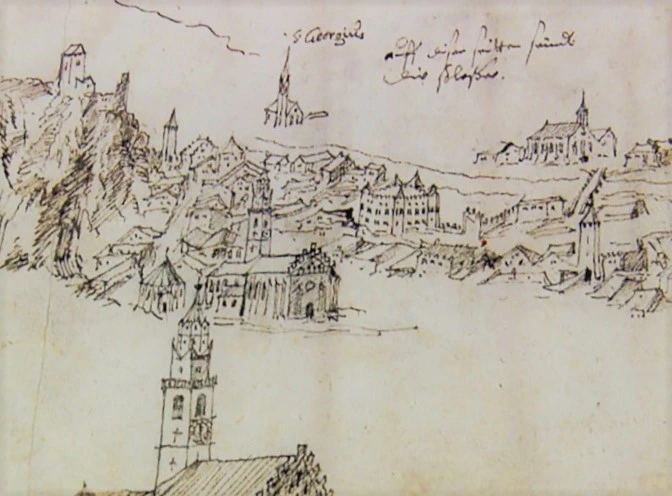
Mittelalter zum Katharinenmarkt 2026

Mittelalter zum Katharinenmarkt combines a traditional market with a medieval atmosphere and historical activities. It is part of Germany's extensive calendar of medieval markets and festivals and is ideal for enthusiasts of crafts, chivalry, and historical re-enactment. Its inclusion in Germany's calendar reflects its connection to historical re-enactment, heritage, and medieval material culture. Demonstrations, encampments, battles, traditional crafts, and equestrian activities offer an engaging glimpse into aspects of daily life and the military dimension of that period, especially when the event takes place in a castle, fortress, or historic town centre.

Image: Wikimedia Commons – Codex brandis meran.jpg — Autor desconocido (manuscrito histórico) — Dominio público

Trofeo Umberto Moschini 2026

18 October 2026 Pisa, Toscana

More information ↗

Trofeo Umberto Moschini 2026

The Trofeo Umberto Moschini is a historical re-enactment event linked to the Compagnia Balestrieri di Pisa (Pisa Crossbowmen's Company). The event highlights crossbow shooting and the tradition of medieval weaponry, offering a perspective closely tied to the military history and combat disciplines of the period. Its inclusion on Italy's calendar reflects its connection to historical re-enactment, heritage, and medieval material culture. Demonstrations, encampments, battles, traditional crafts, and equestrian activities provide an engaging glimpse into aspects of daily life and the military dimension of that era, especially when the event takes place in a castle, fortress, or historic centre.

Image: Wikimedia Commons – A lidar view of Castle Combe in Wiltshire.jpg — Autor no identificado en la ficha — CC BY-SA 4.0

Medieval day at Château d’Urtubie

24 October 2026 Château d’Urtubie, Urrugne, Pyrénées-Atlantiques

More information ↗
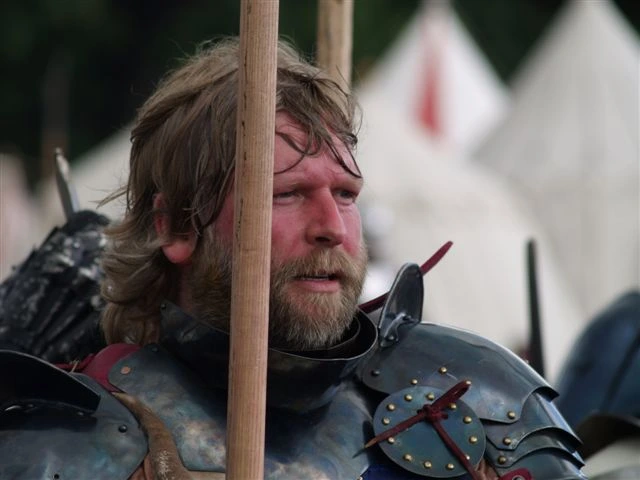
Medieval day at Château d’Urtubie

The Château d’Urtubie is hosting a day dedicated specifically to medieval re-enactment and the military life of the period. The programme includes a historical encampment, weapons demonstrations, armour fencing, Viking combat, blacksmithing, and activities related to heraldry. Due to its content, it is one of the events most directly related to the world of medieval weaponry in this selection and fits particularly well into the Medieval & Templars category. Its inclusion in France's events calendar reflects its connection to historical re-enactment, heritage, and medieval material culture. The demonstrations, encampments, combats, traditional crafts, and equestrian activities offer an engaging glimpse into aspects of daily life and the military dimension of that era, especially when the event takes place in a castle, fortress, or historic town centre.

Image: Wikimedia Commons – Tewkesbury Medieval Festival 2008 - geograph.org.uk - 883527.jpg — andy dolman — CC BY-SA 2.0

Castellote Villa Templaria 2026

30 October 2026 – 1 November 2026 Castellote, Teruel

More information ↗
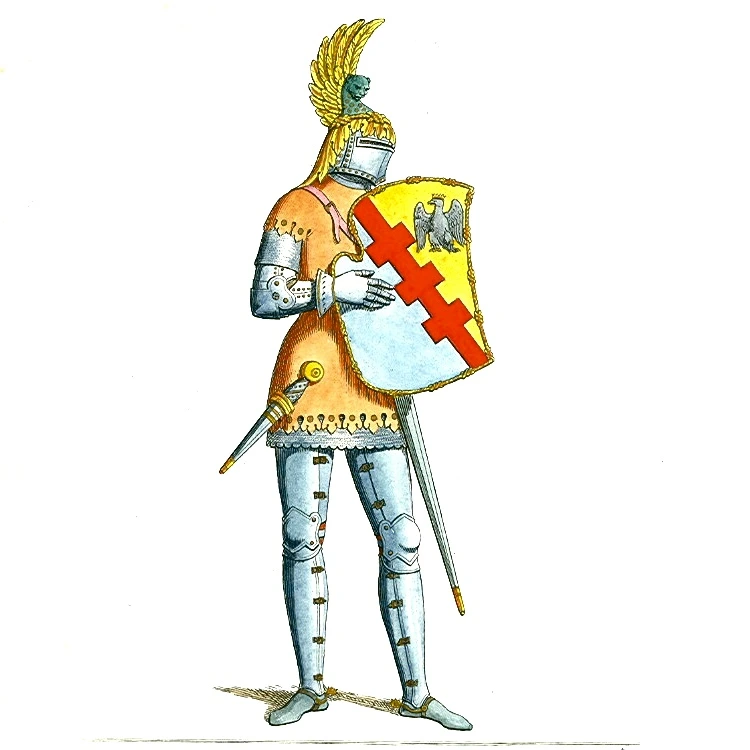
Castellote Villa Templaria 2026

Castellote is once again transformed into a medieval setting with the 7th edition of Villa Templaria. The town recaptures its historical atmosphere with a medieval market and activities linked to the local past and the Templar tradition. This event is especially appealing to fans of knights and military orders. Its inclusion on Spain's calendar reflects its connection to historical re-enactment, heritage, and medieval material culture. Demonstrations, encampments, battles, traditional crafts, and equestrian activities offer an engaging glimpse into aspects of daily life and the military dimension of that period, particularly when the event takes place in a castle, fortress, or historic centre.

Image: Wikimedia Commons – Helmeted Medieval Knight or Soldier (3).JPG — Paul Mercuri — Public Domain Mark 1.0 / Public Domain

Halloween at Château de Bouillon 2026

30 – 31 October 2026 Château de Bouillon, Bouillon

More information ↗
Halloween at Château de Bouillon 2026

The medieval castle of Bouillon hosts two nights of Halloween celebrations, transforming its halls and passageways into a fantasy and horror setting. The ambiance directly utilises the castle's medieval architecture and connects with the imagery of legends and creatures of the night. Its inclusion in Belgium's events calendar reflects its connection to historical re-enactment, heritage, and medieval material culture. Demonstrations, encampments, battles, traditional crafts, and equestrian activities offer an engaging glimpse into aspects of daily life and the military dimension of that period, especially when the event takes place in a castle, fortress, or historic centre.

Image: Wikimedia Commons – LaTestedeBuch-Silo3160.JPG — Autor no identificado en la ficha — CC BY-SA 4.0

Elche Medieval Market 2026 – Festival Medieval d'Elx

5 – 8 November 2026 Elche, Alicante

More information ↗
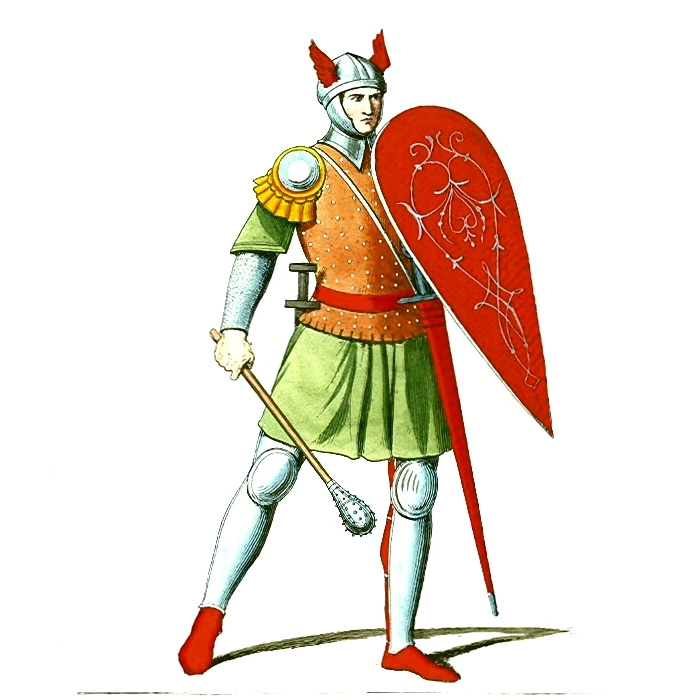
Elche Medieval Market 2026 – Festival Medieval d'Elx

Elche celebrates its Medieval Market as part of the Festival Medieval d'Elx. For four days, the city combines crafts, gastronomy, shows, and historical atmosphere to recapture the spirit of a medieval city. This event unites heritage, tradition, and entertainment, making it one of the highlights of the autumn's historical calendar. Its inclusion on Spain's calendar reflects its connection to historical re-enactment, heritage, and medieval material culture. Demonstrations, encampments, battles, traditional crafts, and equestrian activities offer an engaging glimpse into aspects of daily life and the military dimension of that period, especially when the event takes place in a castle, fortress, or historic centre.

Image: Wikimedia Commons – Helmeted Medieval Knight or Soldier (4).JPG — Paul Mercuri — Public Domain Mark 1.0 / Public Domain

Silves Historical Bow and Crossbow Championship 2026

8 November 2026 Castelo de Silves, Silves
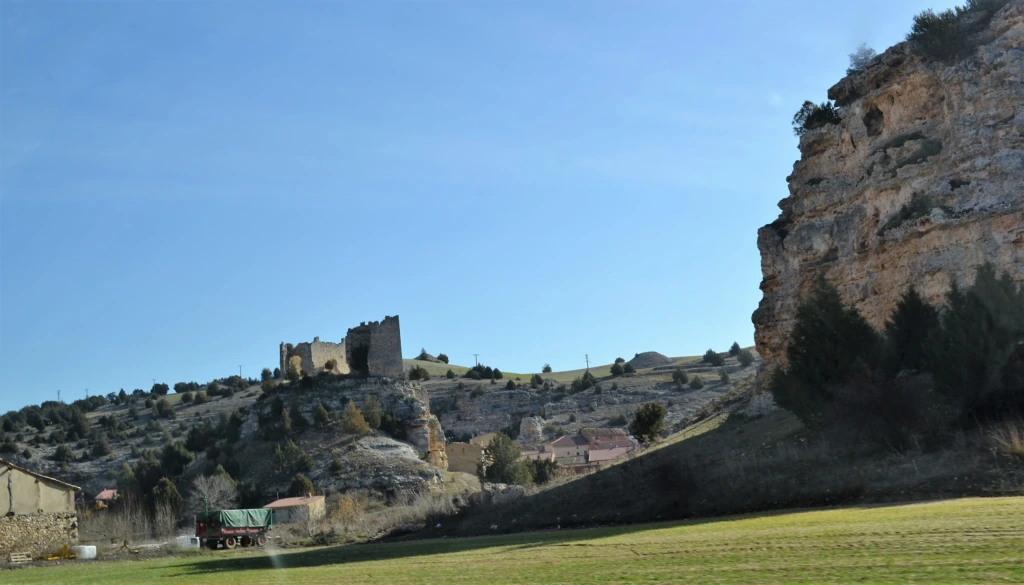
Silves Historical Bow and Crossbow Championship 2026

The Silves Championship revives the historical use of the bow and crossbow within a monumental medieval setting. The combination of heritage and the re-enactment of combat disciplines allows the event to be included in a programme focused on medieval weaponry and historical culture. Its inclusion in Portugal's calendar reflects its connection to historical re-enactment, heritage, and medieval material culture. Demonstrations, encampments, combats, traditional crafts, and equestrian activities offer an engaging glimpse into aspects of daily life and the military dimension of that period, especially when the event takes place in a castle, fortress, or historic centre.

Image: Wikimedia Commons – DSC 0293 Castillo templario de Castillejo de Robledo (SORIA).jpg — Autor no identificado en la ficha — CC BY-SA 4.0

Medieval Market of the Three Cultures of Cáceres 2026

12 – 15 November 2026 Cáceres, Extremadura

More information ↗
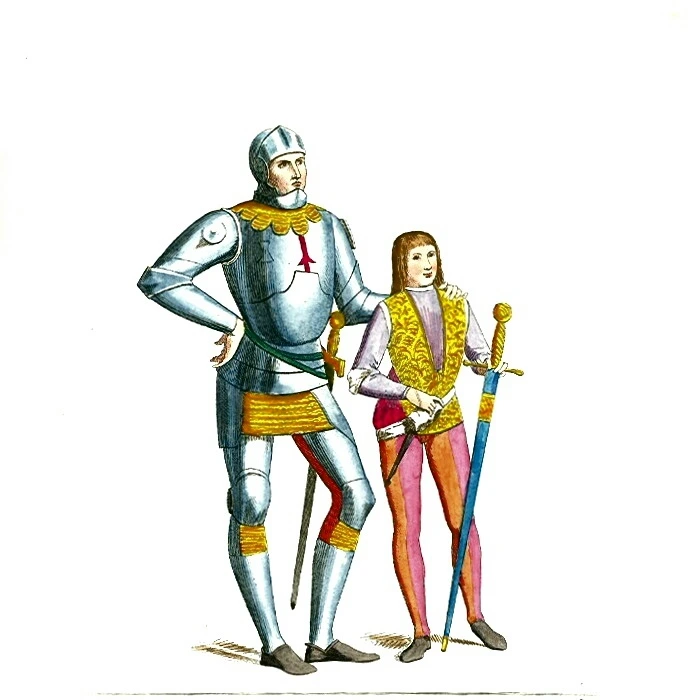
Medieval Market of the Three Cultures of Cáceres 2026

The historic centre of Cáceres hosts a market inspired by the coexistence of the three medieval cultures. For four days, crafts, gastronomy, shows, and historical re-enactments will fill the streets of one of Spain's most important monumental cities. This event is especially appealing to lovers of medieval history. Its inclusion on Spain's cultural calendar reflects its connection to historical re-enactment, heritage, and medieval material culture. Demonstrations, encampments, battles, traditional crafts, and equestrian activities offer an engaging glimpse into aspects of daily life and the military dimension of that period, particularly when the event takes place in a castle, fortress, or historic centre.

Image: Wikimedia Commons – Helmeted Medieval Knight or Soldier (5).JPG — Paul Mercuri — Public Domain Mark 1.0 / Public Domain

Templar Market of Lepe 2026

12 – 15 November 2026 Centro de Lepe, Huelva
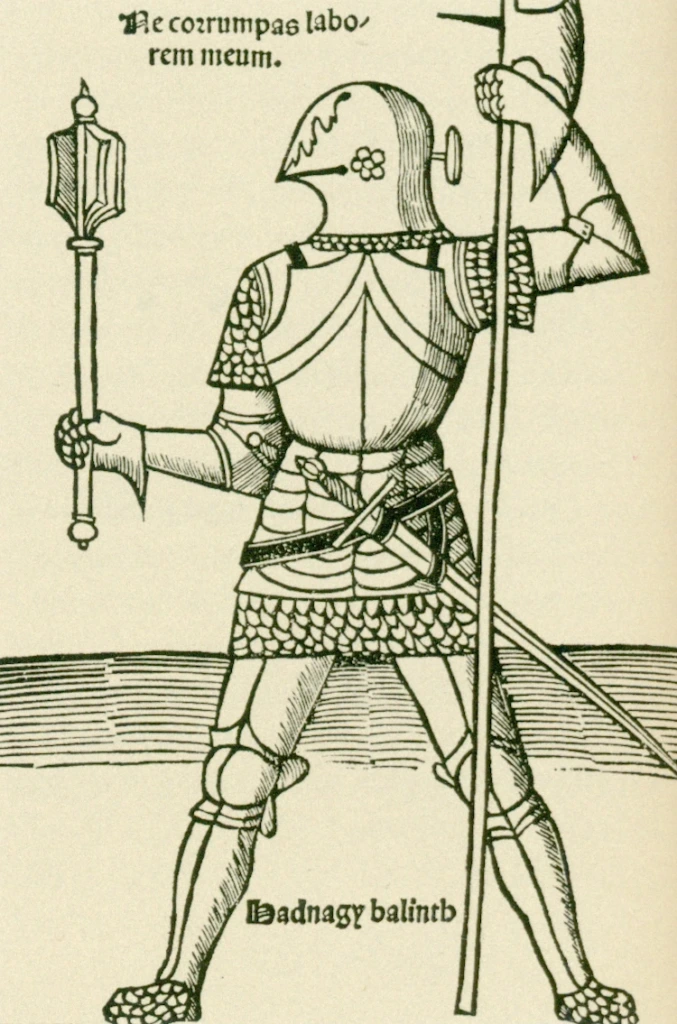
Templar Market of Lepe 2026

For four days, Lepe recreates a medieval atmosphere with a Templar-themed market. The event combines crafts, themed stalls, gastronomy, and entertainment, focusing on the imagery of the military orders and the figure of the medieval knight. Its inclusion on Spain's cultural calendar reflects its connection to historical re-enactment, heritage, and medieval material culture. Demonstrations, encampments, battles, traditional crafts, and equestrian activities offer an engaging glimpse into aspects of daily life and the military dimension of that period, especially when the event takes place in a castle, fortress, or historic town centre.

Image: Wikimedia Commons – Image of a knight in armour, 1511.jpg — Bálint Hadnagy (obra); Szilas (escaneo) — Public Domain Mark 1.0 / Public Domain

Cartagena Medieval Market 2026

20 – 22 November 2026 Casco histórico de Cartagena, Murcia

More information ↗
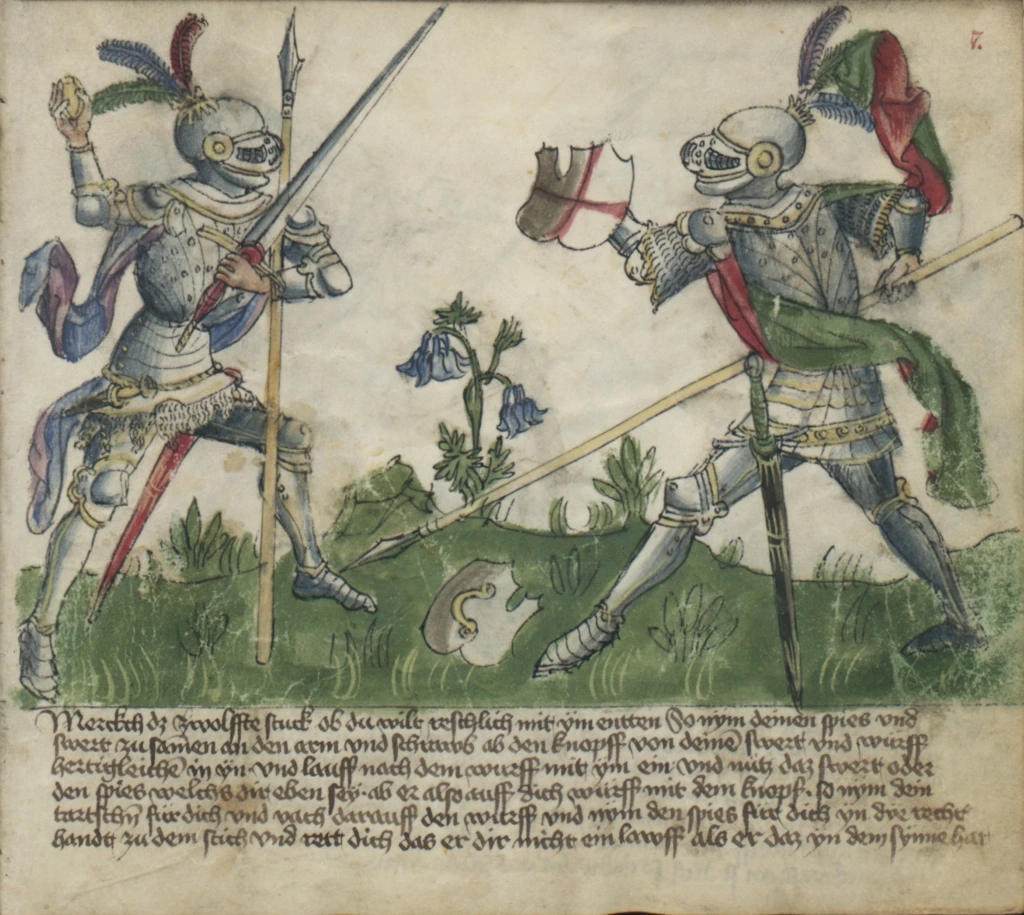
Cartagena Medieval Market 2026

For a weekend, Cartagena recaptures the medieval atmosphere in its historic centre. Crafts, themed stalls, gastronomy, and entertainment transform its streets into a period setting, offering a chance to explore the city's history from a fun and cultural perspective. Its inclusion on Spain's cultural agenda reflects its connection to historical re-enactment, heritage, and medieval material culture. Demonstrations, encampments, battles, traditional crafts, and equestrian activities provide an engaging glimpse into aspects of daily life and the military dimension of that era, especially when the event takes place in a castle, fortress, or historic centre.

Image: Wikimedia Commons – Jagiellonian Ms.Germ.Quart.16 (Gladiatoria) 07r - Longsword in armor.jpg — Autor desconocido (obra); Wiktenauer (fuente) — Public Domain Mark 1.0 / Public Domain

Scroll to Top