


For centuries, a warrior could recognise the world around him by the sound of metal.
The bronze of the Greek hoplites.
The iron of the Roman swords.
The shields and axes of the northern warriors.
The mail and swords of the medieval knights.
The steel of the armour.
And, finally, the crosses and swords of the Templars.
Each era left its own weapons.
But none appeared by chance.
The Greek hoplite learned to fight shoulder to shoulder because his shield forced him to trust the man next to him.
The Macedonian phalanx took that idea even further with a spear so long that it completely transformed the distance of combat.
Rome observed the weapons of other peoples, adapted them, and built with them a military machine capable of dominating the Mediterranean.
The Vikings used tools, spears, axes, and swords to become warriors, traders, and explorers who traversed an extraordinary part of the known world.
Then came the medieval knight.
For centuries, sword and armour waged a silent battle.
When protection improved, the weapon sought a new answer.
When the sword was no longer enough, the dagger appeared.
When armour found a defence, someone sought a new way to pierce it.
It was a race that never ended.
Until firearms began to change the rules of combat, and that world of steel began to disappear.
But some things survived.
The sword ceased to be necessary for battle and began to become a symbol.
The cross stopped marking out an army and came to represent a story.
The ancient tools of the builders were transformed into symbols of a new tradition.
And the Templars, who disappeared in the 14th century, returned centuries later as protagonists of a legend that never stopped growing.
That's why, when we look at a sword, a helmet, a suit of armour, or a cross today, we are seeing much more than an object.
We are seeing the result of a need.
Of an era.
Of a way of understanding war.
And also of a way of remembering the past.
Some pieces reproduce perfectly documented historical objects.
Others recreate traditions that survived for centuries.
And some belong directly to the world of legend.
The key is knowing how to distinguish them.
Because history is even more interesting when we don't need to invent it.
A hornless Viking helmet can tell a fascinating story.
A Roman sword can take us back to Hispania.
A suit of armour can show us the race between attack and defence.
A Templar cross can remind us of an order that disappeared more than seven hundred years ago.
And a ceremonial sword can demonstrate that, when a weapon is no longer needed for fighting, it can still retain the power to represent something.
That is the thread that connects this entire journey.
From bronze to iron.
From iron to steel.
From weapon to symbol.
And from history to legend.
Because behind every piece there is a story.
And some deserve to be told.
Pieces from this story
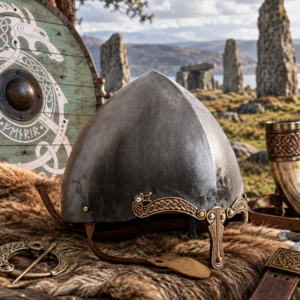 Medieval Celtic Helmet – Blackened Steel and Engraved Brass
92,40 €
Medieval Celtic Helmet – Blackened Steel and Engraved Brass
92,40 €
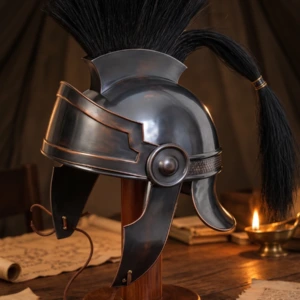 Black Roman Centurion Helmet with Horsehair Crest
84,00 €
Black Roman Centurion Helmet with Horsehair Crest
84,00 €
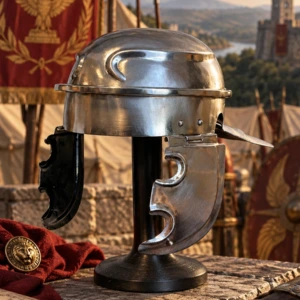 Roman Galea-Type Helmet in Polished Steel
128,40 €
Roman Galea-Type Helmet in Polished Steel
128,40 €
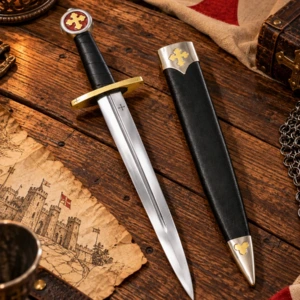 Templar Dagger Veritas Crucis with Golden Cross
82,80 €
Templar Dagger Veritas Crucis with Golden Cross
82,80 €
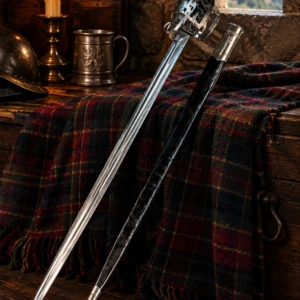 Jacobite Sword with Gilded Basket Hilt
262,80 €
Jacobite Sword with Gilded Basket Hilt
262,80 €
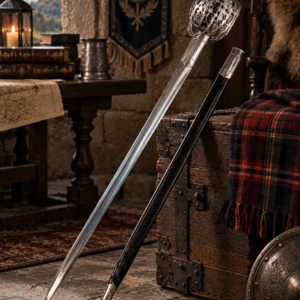 Scottish Officer's Basket-Hilted Sword
262,80 €
Scottish Officer's Basket-Hilted Sword
262,80 €
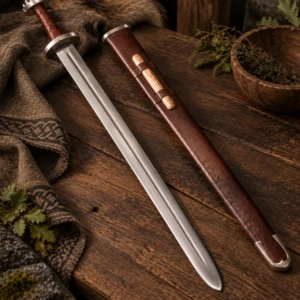 Viking Sword with Five-Lobed Pommel and Leather Scabbard
162,00 €
Viking Sword with Five-Lobed Pommel and Leather Scabbard
162,00 €
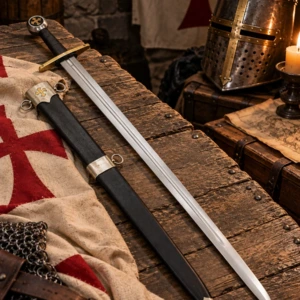 "Militia Templi" sword of the Order of the Temple with Templar Cross and Black Sheath
200,40 €
"Militia Templi" sword of the Order of the Temple with Templar Cross and Black Sheath
200,40 €
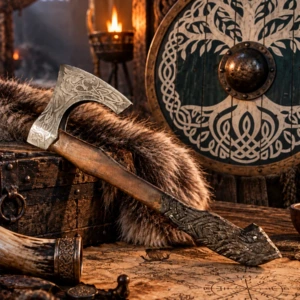 Viking Bearded Axe with Dragon-Head Handle – 50 cm
170,40 €
Viking Bearded Axe with Dragon-Head Handle – 50 cm
170,40 €
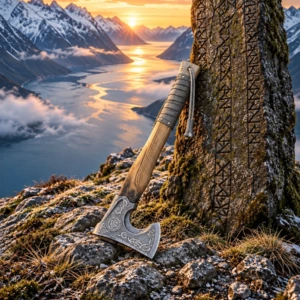 Brown Bearded Viking Axe with Engraved Valknut – 48 cm
70,80 €
Brown Bearded Viking Axe with Engraved Valknut – 48 cm
70,80 €
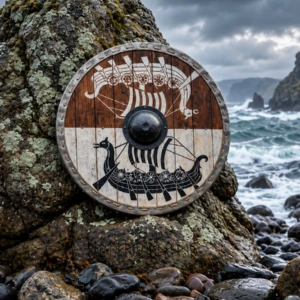 Viking Drakkar Shield – Fleet of the Conquerors
110,40 €
Viking Drakkar Shield – Fleet of the Conquerors
110,40 €
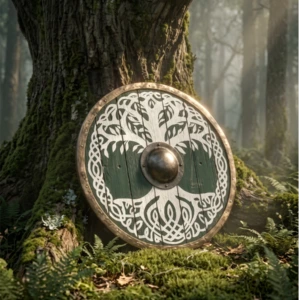 Viking Shield Yggdrasil – Power of the Ancestral Roots
110,40 €
Viking Shield Yggdrasil – Power of the Ancestral Roots
110,40 €
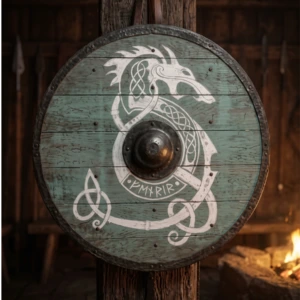 Fenrir Viking Shield – The Legend of the Giant Wolf
142,80 €
Fenrir Viking Shield – The Legend of the Giant Wolf
142,80 €
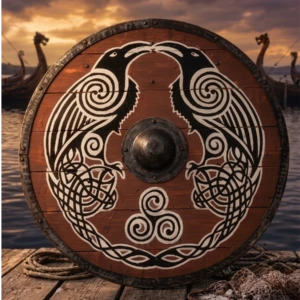 Huginn and Muninn Viking Shield – Odin's Ravens
142,80 €
Huginn and Muninn Viking Shield – Odin's Ravens
142,80 €
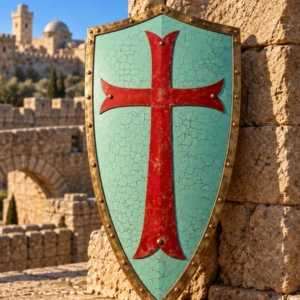 Templar Steel Shield – Red Cross on White
126,00 €
Templar Steel Shield – Red Cross on White
126,00 €
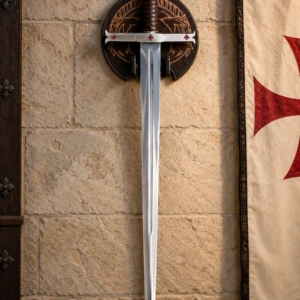 Templar sword of Jacques de Molay
140,40 €
Templar sword of Jacques de Molay
140,40 €
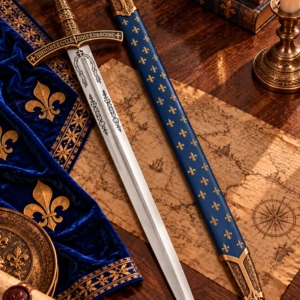 French medieval sword from the 14th century with fleur-de-lis and blue scabbard, 109 cm
120,96 €
French medieval sword from the 14th century with fleur-de-lis and blue scabbard, 109 cm
120,96 €
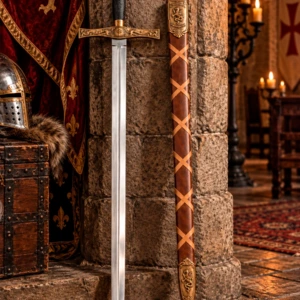 Excalibur sword with braided brown scabbard, 111 cm
149,94 €
Excalibur sword with braided brown scabbard, 111 cm
149,94 €