Rome did not invent the weapon that would make it famous.
It found it far from Italy, in Hispania.
During the Second Punic War, between 218 and 201 BC, Roman armies clashed for years with the troops of Carthage. Hannibal had crossed the Alps with elephants and had taken the war to the heart of Italy. Rome needed to learn quickly.
And in Hispania, it found something that caught its attention.
The Celtiberian warriors used short, sturdy, easily handled swords, capable of cutting and, above all, of attacking with the point in close combat.
The Romans observed.
And copied.
The sword they adopted would be known as the Hispanic gladius, the gladius hispaniensis of Latin sources.
It wasn't particularly long. That was precisely part of its advantage. In a close formation, a soldier doesn't need a sword that makes large swings. He needs something he can use without breaking the line and that allows him to strike quickly forward.
Rome had found a weapon suitable for the way it wanted to fight.
But it still needed to be made much more powerful.
The Roman legion was not a multitude of men armed with the same sword. Every piece of their equipment had a function.
The scutum, the large curved shield, protected a good part of the body.
The pilum, a long javelin, could be thrown before close combat. Its iron point was designed to penetrate enemy shields and, under certain circumstances, bend after impact, making it difficult for the enemy to reuse the weapon or even handle the shield comfortably.
And when the two lines finally clashed, there remained the gladius.
Short.
Fast.
Lethal.
Its effect on the enemy was so brutal that it was recorded in writing.
The historian Livy recounts that, around 200 BC, during a conflict with Macedonia, King Philip V ordered the bodies of his soldiers, fallen in a clash with the Romans, to be displayed in his camp.
His own men, accustomed to spear wounds, were terrified: arms severed with a single blow, heads severed from their bodies.
They had never seen what a gladius could do.
That horror was only a warning of what was to come.
In 197 BC, at Cynoscephalae, this form of combat demonstrated just how effective it could be.
On the other side was the Macedonian army, heir to the tradition of Philip and Alexander. Their soldiers used the enormous sarissa and fought in a formation that could be formidable in open terrain.
But the battlefield does not always respect the plans of generals.
The hills and the uneven terrain broke the Macedonian formation. The long sarissas, so powerful when all the men remained in formation, proved far less manageable when the line broke.
Roman legionaries could split up, advance, and fight in smaller groups.
The old phalanx had found an enemy that didn't need to confront it in the same way.
Rome had learned another lesson:
the biggest weapon doesn't always win. Sometimes the one that allows you to adapt best to the terrain wins.
And the gladius wasn't the only foreign weapon that Rome adopted.
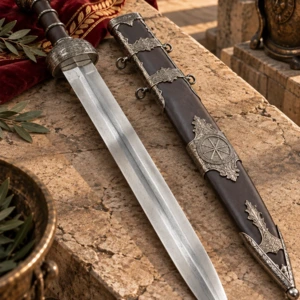
There was also the pugio.
The dagger that accompanied the legionary became a standard piece of Roman equipment during the late Republic and the Empire. It was compact, double-edged, and robust enough to be used as a backup weapon.
Its origin is related to the daggers used in Hispania, although attributing to it an exclusively Cantabrian origin is a matter that requires more nuance than the traditional image allows.
Over time, the pugio could also become an extraordinarily decorated piece. Some scabbards were adorned with metalwork, reliefs, and inlays that revealed as much about the owner as about the weapon they protected.
Meanwhile, the Roman army itself had changed from within.
In 107 BC, Gaius Marius had profoundly reformed the army. Soldiers began to carry their own equipment themselves.
According to a famous tradition, the legionaries carried so much baggage that their comrades began to call them, somewhat ironically, "Marius's mules".
The nickname eventually went down in history.
And it speaks volumes about the transformation the Roman army was undergoing.
The legionary was no longer simply a citizen who went to war with his weapons.
He was a professional soldier.
His equipment was part of his identity.
His shield.
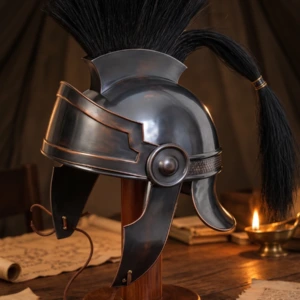
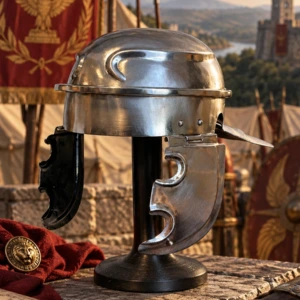
His helmet.
His pilum.
His gladius.
His pugio.
Each piece had a function, and all together they formed a military machine far more complex than the sum of its parts.
And then came one of the most famous episodes in Roman history.
The Ides of March, 44 BC.
Julius Caesar enters the Senate.
Around him are men he knows.
Some have been his allies.
Others owe him their position.
And several of them conceal small metal blades under their clothing.
When the attack begins, the conspirators draw their pugios.
The dagger, born from the experience of other peoples, had become a part of Roman power.
Centuries later, cinema would again construct a single image of the Roman legionary, mixing armour, helmets, swords, and standards from different eras.
But the real Rome was far more changeable.
The gladius evolved.
Defensive equipment changed.
Tactics adapted.
And the army that had begun by copying foreign weapons ended up developing its own military tradition that would dominate much of the Mediterranean world.
Rome did not invent the gladius.
Nor did it invent the pilum.
It didn't even invent the idea of turning an army into a perfectly organised machine.
Its true skill lay elsewhere:
observing what worked, adapting it, and making it its own.
And while Rome was learning to transform the weapons of other peoples into instruments of conquest, far away, new swords were beginning to appear in the hands of warriors who had not yet entered history.
Centuries later, they would be called Vikings.