


Around the 7th century BC, a Greek warrior prepares for battle. He places a bronze helmet on his head, covering his cheeks and nose. The eye openings are narrow, and he can barely see what's happening to the sides. The metal is heavy, heats up, and limits his senses, but when the time comes, it won't matter. The helmet isn't made for comfort. It's made to keep him alive.
He is a hoplite.
His equipment forms a set designed for fighting alongside other men. He carries a spear, a short sword as a secondary weapon, greaves, a breastplate, and an enormous circular shield: the aspis, popularly known as the hoplon.
But that shield has something peculiar about it.
Its design allows it to be held firmly with the arm while covering a good part of the body. It protects the left side especially well, but leaves the right more exposed. One man alone has a problem. Two men together have a solution.
One man's shield partially protects the other.
And so, almost without realising it, the weapon begins to dictate how the men who wield it should fight.
The hoplites advance in tight ranks. Each one protects the comrade next to him and expects his comrade to do exactly the same. Spears protrude from the front of the formation while shields create a continuous wall of wood and bronze.
The phalanx is born.
It is not simply a way of positioning soldiers. It is a consequence of their equipment. The hoplite does not need to be the fastest or strongest warrior. He needs to hold his position.
For generations, this form of combat became one of the great military forces of the Greek world.
In 480 BC, this discipline would find one of its most famous stages.
A huge Persian army advances towards Greece. In its path appears a narrow pass between the mountains and the sea: Thermopylae.
There, the Spartan king Leonidas and his men manage to take advantage of the terrain to face an enemy vastly superior in numbers for days. The phalanx works because the space prevents the Persians from easily outflanking it.
But no formation remains perfect forever.
More than a century later, in Macedonia, a king would understand that if the shield and spear could change the way battles were fought, they could also be taken much further.
His name was Philip II.
His answer was a gigantic spear: the sarissa, a pike that could exceed six metres in length. The soldier wielding it was protected by a veritable barrier of points even before the enemy could approach.
The Macedonian phalanx had taken the original idea to another level.
Philip used that army to impose his dominance over Greece. And when he died in 336 BC, he left his son something far more valuable than a kingdom.
He left him an army.
His son was Alexander.
Two years later, he would begin a campaign that would take those long sarissas much further than their creator had probably imagined. Macedonia crossed into Asia, and in a few years, Alexander defeated the Persian Empire and extended his dominion to the borders of India.
History had demonstrated something that would be repeated time and again in the following centuries:
when the weapon changes, the way of waging war can also change.
But while the Greek armies evolved, another Greece was also born. A Greece that centuries later would be reconstructed by artists, writers, filmmakers, and designers until it became an image that almost no one questions any more.
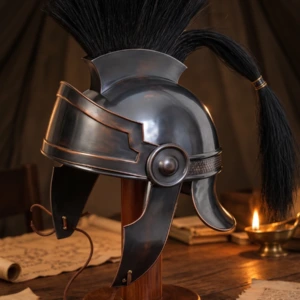
The Spartan warrior of our imagination wears a large vertical crest on his helmet.
The reality was different.
On ancient pottery and reliefs, both longitudinal and transverse crests appear, made of horsehair, and some representations suggest that the transverse crest distinguished officers. The image of an entire Spartan army crowned with large, spectacular crests belongs, to a large extent, to the way in which popular culture has reinvented Antiquity.
Cinema did not invent Greek warriors.
But it did make them easier to recognise.
And perhaps that's the most interesting part of this whole journey: gradually separating the warrior who actually existed from the one we've constructed since.
Because beneath all those images lies something much simpler.
A man.
A bronze helmet.
A shield that forces him to trust the man marching beside him.
And a spear that, with the passage of time, will eventually become a six-metre pike and carry an army to the ends of the known world.
Greece didn't invent all the weapons it used.
But it learned something that other peoples would later perfect: a good weapon doesn't just change the way you fight. It can change the way you organise an entire army.
And Rome was about to learn that same lesson.
But in its own way.
Pieces from this story
Next story: 2. Rome — The weapon they copied and perfected →