


Around the year 800, somewhere in Scandinavia, a man prepares to leave home.
He doesn't need much.
A wooden shield, a spear, and an axe might be enough to turn a peasant into a warrior. A sword is another matter. It's expensive, difficult to make, and not within everyone's reach.
That's why, for much of the Viking Age, the spear was the weapon of the common warrior.
The shield completed the set.
Together, they allowed them to form a compact line in which each man protected part of the body of the one next to him. It was a way of fighting that rewarded the discipline and strength of the group as much as individual skill.
But there were men who could afford something more.
A sword.
And among all the swords that circulated in northern Europe during those centuries, there were some that achieved an extraordinary reputation.
On the blades appeared an inscription:
+VLFBERHT+
The name became a kind of signature.
The curious thing is that those swords didn't originate in Scandinavia. Many came from Frankish workshops located in the Rhine region and reached the north through trade, exchange, plunder, or the movements of warriors.
Their steel was of exceptional quality for its time. Some of these blades show a composition and manufacturing process that resulted in a more homogeneous and resistant metal than that typically found in many European swords of the period.
And then something happened that seems surprisingly modern to us.
Reputation bred imitations.
Some swords incorrectly copied the name VLFBERHT, as if a swordsmith had understood that those letters were the mark that transformed an ordinary sword into a prestigious one.
Almost a thousand years before modern trademarks, an inscription on a blade could already signify quality, prestige, and value.
Today, much of what we know about these swords comes from the classification established by the Norwegian archaeologist Jan Petersen in 1919, based on hundreds of finds: the same classification still used by museums and archaeologists to date them.
But the sword wasn't a weapon everyone could afford.
For most, the axe remained much more accessible.
It was used for work.
For cutting wood.
For building a house.
And, when war came, it could become a formidable weapon.
Over time, some warriors took this tool to extremes that had nothing to do with agricultural work.
One of the most famous examples would appear far from Scandinavia.
In 988, Prince Vladimir of Kiev sent Varangian warriors to aid the Byzantine Emperor Basil II.
Those Scandinavians would eventually form the core of the Varangian Guard, an elite unit tasked with protecting the emperor of Constantinople.
Among their weapons, a type of long-handled axe stood out, which would become closely associated with these warriors.
The Viking world had not confined itself to attacking monasteries and settlements in Western Europe.
Its men travelled.
They traded.
They served as mercenaries.
They founded settlements.
And they reached places as far away as Constantinople.
Decades later, one of those Varangians would be remembered far beyond the borders of the Byzantine Empire.
His name was Harald Sigurdsson.
He had served in the Varangian Guard before returning to Scandinavia, where he would eventually become king of Norway.
History would know him as Harald Hardrada.
In 1066, Harald crossed the sea to try to conquer England.
On 25 September, he met the English army at Stamford Bridge.
There he died.
For many historians, that battle would become one of the symbols of the end of the Viking Age.
But the image of the Viking was about to outlive the Vikings themselves.
Because for centuries, no one imagined those warriors with horns on their helmets.
The image appeared much later.
In 1876, the German designer Carl Emil Doepler created horned helmets for the costumes of a production of Richard Wagner's operas.
The idea worked perfectly on stage.
It was spectacular.
Easy to recognise.
And completely anachronistic.
But the image outlived the opera.
It passed into illustrations, comics, film, cartoons, video games, and finally, into the collective imagination.
The only complete Viking helmet we know of, found in Gjermundbu, Norway, doesn't have horns.
It has something much less spectacular.
Iron.
A mask-like protection for the eyes and nose.
And a structure designed to protect a warrior's head.
It's a much simpler image than the Viking of cartoons.
But perhaps it's also more interesting.
Because behind the legend were men who used the weapons they had at hand: spears, shields, axes, and, when they could afford them, swords.
Some were made in the north.
Others travelled from distant lands.
Some bore names that proclaimed their prestige.
And others were simply tools they had learned to use in a different way.
The Viking Age ended, but its weapons did not disappear.
The sword continued to evolve.
The shield changed.
Armour became more complex.
And in Europe, a new type of warrior began to appear, protected by ever more steel.
The world of the Vikings was coming to an end.
The world of medieval knights had just begun.
Pieces from this story
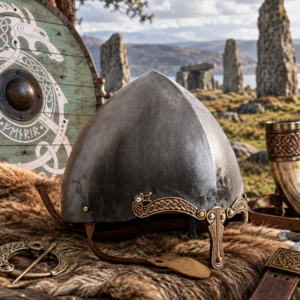 Medieval Celtic Helmet – Blackened Steel and Engraved Brass
92,40 €
Medieval Celtic Helmet – Blackened Steel and Engraved Brass
92,40 €
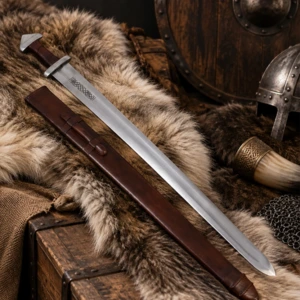 Viking Type H/I Sword with Engraved Blade and Leather Scabbard
159,60 €
Viking Type H/I Sword with Engraved Blade and Leather Scabbard
159,60 €
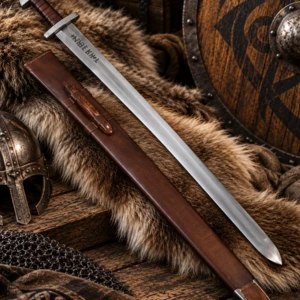 Petersen Type X Viking Sword with Ulfberht Inscription
150,00 €
Petersen Type X Viking Sword with Ulfberht Inscription
150,00 €
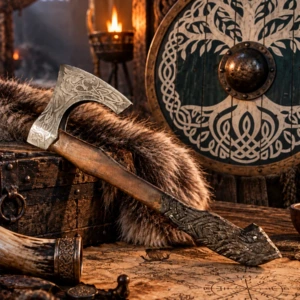 Viking Bearded Axe with Dragon-Head Handle – 50 cm
170,40 €
Viking Bearded Axe with Dragon-Head Handle – 50 cm
170,40 €
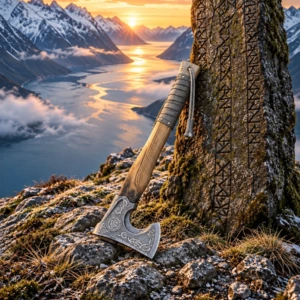 Brown Bearded Viking Axe with Engraved Valknut – 48 cm
70,80 €
Brown Bearded Viking Axe with Engraved Valknut – 48 cm
70,80 €
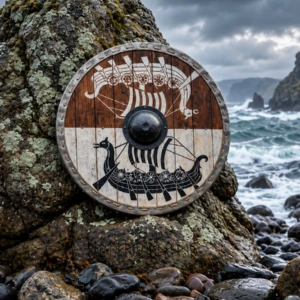 Viking Drakkar Shield – Fleet of the Conquerors
110,40 €
Viking Drakkar Shield – Fleet of the Conquerors
110,40 €
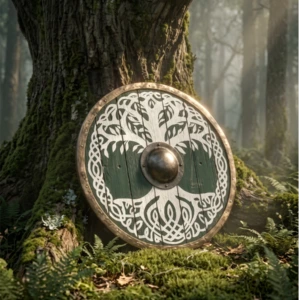 Viking Shield Yggdrasil – Power of the Ancestral Roots
110,40 €
Viking Shield Yggdrasil – Power of the Ancestral Roots
110,40 €
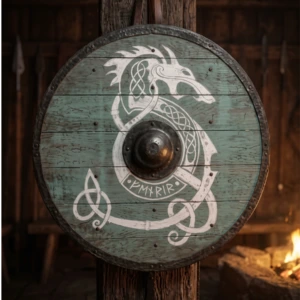 Fenrir Viking Shield – The Legend of the Giant Wolf
142,80 €
Fenrir Viking Shield – The Legend of the Giant Wolf
142,80 €
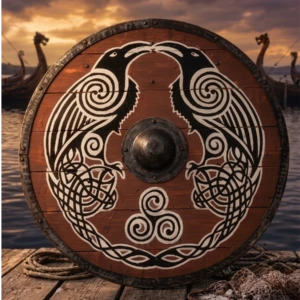 Huginn and Muninn Viking Shield – Odin's Ravens
142,80 €
Huginn and Muninn Viking Shield – Odin's Ravens
142,80 €
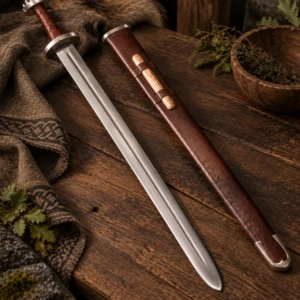 Viking Sword with Five-Lobed Pommel and Leather Scabbard
162,00 €
Viking Sword with Five-Lobed Pommel and Leather Scabbard
162,00 €
Next story: 4. Middle Ages — The struggle between weapon and armour →