
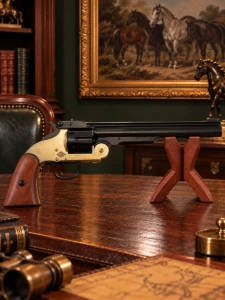
Military History

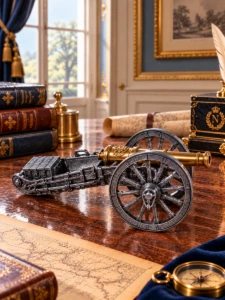
MCA-001 Miniature Napoleon Cannon, Gribeauval System – France 1806, 17 cm
Miniature Napoleon Cannon, Gribeauval System – France 1806, 17 cm
31,50 €
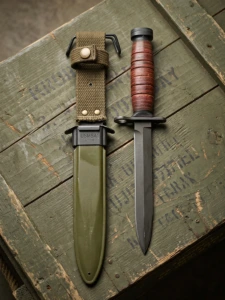
MCA-002 M4 bayonet for the M1 carbine with M8A1 scabbard – USA, World War II
M4 bayonet for the M1 carbine with M8A1 scabbard – USA, World War II
60,00 €
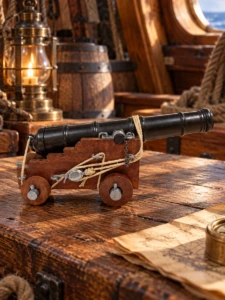
MCA-004 Miniature 18th-century British naval cannon, 28 cm
Miniature 18th-century British naval cannon, 28 cm
90,72 €
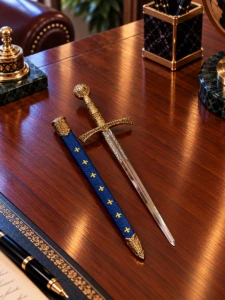
MCA-005 French medieval sword letter opener with fleur-de-lis sheath, 29 cm
French medieval sword letter opener with fleur-de-lis sheath, 29 cm
13,86 €
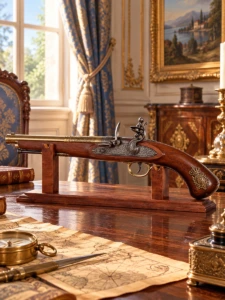
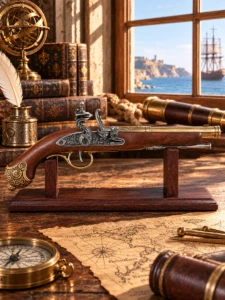
PIC-001 Left-handed flintlock pistol with Napoleon's coat of arms – France, late 18th century
Left-handed flintlock pistol with Napoleon's coat of arms – France, late 18th century
51,66 €
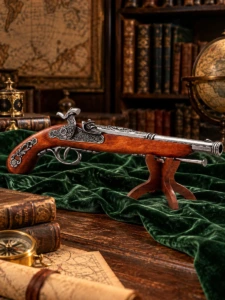
PIC-002 French percussion pistol, 1832
French percussion pistol, 1832
49,14 €
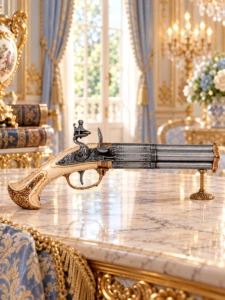
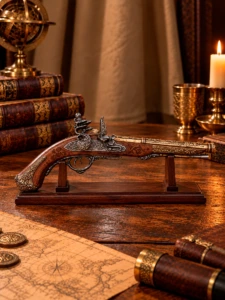
PIC-003 Flintlock pistol with 4 rotating barrels – France, 18th century
Flintlock pistol with 4 rotating barrels – France, 18th century
55,44 €
PIC-004 Percussion pistol from Brescia (Italy), 1825
Percussion pistol from Brescia (Italy), 1825
52,92 €
PIC-005 Flintlock pistol with brass barrel, 18th century
Flintlock pistol with brass barrel, 18th century
52,92 €
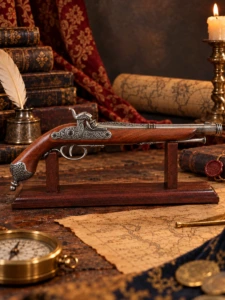
PIC-006 Napoleon's 2-Barrel Flintlock Pistol – Saint-Étienne, France 1806
Napoleon's 2-Barrel Flintlock Pistol – Saint-Étienne, France 1806
88,20 €
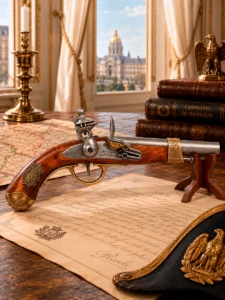
PIC-007 Napoleon's Flintlock Pistol – Saint-Étienne, France 1806
Napoleon's Flintlock Pistol – Saint-Étienne, France 1806
75,60 €
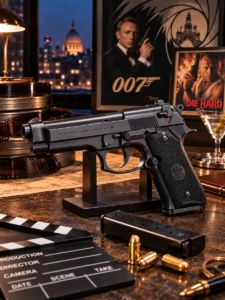
PSA-003 92 F 9 mm Parabellum Pistol – Italy 1975
92 F 9 mm Parabellum Pistol – Italy 1975
132,30 €
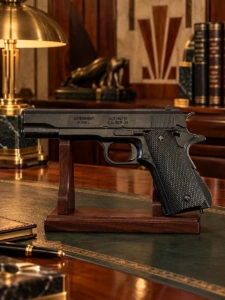
PSA-005 Black 1911 pistol caliber .45 USA (same as the P1227), non-detachable.
Black 1911 pistol caliber .45 USA (same as the P1227), non-detachable.
84,42 €
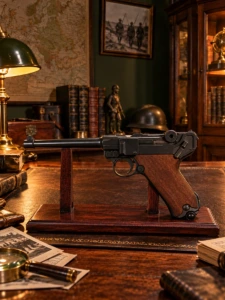
PSA-006 Luger P08 Parabellum pistol with wooden stock, 30 cm
Luger P08 Parabellum pistol with wooden stock, 30 cm
143,64 €
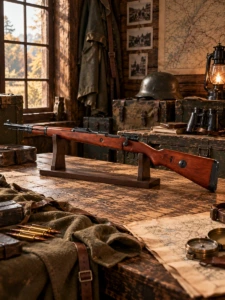
PSL-003 Mauser 98k Carbine without Sling – Germany 1935
Mauser 98k Carbine without Sling – Germany 1935
275,94 €
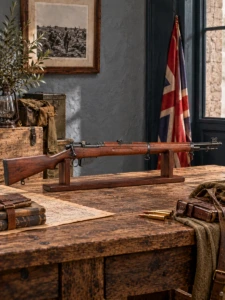
PSL-004 Lee-Enfield SMLE Mk III Rifle – United Kingdom 1907
Lee-Enfield SMLE Mk III Rifle – United Kingdom 1907
297,36 €
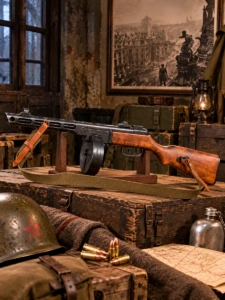
PSL-005 PPSh-41 Submachine Gun with Drum Magazine and Sling – Soviet Union 1941
PPSh-41 Submachine Gun with Drum Magazine and Sling – Soviet Union 1941
277,20 €
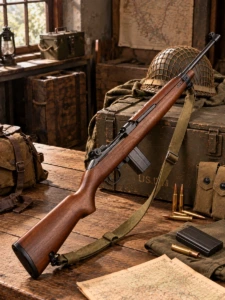
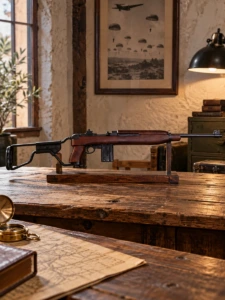
PSL-006 USM1 rifle from 1940 + sling
USM1 rifle from 1940 + sling
268,38 €
PSL-007 USM1 for 1940-1941 without shoulder strap
USM1 for 1940-1941 without shoulder strap
308,70 €
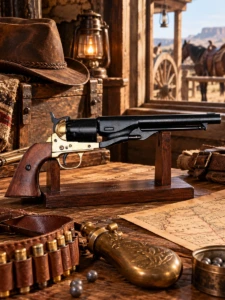
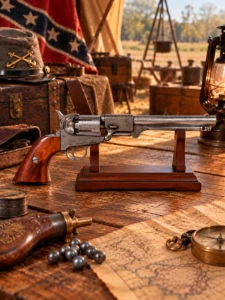
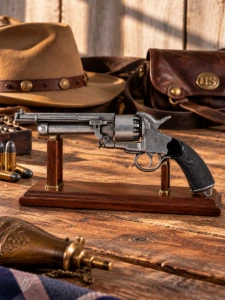
REV-001 Army 1860 Revolver of the American Civil War – USA
Army 1860 Revolver of the American Civil War – USA
90,72 €
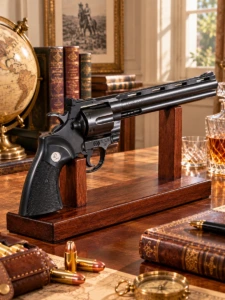
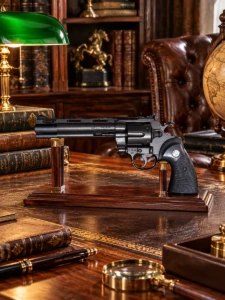
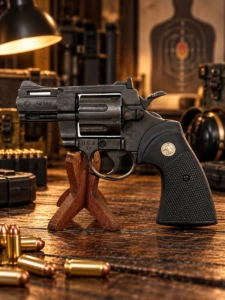
REV-002 Python .357 Magnum 8" Revolver, Black – USA 1955
Python .357 Magnum 8" Revolver, Black – USA 1955
117,18 €
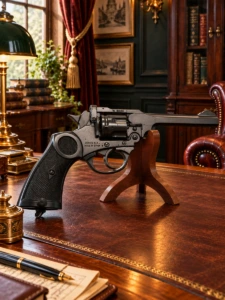
REV-004 MK4 revolver, .38 caliber, 200 caliber, year 1923
MK4 revolver, .38 caliber, 200 caliber, year 1923
84,42 €
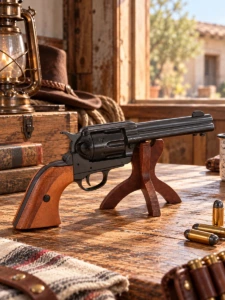
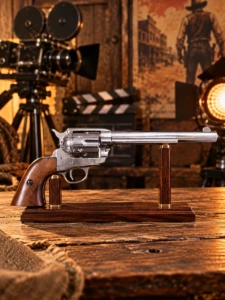
REV-006 .45 caliber revolver, manufactured in the USA in 1886.
.45 caliber revolver, manufactured in the USA in 1886.
78,12 €
REV-007 US Navy Revolver, 1851
US Navy Revolver, 1851
88,20 €
REV-008 Python .357 Magnum 31cm Revolver
Python .357 Magnum 31cm Revolver
104,58 €
REV-009 American Civil War revolver, 1860
American Civil War revolver, 1860
90,72 €
REV-010 Python .357 Magnum 21cm Revolver
Python .357 Magnum 21cm Revolver
102,06 €
REV-011 Long, shiny gray gun
Long, shiny gray gun
81,90 €
REV-012 Smith & Wesson USA 1869 Revolver
Smith & Wesson USA 1869 Revolver
97,02 €

Historical replicas, from Napoleon to the 20th century

Replicas of the pieces that shaped military history, from the Napoleonic Wars to the two World Wars and beyond.

  • 18th and 19th centuries: the Brown Bess musket with bayonet, Napoleon's flintlock pistols and rifle, a miniature Gribeauval system cannon and the 1860 Army revolver of the American Civil War.
  • First and Second World Wars: the Lee-Enfield rifle, the Mauser 98k carbine, the Thompson submachine gun, the Soviet PPSh-41 and the M1911 pistol.
  • After 1945: the AK-47, the Python .357 Magnum revolver, the 92 F pistol and the Desert Eagle.

All of them are decorative metal and wood replicas that cannot fire: they reproduce the look, size and some mechanisms of the original (loading, bolt, removable magazine), but they cannot shoot. They are sold only to adults, and some countries restrict their import; each product page says so.

In the History tab we tell you who designed these pieces and what role they played in their time.

1. The volley and the bayonet

At the end of the 17th century, an infantryman had a problem. His musket could launch a lead ball at the enemy, but after firing, he needed time to reload. And if cavalry appeared at that moment, the soldier was practically defenceless.

For a long time, European armies had solved the problem by dividing the infantry in two. Musketeers fired, and pikemen, armed with long pikes, protected their comrades from cavalry charges. Each had its role, but both depended on the other.

Then a seemingly simple solution appeared: the bayonet.

The first bayonets were plug bayonets and were inserted directly into the muzzle of the barrel. They served like a lance, but had an obvious drawback: with them attached, the musket could no longer fire. The socket bayonet solved the problem. It was placed around the barrel and allowed the firearm to continue being used with the bayonet fixed. Suddenly, the same soldier could shoot the enemy and, if they got too close, face them with cold steel. He no longer needed a pikeman for protection, and little by little, the pike disappeared from the battlefields. The infantryman became, at the same time, both marksman and lancer.

Around 1722, the British army adopted one of the muskets that would become a symbol of an entire era: the Land Pattern, popularly known as the Brown Bess. It was a long, heavy, smoothbore weapon with a calibre of approximately 19 millimetres. It fired a spherical lead ball and used a flintlock mechanism.

Its operation was simple, although not always reliable. When the trigger was pulled, the flint struck a steel piece called the frizzen, producing a spark. This ignited the gunpowder in the pan, and the flame travelled to the main charge in the barrel. When everything worked correctly, the shot was fired instantly. But if the flint was worn or the gunpowder had become damp, something very different could happen: a flash in the pan and no shot. In the rain, mud, and smoke of the battlefield, such misfires were common.

And firing again took time. The soldier would bite a paper cartridge containing the gunpowder and the ball, prime the pan, pour the gunpowder into the muzzle, insert the paper-wrapped ball, and use the ramrod to push it down. Only then could he fire again. A well-trained man could achieve three or four shots per minute under ideal conditions; in combat, amidst the smoke, fatigue, and fear, two or three was the norm.

Furthermore, the musket was not an accurate weapon. Its barrel was smoothbore, and it used a spherical ball, so deliberately hitting a specific man at a distance was very difficult. Armies found a solution: they didn't need each soldier to hit their target individually.

They needed them all to fire together.

Infantry was organised into large lines of two or three ranks. The men advanced shoulder to shoulder, waited for the order, and fired simultaneously. Individual accuracy mattered less when hundreds of bullets were flying towards the same target. Then came the bayonet. Warfare in this era thus made discipline one of the infantry's greatest weapons: the soldier had to hold his position, load, fire, and advance when ordered. The musket might be imperfect, but an entire formation acting as a single unit was devastating.

France followed a similar path. Its 1777 musket and the revised Year IX version, which equipped Napoleon's infantry, used the same principle. Its calibre was somewhat smaller, around 17.5 millimetres, but its limitations were similar. During the Napoleonic Wars, the British and French fought with weapons of the same technological generation; the difference lay in the training, tactics, and morale of their armies.

In 1815, at Waterloo, that style of fighting experienced one of its most famous moments. When the French cavalry charged the British positions, the soldiers formed squares, closing their ranks to create a compact mass of men and bayonets. For the riders, it was a difficult barrier to break through, and the horses resisted charging against a formation bristling with steel.

The small iron tube that had begun by replacing the pike had ended up transforming the way infantry fought. The pike was now at the end of their own musket.

But that world was nearing its end. The percussion cap would make ignition more reliable, and rifled barrels would greatly increase accuracy. The old ritual of biting the cartridge, priming the pan, loading from the muzzle, and striking with the ramrod was beginning to have its days numbered.

2. The artilleryman who became emperor

During the Seven Years' War, a French officer named Jean-Baptiste Vaquette de Gribeauval spent several years serving in the Austrian army, then an ally of France. There he discovered something that would forever change his understanding of artillery.

The Austrian cannons were lighter and better organised. They could keep pace with the army instead of crawling slowly behind it. Gribeauval returned to France convinced that his compatriots needed to do the same, and in 1765 he had his opportunity: a royal decree of 15 October put his new artillery system into effect.

The changes didn't seem spectacular at first glance, but together they represented a true transformation. Field cannons were reduced to three main calibres, 4, 8, and 12 pounds, in addition to a howitzer. The barrels were made shorter and lighter, and a screw for adjusting elevation and a graduated sight for improved aiming were incorporated.

But the most important change lay in something much less visible. Gun carriages, wheels, axles, and limbers began to be manufactured with standardised dimensions. A broken wheel could be replaced with one from another cannon, and maintenance during a campaign ceased to be a headache. The idea was simple: lighter, more manageable, and easier-to-maintain artillery.

However, changing a military tradition is never easy. The new system encountered strong resistance within the artillery corps itself, and its implementation was stalled for several years. Only from 1776 onward, when Gribeauval became inspector general of artillery, did his reforms finally take hold.

And while that system was transforming French cannons, a young man was beginning his training within that world.

His name was Napoleon Bonaparte.

In 1785, he graduated from the École Militaire in Paris as a second lieutenant of artillery. He was not yet the man who would eventually dominate much of Europe, but he had chosen a speciality that would define his career. In December 1793, during the siege of Toulon, then in British hands, he had his first major opportunity: he organised the French batteries until they dominated the harbour and forced the enemy fleet to retreat. The success had immediate consequences. At only 24 years old, he was promoted to brigadier general.

When he came to power, Napoleon began to use cannons in an increasingly aggressive manner. Instead of distributing them evenly along the front, he concentrated them at a decisive point and amassed enormous firepower there. If an enemy position was too strong to attack directly, it had to be hit first with artillery; once the breach was opened, the infantry and cavalry could exploit it. In 1809, at the Battle of Wagram, he managed to assemble nearly a hundred pieces in a single battery.

The cannon was no longer just a support weapon. It was the hammer that broke the enemy line.

Napoleonic artillery also evolved throughout his campaigns. In 1803, the so-called Year XI system appeared, introducing new guns, including the 6-pounder cannon, and during the Napoleonic Wars, these models coexisted with those of Gribeauval.

While large cannons dominated the battlefield, officers and cavalry carried much smaller weapons. Flintlock pistols were the standard sidearm of the cavalry, carried in holsters on either side of the saddle, and shared a fundamental limitation with muskets: after each shot, they had to be reloaded from the muzzle, something almost impossible on horseback. For this reason, some were manufactured with two barrels, allowing for an immediate second shot. In the hands of officers and high-ranking officials, the weapon could also become a symbol of authority. Gunsmiths like Nicolas-Noël Boutet, head of the Versailles manufactory, produced richly decorated pieces for the Empire that are now preserved in museums.

Gribeauval had worked to solve a problem that seemed purely technical: enabling cannons to move with the army. Napoleon took that solution much further, transforming artillery into the weapon that decided where and when to strike.

Gribeauval built the tool. Napoleon learned how to use it.

3. Six shots without reloading

For the revolver to exist, the flintlock first had to disappear.

At the beginning of the 19th century, firearms began to abandon the old flintlock. In 1807, a Scottish clergyman and hunting enthusiast, Alexander Forsyth, patented an ignition system based on fulminates, compounds that detonate when simply struck. Shortly afterwards, the percussion cap appeared, a small copper cap that could be placed in the weapon in a second and was much more reliable in humid conditions. It seemed like a small change, but it opened the door to a new generation of weapons.

Before Samuel Colt, there had already been multi-barrelled firearms and some with rotating cylinders. The problem was making the mechanism work practically and reliably. Colt, a young man from Connecticut, would recount years later that the idea came to him aboard a ship, observing the movement of the ship's wheel, and that he carved his first model in wood during the voyage. Whether it was true or part of the legend he himself cultivated, we don't know. What we do know is the solution he found: when the weapon was cocked, the mechanism itself rotated the cylinder, perfectly aligning it with the barrel.

Colt patented his system in England in 1835 and in the United States the following year. But inventing a mechanism didn't guarantee a business, and his first factory, in Paterson, New Jersey, went bankrupt in 1842.

It seemed the story might end there. But then war broke out.

During the conflict between the United States and Mexico, Texas Ranger Captain Samuel Walker was looking for a powerful weapon capable of firing several shots in quick succession. He contacted Colt, and from that collaboration, a massive revolver was born in 1847, restoring the inventor's fortune and allowing him to build his large factory in Hartford.

The evolution culminated in the Colt Army Model 1860, a .44 calibre revolver with six chambers and an eight-inch barrel. It was lighter than the larger models that came before and could be carried in a belt holster. But it was still not a cartridge weapon. Each chamber was loaded separately: first the gunpowder, then the bullet, which was seated using the lever located under the barrel, and finally a percussion cap on each nipple. It was a slow process, but once loaded, that cylinder held something that just a few decades earlier would have seemed extraordinary: six shots ready to be used one after the other.

In 1861, the American Civil War began, and the Army 1860 became one of the Union's main revolvers. The Federal army acquired more than one hundred thousand units, primarily for the cavalry. For a rider, being able to fire several times without stopping to reload made a huge difference. The weapon also appeared on the Confederate side, with examples purchased before the war or captured from the enemy.

Samuel Colt did not live to see the end of that conflict. He died in January 1862, when the war was still far from over. His revolver, however, continued its journey.

After the war, the Army 1860 accompanied soldiers and settlers in their westward expansion. Meanwhile, technology continued to advance, and the next great transformation was hidden in something seemingly simple: a metallic cartridge that combined the bullet, gunpowder, and primer in a single piece. Muzzleloading began to be left behind. Many revolvers were converted to use cartridges, and in 1873, Colt introduced the Single Action Army, which would become one of the great icons of the West. Much later, popular novels and films forever cemented the image of the revolver on the belt, although the films didn't always respect the dates and mixed weapons from different eras.

Colt hadn't invented the revolver from scratch. What he achieved was something more difficult: transforming an idea that others had attempted into a practical, reliable mechanism that could be mass-produced.

And that's what changed history.

4. Duel of the bolt actions

By the end of the 19th century, the infantryman had already left the world of the musket behind. Metallic cartridges had replaced separately loaded gunpowder and bullets, and bolt-action rifles, which had existed since the mid-19th century, had evolved into repeating rifles, with several cartridges stored within the weapon. The problem was no longer how to load.

It was how many shots to carry and at what rate to fire them.

The mechanism seemed simple. The soldier lifted the bolt, pulled it back to eject the spent casing, pushed a new cartridge into the chamber, and closed it again. But small differences in design could completely change the speed and how the weapon was used, and two of those differences ended up clashing in the trenches.

Great Britain found its answer in the system of James Paris Lee, a Scottish inventor based in North America, who designed a bolt with a separate box magazine. Combined with the rifling developed at the Royal Small Arms Factory at Enfield, it resulted in the Lee-Enfield. Its most famous version, the Short Magazine Lee-Enfield Mk III, was adopted in 1907. It was a relatively short rifle, and its magazine held ten rounds, twice as many as many of its rivals.

But capacity wasn't its only advantage. The bolt had a short travel and cocked itself as it closed, so a trained soldier could operate it with remarkable speed without removing the rifle from his shoulder. The British Army turned this feature into a true combat skill. Its soldiers practised the so-called "mad minute": at least fifteen aimed shots in one minute at a target 300 yards away. The best marksmen far exceeded that number.

On the other side of the North Sea, a different philosophy was developing. In Germany, Paul Mauser and his brother Wilhelm had spent years perfecting the bolt-action rifle, and in 1898 the German army adopted the Gewehr 98. Its internal magazine held only five cartridges, but its bolt was extraordinarily robust: two large locking lugs at the front and an extractor that held the cartridge in place throughout its travel.

The design had an enormous international influence, and Spain was well acquainted with it. The Spanish army used the Mauser Model 1893, and in 1898, in the hills of San Juan, during the war with the United States, their rifles played a leading role. The figures from that battle have been recounted in many ways, but the performance of the Spanish Mauser impressed the Americans. Shortly afterwards, their new rifle, the 1903 Springfield, incorporated solutions from the Mauser system, and the United States ended up paying the German firm for the use of its patents.

In 1914, the two systems clashed in the Great War. In the early battles at Mons and during the subsequent British retreat, the rate of fire of the British riflemen fuelled one of the great stories of that war. It is said that some Germans believed they were facing machine guns when in reality they were facing the rapid fire of the riflemen. The story became legend, although accounts are scattered and British units also possessed some machine guns.

The rivalry did not end in 1918. In Germany, the Gewehr 98 evolved into the Karabiner 98k, adopted in 1935. Although its name suggested a carbine, it was actually a medium-length rifle. It was the standard weapon of the German soldier during the Second World War and, with a telescopic sight, also that of their snipers. Great Britain, meanwhile, continued to rely on the Lee-Enfield, which from 1926 was officially called the Rifle No. 1 Mk III, and from 1941 onwards was gradually replaced by the No. 4, a modernised and simpler-to-manufacture version.

For almost half a century, two philosophies had followed different paths. The Lee-Enfield focused on the capacity of its magazine and the speed of its bolt; the Mauser, on the robustness of its mechanism. Neither invented the bolt-action rifle, but both brought it to its most refined form.

There was no clear winner in that duel. Both rifles served in two world wars, and even today, in their own way, they remain the benchmark of what a bolt-action rifle can be.

5. The .45 calibre

At the beginning of the 20th century, the United States Army had a problem. Its soldiers were fighting in the Philippines, and many officers felt that the standard-issue .38 calibre revolver lacked the power to stop a determined attacker at close range.

In 1904, Captain John T. Thompson and military physician Louis La Garde conducted a series of tests to determine the appropriate calibre for the army's new sidearm. Their conclusion was clear: it had to be at least .45 calibre.

The army then launched a competition. Among the designers who participated was John Moses Browning, one of the greatest names in the history of firearms, who submitted a semi-automatic pistol manufactured by Colt and chambered for a cartridge designed specifically for it: the .45 ACP.

The ultimate test wasn't just about how well it fired. It was about how much it could withstand. During the trials, Browning's pistol fired six thousand rounds without a single malfunction, while its competitor suffered numerous breakdowns. The result was decisive, and on 29 March 1911, the U.S. Army adopted the new pistol as the M1911. In the mid-1920s, it underwent a series of modifications and was designated the M1911A1.

But the .45 calibre wasn't going to stay confined to a pistol.

The same Thompson who had championed that calibre was now thinking about something different. During World War I, he envisioned a lightweight automatic weapon that used pistol ammunition and could "sweep" a trench at close range. In 1916, he founded the Auto-Ordnance company to develop it, and he gave the result a name that didn't exist until then: submachine gun. The war, however, ended before his weapon reached the European battlefields.

Thompson had to wait.

The weapon was released to the civilian market in 1921 and initially encountered a very different setting from the one its creator had imagined. During Prohibition, criminal gangs in cities like Chicago adopted it, and the press began calling it the Tommy gun or the Chicago Typewriter. The St. Valentine's Day Massacre of 1929 cemented that image.

Its military destiny came later. The U.S. Navy adopted the Model of 1928, and the Army incorporated the Thompson in the late 1930s. With World War II came large-scale production: first the M1928A1, which could use drum or straight magazines, and from 1942 the M1 and M1A1 versions, simplified for faster production and designed only for straight magazines, which were more reliable in the field. Twenty-five years after its conception for the trenches, Thompson's weapon finally went to war.

And then the circle was complete. Browning's pistol and Thompson's submachine gun shared the same cartridge. The .45 ACP round that fed the pistol in an officer's holster also fed the automatic weapon of the soldier advancing beside him, in Europe, in the Pacific, and, years later, in Korea.

The submachine gun eventually gave way to more modern weapons. The pistol endured much longer. It survived two world wars, Korea, and Vietnam, and the U.S. armed forces amassed some 2.7 million units. When it ceased to be the standard-issue sidearm in 1985, seventy-four years had passed since that 1911 decision.

It had all begun with a simple question about the calibre of a pistol. The answer ended up arming several generations of soldiers.

6. Manufacture to win

In the summer of 1941, Germany invaded the Soviet Union, and within a few months, the Red Army lost a huge number of men and weapons. While the country tried to contain the German advance, Soviet industry faced another challenge: relocating entire factories beyond the Urals while simultaneously continuing to produce weapons for a war that offered no respite.

Under those circumstances, it was no longer enough to design a good weapon. It had to be able to be manufactured quickly, with few tools, and in enormous quantities.

The Red Army was then using the PPD-40, a submachine gun of good quality but expensive and slow to manufacture, with numerous machined parts. The solution came from Georgy Shpagin, who designed a weapon intended from the outset for mass production: the PPSh-41.

Many of its parts were made of stamped sheet steel, and it required approximately half the machining hours of its predecessor. Even the barrel, chrome-lined on the inside, was designed to withstand wear and tear and ammunition of varying quality. The result was a simple, robust, and extraordinarily fast weapon: it fired the 7.62×25mm Tokarev pistol cartridge at a rate of around 1,000 rounds per minute, with a 71-round drum magazine. This came at a price, as it consumed ammunition at an enormous rate, and the drum tended to jam if it was completely full. From 1942 onwards, a lighter and more reliable 35-round curved magazine was added.

Around six million PPSh-41s were manufactured, and the submachine gun became one of the iconic images of the Soviet soldier during the war, from the ruins of Stalingrad to the streets of Berlin. Even the Germans appreciated its qualities: they used captured examples and even adapted some to fire their 9mm ammunition.

But the war continued to teach lessons. The Germans had experimented with a new idea: an intermediate cartridge, less powerful than rifle ammunition but more powerful than pistol ammunition, with which a soldier could fire in automatic mode without losing control of the weapon at actual combat distances. The Soviets took note and in 1943 developed their own, the 7.62×39mm. All that was missing was the right weapon.

It was then that a virtually unknown man appeared.

Mikhail Kalashnikov was a tank sergeant when he was wounded in October 1941, in the fighting around Bryansk. During his convalescence, he began to draw weapons. He wasn't an engineer, but he managed to work his way into the Soviet design bureaus, and in 1947 his rifle won the trials. Two years later, the Soviet army officially adopted it. The AK, the Kalashnikov automatic rifle, was born.

Its design philosophy was inherited from that of the PPSh. It wasn't designed with delicate construction, but rather with few parts, generous clearances, and a mechanism capable of functioning in dirt, mud, and cold. A recruit could learn to use it in a short time. For paratroopers and vehicle crews, where space was limited, a version with a folding metal stock, the AKS, was also created.

The first version had manufacturing problems with the stamped sheet metal receiver, and for some years, machined construction was reinstated. In 1959, the AKM arrived, solving the problem with lighter sheet metal, and it was this version that spread throughout much of the world. Manufactured in numerous countries, with or without licence, the Kalashnikov family achieved a level of distribution unmatched by any other rifle. It even appears on the flag of Mozambique.

The PPSh-41 had pushed industrial production to its limits. The AK applied that same philosophy of simplicity to a new generation of weapons. Between the two of them they demonstrated something that World War II had made clear: the ability to manufacture a weapon by the millions could be as decisive as the weapon itself.

7. From the barracks to the screen

For centuries, weapons were primarily designed for one thing: combat. But in the second half of the 20th century, something different began to happen. Some of the most recognisable weapons were no longer designed for war, but for police work, sport shooting, or hunting. And a new stage emerged, capable of turning them into icons: the screen.

The story begins with a cartridge. In 1935, Smith & Wesson introduced the .357 Magnum, developed in collaboration with shooters like Elmer Keith and Phil Sharpe. It was longer and more powerful than the .38 Special, although of a similar calibre, and it opened a new category of ammunition for high-powered revolvers.

Twenty years later, in 1955, Colt launched its top-of-the-range revolver in that calibre: the Python. It was no ordinary revolver. It had a ventilated rib over the barrel, a counterweight running the length of its underside, and a mechanism hand-tuned by expert gunsmiths. Its smooth and precise trigger became its most famous feature. It was used by police forces and competitive shooters, and was offered in different barrel lengths, from the shortest to the eight-inch models intended for target shooting and hunting. Its fame would eventually far surpass its original uses.

Meanwhile, in Italy, another story was taking shape. Beretta can trace its documented activity back to 1526, when a master craftsman named Bartolomeo Beretta was paid to manufacture arquebus barrels for the Republic of Venice. Four and a half centuries later, in 1975, the company introduced the Beretta 92, a 9mm Parabellum pistol with a 15-round magazine and a distinctive open-top slide.

When the United States sought a replacement for the ageing M1911, the Beretta took part in lengthy and controversial trials. It was ultimately selected and, in 1985, entered service as the M9. The change was significant: after decades with a .45 calibre pistol, the US armed forces adopted the 9mm, the NATO calibre. The M9 remained in service until, from 2017 onwards, the SIG Sauer M17 began to replace it.

If the Python represented refinement and the Beretta the changing of the guard for a generation of military pistols, there was still a third story, starring a weapon that was hard to ignore.

In the late 1970s, the American company Magnum Research considered an idea that seemed almost contradictory: a semi-automatic pistol capable of firing Magnum revolver cartridges. To withstand such power, it used a gas-operated system and a rotating bolt, more typical of a rifle than a pistol. The design, from 1982, was developed and manufactured in Israel, and thus the Desert Eagle was born. It weighed around two kilos and could use .357 Magnum, .44 Magnum, and later, .50 Action Express ammunition.

The Desert Eagle was never a standard-issue military weapon. Its domain was hunting, sport shooting, and collecting. But the fame it didn't need on a battlefield it found elsewhere.

In the cinema.

From Westerns and gangster films, and later in crime films, action films, TV series, and video games, the screen has always used weapons as part of its characters' personalities. A weapon can reveal something about a character before they utter a single word. A revolver with a perfect trigger speaks of a veteran police officer; an Italian pistol, of a professional; an oversized semi-automatic, of someone who doesn't go unnoticed.

Thus, weapons that almost never set foot on a battlefield became recognisable to millions of people who had never even held one. They no longer needed a war to become famous. It was enough for them to appear on a screen, in the hands of a character who doesn't even exist.

The Soviet PPSh-41 submachine gun, designed by Georgi Shpagin, was largely made of stamped steel sheet and required half the machining hours of its predecessor, the PPD-40.

The .357 Magnum cartridge was born in 1935 at Smith & Wesson, developed in conjunction with shooters such as Elmer Keith and Phil Sharpe, and ushered in the era of high-powered revolvers.

The socket bayonet was placed around the barrel and allowed firing with it fixed. Thanks to this invention, the pike gradually disappeared from the battlefields.

With the Gribeauval system (1765), French field guns were reduced to three calibres: 4, 8, and 12 pounds, plus a howitzer. An elevation screw and a graduated rear sight were also added for improved aiming.

The percussion cap was a small copper cap that could be inserted in a second and was much more resistant to moisture. Without it, the revolver would not have existed.

The Lee-Enfield SMLE Mk III, adopted in 1907, carried ten cartridges in the magazine: twice as many as many of its rivals.

Fiera Nazionale di Antiquariato e Collezionismo – Gonzaga

17 – 18 October 2026 Fiera Millenaria, Gonzaga (Mantua)

More information ↗
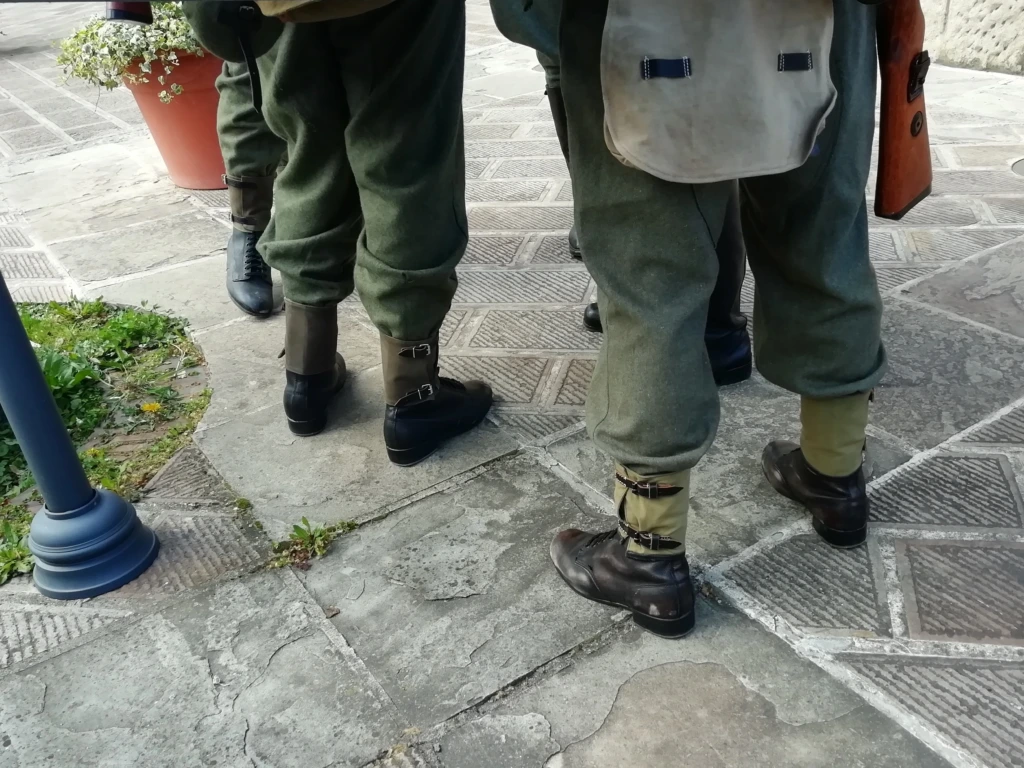
Fiera Nazionale di Antiquariato e Collezionismo – Gonzaga

The Gonzaga National Fair brings together antiques and collectibles, and specifically includes militaria among its sectors. For a specialised agenda, it is of interest as a meeting point for collectors of historical objects and pieces related to 20th-century military history. The event is particularly well-suited to the 20th Century Militaria section due to its connection with the collecting, conservation, and study of contemporary military artefacts. Uniforms, insignia, documents, equipment, and other material evidence allow for a deeper understanding of European military history and help preserve the memory of 20th-century conflicts.

Image: Wikimedia Commons – Rievocazione storica Tolè abc25.jpg — Patafisik — CC BY-SA 4.0

Ciney Militaria – Autumn 2026

25 October 2026 Ciney Expo, Ciney

More information ↗
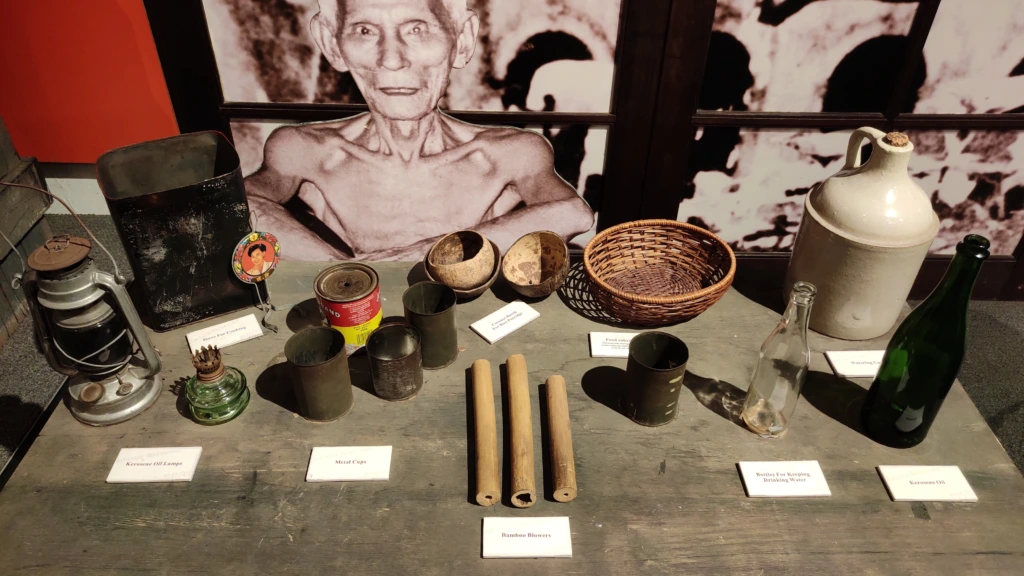
Ciney Militaria – Autumn 2026

Ciney Militaria is one of Europe's leading military collectibles fairs, bringing together hundreds of exhibitors. The autumn edition offers an international meeting point for studying and collecting uniforms, insignia, documents, and other historical artefacts. The event is particularly relevant for the 20th Century Militaria section due to its connection with the collecting, preservation, and study of contemporary military objects. Uniforms, insignia, documents, equipment, and other material evidence allow for a deeper understanding of European military history and help preserve the memory of 20th-century conflicts.

Image: Wikimedia Commons – Store, Fort Siloso (172045).jpg — Moheen Reeyad — CC BY-SA 4.0

Militalia – 78th edition

31 October 2026 – 1 November 2026 Parco Esposizioni Novegro, Segrate (Milán)

More information ↗
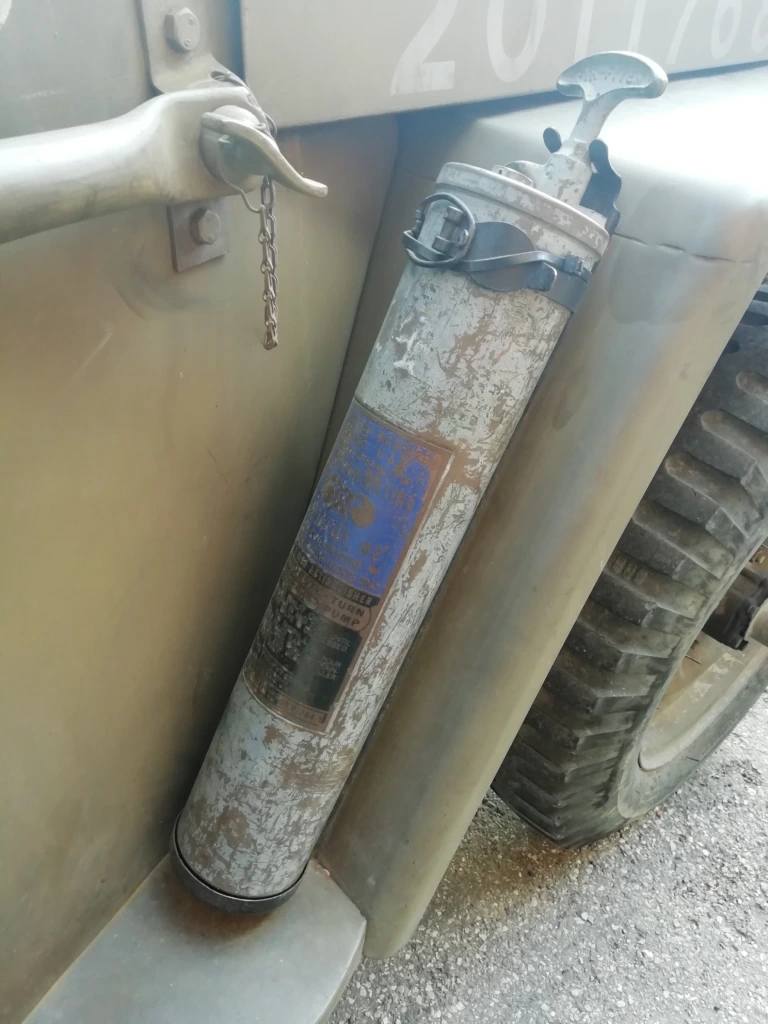
Militalia – 78th edition

Militalia is one of Italy's leading trade fairs dedicated to militaria and military collectibles. The 78th edition brings together exhibitors and enthusiasts in Novegro, showcasing artefacts and objects related to military history, uniforms, insignia, and 20th-century collectibles. The event is particularly relevant for the 20th Century Militaria section due to its focus on collecting, preserving, and studying contemporary military objects. Uniforms, insignia, documents, equipment, and other material evidence offer a deeper understanding of European military history and help preserve the memory of 20th-century conflicts.

Image: Wikimedia Commons – Rievocazione storica Tolè abc11.jpg — Patafisik — CC BY-SA 4.0

Bourse MILITARIA de Lisieux 2026

1 November 2026 Moult-Chicheboville, Calvados

More information ↗
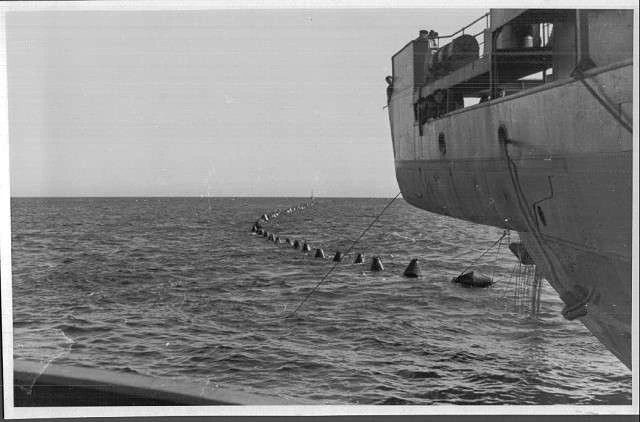
Bourse MILITARIA de Lisieux 2026

The Bourse Militaria de Lisieux is a specialised event for collectors and enthusiasts of military history. The fair brings together objects such as antique weapons, insignia, uniforms, helmets, documents, books, and various collectibles. Its location in Normandy provides a particularly relevant context for those studying 20th-century military history, and especially the memory of the Second World War. The fair is particularly well-suited to the 20th Century Militaria section due to its focus on the collecting, preservation, and study of contemporary military artefacts. Uniforms, insignia, documents, equipment, and other material evidence allow for a deeper understanding of European military history and help preserve the memory of 20th-century conflicts.

Image: Wikimedia Commons – Operation Walross Anti Submarine Net.jpg — Autor desconocido — Dominio público

International Weapon and Militaria Collectors Fair – Greding 2026

6 – 7 November 2026 Greding, Alemania
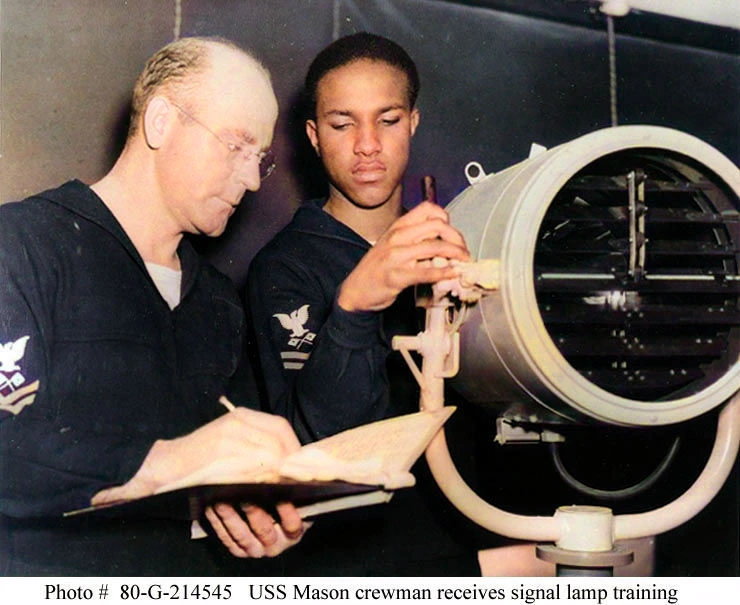
International Weapon and Militaria Collectors Fair – Greding 2026

The Greding International Historical Arms and Militaria Fair is a specialised event for collectors. Within the 20th Century Militaria category, its focus is on the preservation and study of artefacts related to contemporary military history. The fair is particularly well-suited to the 20th Century Militaria section due to its connection with the collecting, preservation, and study of contemporary military objects. Uniforms, insignia, documents, equipment, and other material evidence offer a deeper understanding of European military history and help preserve the memory of 20th-century conflicts.

Image: Wikimedia Commons – Signal lamp training color.jpg — Unknown / Official U.S. Navy Photograph — Dominio público

No sólo MILITARIA – 45th Militaria Fair

7 – 8 November 2026 La Torre – Ciudad del Conductor, Parla (Madrid)

More information ↗
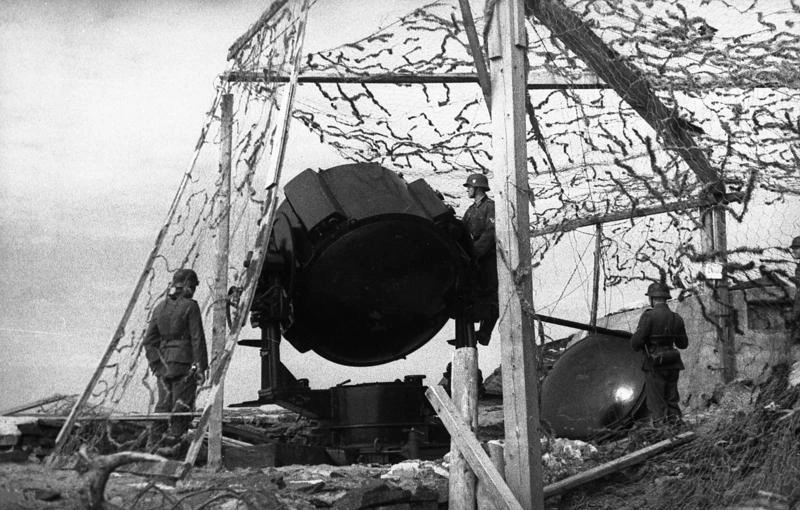
No sólo MILITARIA – 45th Militaria Fair

The 45th No sólo MILITARIA fair will bring together collectors, military history enthusiasts, and historical re-enactment groups. The November edition will feature collectibles, uniforms, helmets, edged weapons, military vehicles, historical displays, and a lecture room with talks. Furthermore, 2026 commemorates the 90th anniversary of the start of the Spanish Civil War, with a particularly extensive exhibition of vehicles and military equipment from that conflict. The event is especially relevant for the 20th Century Militaria section due to its focus on collecting, preserving, and studying contemporary military artefacts. Uniforms, insignia, documents, equipment, and other material evidence allow for a deeper understanding of European military history and help preserve the memory of 20th-century conflicts.

Image: Wikimedia Commons – Bundesarchiv Bild 101I-114-0073-28, Nordeuropa, Flakscheinwerfer.jpg — Plenik, Bruno / Bundesarchiv — CC BY-SA 3.0 Germany

Bourse militaria de Goupillières 2026

8 November 2026 Goupillières, Seine-Maritime

More information ↗

Bourse militaria de Goupillières 2026

The 49th Goupillières Militaria Exchange and Military Antiques Fair brings together collectors and enthusiasts in Normandy. The region boasts an extraordinary heritage related to the history of the Second World War, making this type of event particularly appealing to those seeking artefacts, uniforms, insignia, and other mementos of contemporary conflicts. A natural addition to the 20th Century Militaria category, the event is especially well-suited to the 20th Century Militaria section due to its focus on the collecting, preservation, and study of contemporary military objects. Uniforms, insignia, documents, equipment, and other material evidence offer a deeper understanding of European military history and help preserve the memory of 20th-century conflicts.

Image: Wikimedia Commons – Port flottant - ponton - Arromanches 1.JPG — Vincent — Dominio público

First Congress of Napoleonic Re-enactment in Spain

20 – 22 November 2026 Centro Joaquín Roncal, Zaragoza

More information ↗
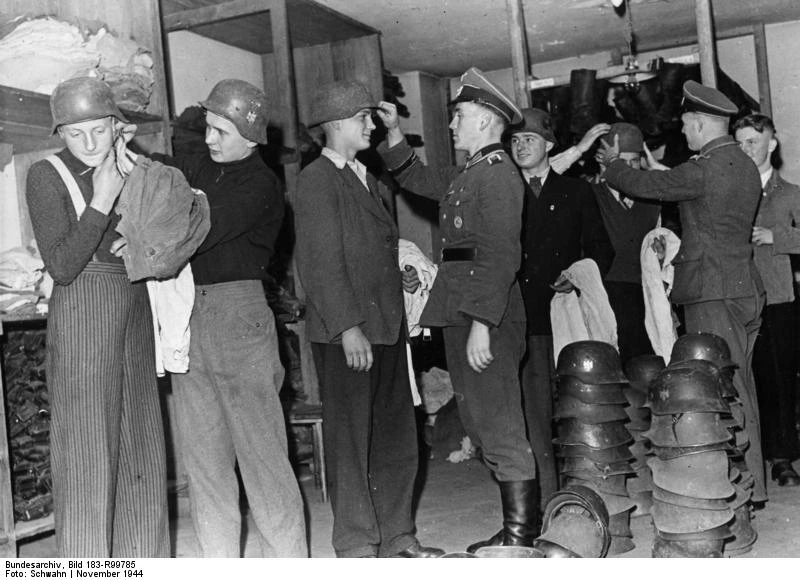
First Congress of Napoleonic Re-enactment in Spain

The Spanish Napoleonic Association is organising the first Napoleonic Re-enactment Congress in Spain. The event will bring together specialists and re-enactors to share research, experiences, and knowledge related to the historical re-enactment of the Napoleonic period. This cultural and specialised event is ideal for those who study military history and its forms of representation. The event is particularly relevant for the 20th Century Militaria section due to its focus on the collecting, preservation, and study of contemporary military artefacts. Uniforms, insignia, documents, equipment, and other material evidence allow for a deeper understanding of European military history and help preserve the memory of 20th-century conflicts.

Image: Wikimedia Commons – Bundesarchiv Bild 183-R99785, Einkleidung Kriegsfreiwilliger.jpg — Schwahn / Bundesarchiv — CC BY-SA 3.0 Germany

Scroll to Top