


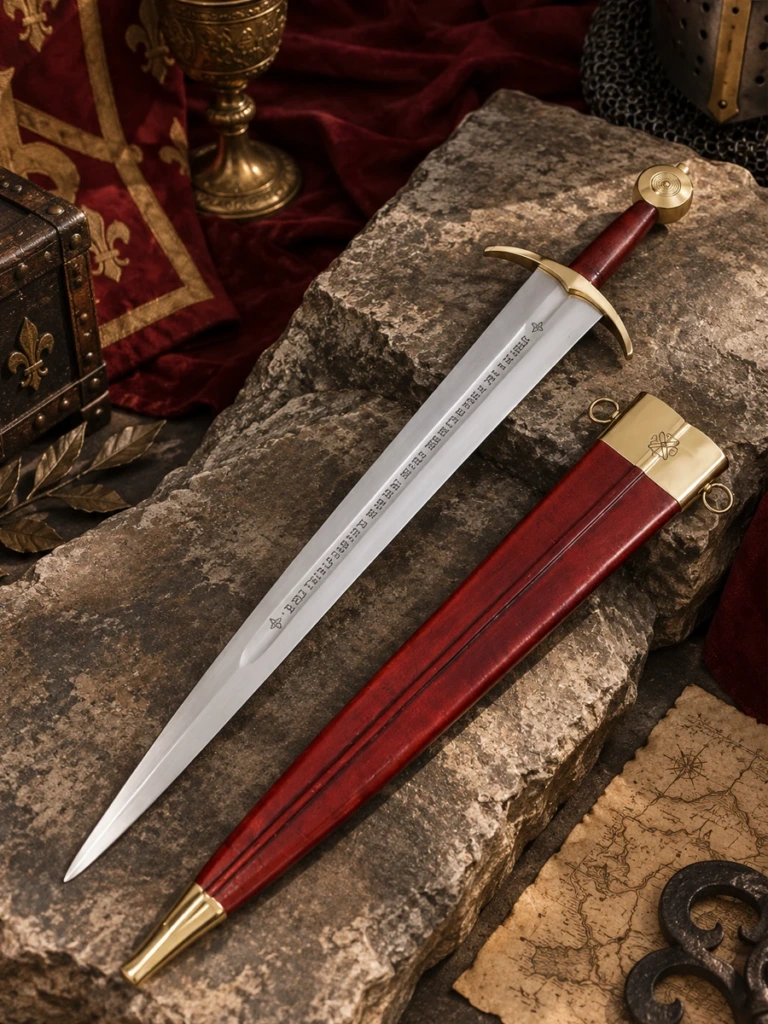
Other items shown in the photos are not included.
Medieval Type XIV Sword with Engraved Blade
Availability: 14 in stock
SKU: ESP-006The Type XIV blade is one of the classifications established by historian Ewart Oakeshott in his typology of medieval swords, and it dates from the late 13th to the first half of the 14th century. It is characterised by its width and relatively short length compared to other models of the period, with a pronounced taper to a sharp point, making it equally effective for cutting and thrusting, at a time when plate armour was beginning to spread among European knights. The wheel pommel, like the one on this piece, was one of the most common features of this type of sword, providing the necessary counterweight for good balance in the hand.
This replica also incorporates an engraved motif on the upper part of the blade, a decorative element that in the medieval period could include anything from religious symbols to inscriptions or armourer's marks, and which here is used as an ornamental feature that enhances the overall design.
The piece reproduces a sword from around 1300-1350 held in the Musée de l'Armée in Paris. Exactly where it was found is unknown, although Ewart Oakeshott believed it may have come from Chartres Cathedral in France. The quality of its fittings suggests it belonged to someone of high rank.
Identification
- Type of piece
- Medieval one-handed sword, with a type XIV blade (Oakeshott classification) with decorative engraving
- Model
- Medieval Type XIV Sword with Engraved Blade
- Historical period depicted
- Late 13th - first half of the 14th century (c. 1275-1340), heyday of the Type XIV blade according to the Oakeshott typology
Blade
- Steel type
- Tempered high carbon steel (48-52 HRC), with decorative engraving on the upper part of the blade
- Overall length
- 82.5 cm
- Blade length
- 65.7 cm
- Blade type
- Straight, broad and double-edged, with a strong taper towards the tip (type XIV profile according to the Oakeshott typology), with an engraved motif on the upper part of the blade; full tang
- Blade finish
- High-polished finish, with decorative engraving
- Edge condition
- Unsharpened / decorative
Grip and guard
- Guard type (crossguard)
- One-piece curved crossguard
- Guard material
- Gold-finished metal (the manufacturer indicates iron)
- Grip
- Wrapped in maroon leather, in a spiral
- Pommel
- Wheel (disc) pommel, in gilded metal to match the guard, with an engraved circular motif
- Handle length
- 9.8 cm
Scabbard
- Scabbard material
- Wood covered in maroon leather
- Scabbard fittings
- Throat with two suspension rings and chape, in gilded metal to match the guard
General information
- Total weight
- Approx. 1300 g
- Sword type
- Medieval one-handed sword with a type XIV (Oakeshott) blade, double-edged
- Recommended use
- Collecting, decoration and historical re-enactment; unsharpened
This sword is handcrafted with a straight, wide blade of high-carbon steel, tempered to a hardness of 48-52 HRC and fitted with a full tang, featuring an engraved motif on the upper part as a decorative detail. The curved crossguard and wheel-shaped pommel are crafted from matching gold-tone metal. The grip is wrapped in garnet-coloured leather, spirally wound for enhanced handling. The set is completed with a wooden scabbard covered in matching garnet leather, featuring a throat, two suspension rings, and a chape in the same gold-tone metal as the guard.
- Medieval one-handed sword with a broad type XIV blade according to Oakeshott's historical typology.
- Replica of a sword from c. 1300-1350 held at the Musée de l'Armée in Paris.
- Hardened high-carbon steel blade (48-52 HRC) with decorative engraved motif, without a real edge.
- Curved crossguard and wheel pommel, both in gilt metal.
- Handle wrapped in garnet leather, spirally wound.
- Wooden scabbard covered in garnet leather, with throat, suspension rings and chape in gilt metal.
- Ideal for collectors, medieval history enthusiasts and historical re-enactors.
No questions about this piece yet. Not sure about something? Ask us.