For centuries, weapons were primarily designed for one thing: combat. But in the second half of the 20th century, something different began to happen. Some of the most recognisable weapons were no longer designed for war, but for police work, sport shooting, or hunting. And a new stage emerged, capable of turning them into icons: the screen.
The story begins with a cartridge. In 1935, Smith & Wesson introduced the .357 Magnum, developed in collaboration with shooters like Elmer Keith and Phil Sharpe. It was longer and more powerful than the .38 Special, although of a similar calibre, and it opened a new category of ammunition for high-powered revolvers.
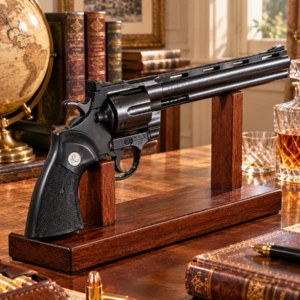
Twenty years later, in 1955, Colt launched its top-of-the-range revolver in that calibre: the Python. It was no ordinary revolver. It had a ventilated rib over the barrel, a counterweight running the length of its underside, and a mechanism hand-tuned by expert gunsmiths. Its smooth and precise trigger became its most famous feature. It was used by police forces and competitive shooters, and was offered in different barrel lengths, from the shortest to the eight-inch models intended for target shooting and hunting. Its fame would eventually far surpass its original uses.
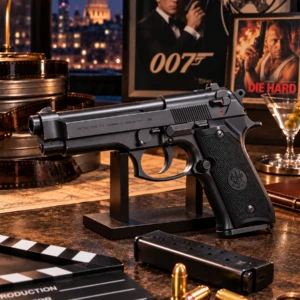
Meanwhile, in Italy, another story was taking shape. Beretta can trace its documented activity back to 1526, when a master craftsman named Bartolomeo Beretta was paid to manufacture arquebus barrels for the Republic of Venice. Four and a half centuries later, in 1975, the company introduced the Beretta 92, a 9mm Parabellum pistol with a 15-round magazine and a distinctive open-top slide.
When the United States sought a replacement for the ageing M1911, the Beretta took part in lengthy and controversial trials. It was ultimately selected and, in 1985, entered service as the M9. The change was significant: after decades with a .45 calibre pistol, the US armed forces adopted the 9mm, the NATO calibre. The M9 remained in service until, from 2017 onwards, the SIG Sauer M17 began to replace it.
If the Python represented refinement and the Beretta the changing of the guard for a generation of military pistols, there was still a third story, starring a weapon that was hard to ignore.
In the late 1970s, the American company Magnum Research considered an idea that seemed almost contradictory: a semi-automatic pistol capable of firing Magnum revolver cartridges. To withstand such power, it used a gas-operated system and a rotating bolt, more typical of a rifle than a pistol. The design, from 1982, was developed and manufactured in Israel, and thus the Desert Eagle was born. It weighed around two kilos and could use .357 Magnum, .44 Magnum, and later, .50 Action Express ammunition.
The Desert Eagle was never a standard-issue military weapon. Its domain was hunting, sport shooting, and collecting. But the fame it didn't need on a battlefield it found elsewhere.
In the cinema.
From Westerns and gangster films, and later in crime films, action films, TV series, and video games, the screen has always used weapons as part of its characters' personalities. A weapon can reveal something about a character before they utter a single word. A revolver with a perfect trigger speaks of a veteran police officer; an Italian pistol, of a professional; an oversized semi-automatic, of someone who doesn't go unnoticed.
Thus, weapons that almost never set foot on a battlefield became recognisable to millions of people who had never even held one. They no longer needed a war to become famous. It was enough for them to appear on a screen, in the hands of a character who doesn't even exist.