At the end of the 17th century, an infantryman had a problem. His musket could launch a lead ball at the enemy, but after firing, he needed time to reload. And if cavalry appeared at that moment, the soldier was practically defenceless.
For a long time, European armies had solved the problem by dividing the infantry in two. Musketeers fired, and pikemen, armed with long pikes, protected their comrades from cavalry charges. Each had its role, but both depended on the other.
Then a seemingly simple solution appeared: the bayonet.
The first bayonets were plug bayonets and were inserted directly into the muzzle of the barrel. They served like a lance, but had an obvious drawback: with them attached, the musket could no longer fire. The socket bayonet solved the problem. It was placed around the barrel and allowed the firearm to continue being used with the bayonet fixed. Suddenly, the same soldier could shoot the enemy and, if they got too close, face them with cold steel. He no longer needed a pikeman for protection, and little by little, the pike disappeared from the battlefields. The infantryman became, at the same time, both marksman and lancer.
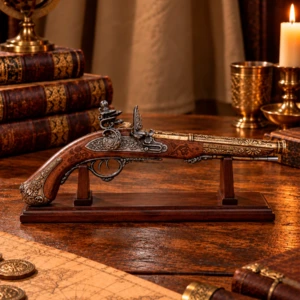
Around 1722, the British army adopted one of the muskets that would become a symbol of an entire era: the Land Pattern, popularly known as the Brown Bess. It was a long, heavy, smoothbore weapon with a calibre of approximately 19 millimetres. It fired a spherical lead ball and used a flintlock mechanism.
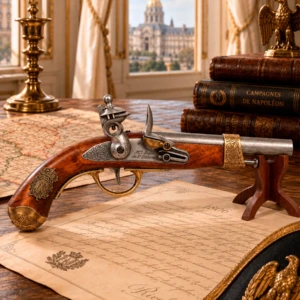
Its operation was simple, although not always reliable. When the trigger was pulled, the flint struck a steel piece called the frizzen, producing a spark. This ignited the gunpowder in the pan, and the flame travelled to the main charge in the barrel. When everything worked correctly, the shot was fired instantly. But if the flint was worn or the gunpowder had become damp, something very different could happen: a flash in the pan and no shot. In the rain, mud, and smoke of the battlefield, such misfires were common.
And firing again took time. The soldier would bite a paper cartridge containing the gunpowder and the ball, prime the pan, pour the gunpowder into the muzzle, insert the paper-wrapped ball, and use the ramrod to push it down. Only then could he fire again. A well-trained man could achieve three or four shots per minute under ideal conditions; in combat, amidst the smoke, fatigue, and fear, two or three was the norm.
Furthermore, the musket was not an accurate weapon. Its barrel was smoothbore, and it used a spherical ball, so deliberately hitting a specific man at a distance was very difficult. Armies found a solution: they didn't need each soldier to hit their target individually.
They needed them all to fire together.
Infantry was organised into large lines of two or three ranks. The men advanced shoulder to shoulder, waited for the order, and fired simultaneously. Individual accuracy mattered less when hundreds of bullets were flying towards the same target. Then came the bayonet. Warfare in this era thus made discipline one of the infantry's greatest weapons: the soldier had to hold his position, load, fire, and advance when ordered. The musket might be imperfect, but an entire formation acting as a single unit was devastating.
France followed a similar path. Its 1777 musket and the revised Year IX version, which equipped Napoleon's infantry, used the same principle. Its calibre was somewhat smaller, around 17.5 millimetres, but its limitations were similar. During the Napoleonic Wars, the British and French fought with weapons of the same technological generation; the difference lay in the training, tactics, and morale of their armies.
In 1815, at Waterloo, that style of fighting experienced one of its most famous moments. When the French cavalry charged the British positions, the soldiers formed squares, closing their ranks to create a compact mass of men and bayonets. For the riders, it was a difficult barrier to break through, and the horses resisted charging against a formation bristling with steel.
The small iron tube that had begun by replacing the pike had ended up transforming the way infantry fought. The pike was now at the end of their own musket.
But that world was nearing its end. The percussion cap would make ignition more reliable, and rifled barrels would greatly increase accuracy. The old ritual of biting the cartridge, priming the pan, loading from the muzzle, and striking with the ramrod was beginning to have its days numbered.