


So far we have seen the sword in the hands of Greeks, Romans, Vikings, and knights.
We have seen it change in shape, size, and function.
But before continuing towards the Temple, it is worth pausing for a moment and looking at a sword closely.
Because almost none of its parts are there by chance.
Let's start with the end furthest from the blade.
The pommel seems, at first glance, a simple decorative finial. On some weapons it may be just that, but its function is much more important: it helps to balance the sword and allows for better control of a blade that, in many cases, weighs more than a kilogram.
At the other end is the guard or crossguard.
It protects the hand, but it also fulfils another essential function: it prevents the hand from slipping towards the blade and helps to control the weapon when the swords clash.
Between these two pieces is the grip.
And then the blade begins.
For centuries, blades adopted different shapes because warriors needed to solve different problems.
A relatively wide blade is effective when the enemy has little protection.
But when armour begins to cover the body with steel plates, the situation changes.
It is no longer enough to hit harder.
You have to find a place where the steel isn't.
Blades begin to get narrower, and points become increasingly important.
And here one of the most persistent myths of popular culture appears.
The so-called "blood groove".
Many swords have a longitudinal groove in the blade, and for generations it has been said that it served to allow blood to drain from the victim's body.
This is not the case.
Its function is primarily structural: it allows for some of the blade's weight to be removed while maintaining good strength, in a way comparable to the principle used in certain engineering structures.
The sword, once again, is not designed to impress.
It is designed to function.
And when armour became even more resistant, a problem arose that the sword could not always solve.
Now imagine two men in full armour.
One manages to knock the other down.
The enemy is on the ground, but his armour still protects him.
A broad-bladed sword has difficulty finding a vulnerable point.
Something different is needed.
A shorter blade.
Narrower.
More rigid.
A blade that can slip through an opening.
Around the mid-13th century, the misericorde dagger appeared, associated in medieval tradition with blows aimed at the vulnerable points of a fallen adversary: the gaps in the helmet, the armpits, or the areas where the plates left space to allow movement.
Over time, this logic would be refined.
During the 14th and 15th centuries, the rondel dagger became widespread, easily recognisable by its circular discs on the hilt.
It was no longer simply a small sword.
It was a specialised tool for a world in which there was increasingly more steel between man and his enemy.
And here we can see something that has been repeated since the beginning of our story.
The weapon changes because the enemy changes.
The Greek shield had shaped the phalanx.
The Macedonian phalanx had responded to new needs.
Rome had found in the gladius a weapon suitable for its own way of fighting.
Medieval armour had forced modifications to swords.
And now the dagger sought what armour could not protect.
That is why a historical sword should not be seen merely as an object.
Its shape tells a story.
A wide blade tells us about one type of enemy.
A narrow point tells us about another.
A simple guard belongs to a certain era and style of fighting; a more complex hilt may respond to completely different needs.
Even the weight and balance tell us something about how it was conceived.
When we look at a sword, we are actually looking at the final result of a conversation that lasted centuries.
The weapon asks the question. The armour answers. And the weapon changes again.
But there is a moment in history when the sword ceases to be merely a weapon.
It also begins to become a symbol.
A cross on a white mantle.
A sword at the belt.
A knight who no longer fights solely for himself, but as a member of an institution.
Europe is about to meet the men who will transform that combination of faith, discipline, and warfare into one of the most famous military orders in history.
The Templars.
Pieces from this story
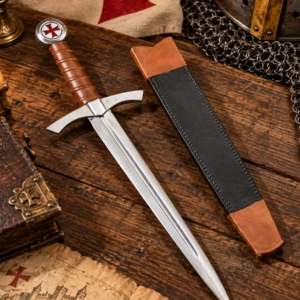 Forged Templar Dagger with Red Cross on the Pommel and Leather Sheath
72,00 €
Forged Templar Dagger with Red Cross on the Pommel and Leather Sheath
72,00 €
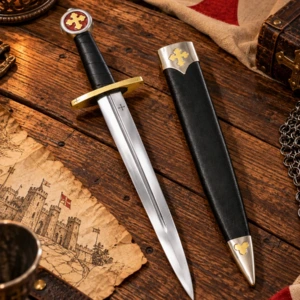 Templar Dagger Veritas Crucis with Golden Cross
82,80 €
Templar Dagger Veritas Crucis with Golden Cross
82,80 €
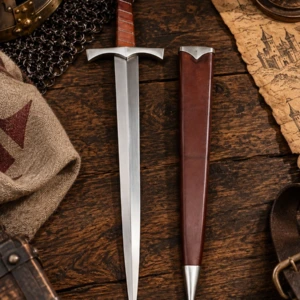 Forged Medieval Dagger with Thick Unsharpened Blade and Leather Sheath
66,00 €
Forged Medieval Dagger with Thick Unsharpened Blade and Leather Sheath
66,00 €
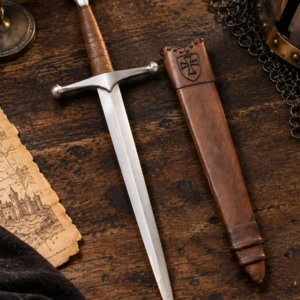 Forged German Combat Dagger with Engraved Leather Sheath
72,00 €
Forged German Combat Dagger with Engraved Leather Sheath
72,00 €
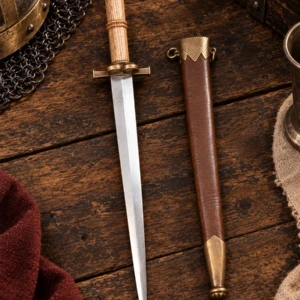 Forged German Dagger with Wooden Handle and Bronze-Tone Fittings
87,60 €
Forged German Dagger with Wooden Handle and Bronze-Tone Fittings
87,60 €
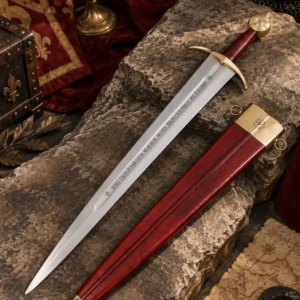 Medieval Type XIV Sword with Engraved Blade
200,40 €
Medieval Type XIV Sword with Engraved Blade
200,40 €
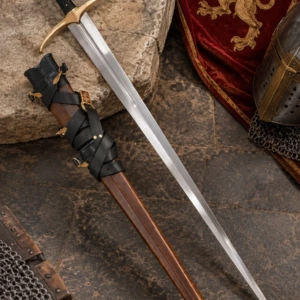 Medieval Knight's Sword with Wheel Pommel and Curved Guard
224,40 €
Medieval Knight's Sword with Wheel Pommel and Curved Guard
224,40 €
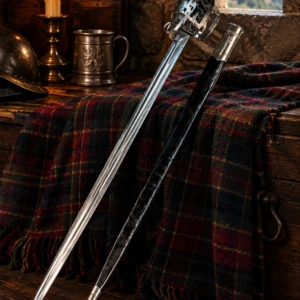 Jacobite Sword with Gilded Basket Hilt
262,80 €
Jacobite Sword with Gilded Basket Hilt
262,80 €
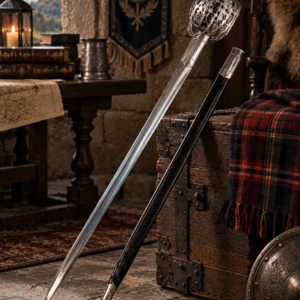 Scottish Officer's Basket-Hilted Sword
262,80 €
Scottish Officer's Basket-Hilted Sword
262,80 €
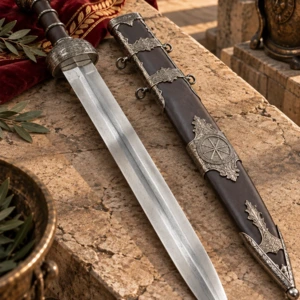 80 cm Roman Gladius with Medallion Scabbard
140,40 €
80 cm Roman Gladius with Medallion Scabbard
140,40 €
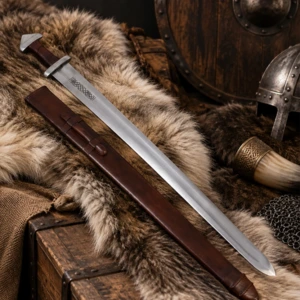 Viking Type H/I Sword with Engraved Blade and Leather Scabbard
159,60 €
Viking Type H/I Sword with Engraved Blade and Leather Scabbard
159,60 €
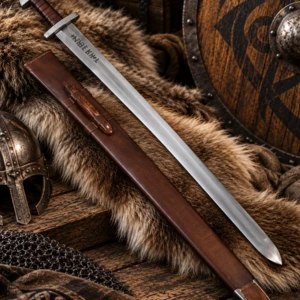 Petersen Type X Viking Sword with Ulfberht Inscription
150,00 €
Petersen Type X Viking Sword with Ulfberht Inscription
150,00 €
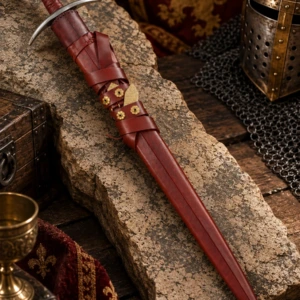 Medieval Type XIV Sword from the 13th Century with Garnet Leather Scabbard
219,60 €
Medieval Type XIV Sword from the 13th Century with Garnet Leather Scabbard
219,60 €
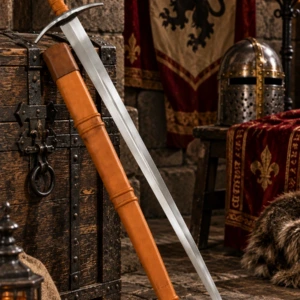 Medieval Sword Type XV from the 14th Century with Wheel Pommel and Curved Crossguard
176,40 €
Medieval Sword Type XV from the 14th Century with Wheel Pommel and Curved Crossguard
176,40 €
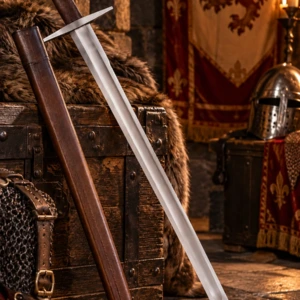 Medieval Combat Sword "William the Marshal" from the 12th Century
176,40 €
Medieval Combat Sword "William the Marshal" from the 12th Century
176,40 €
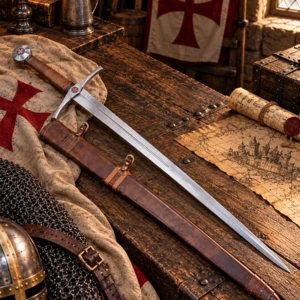 Medieval two-handed greatsword - Forged steel and leather
152,40 €
Medieval two-handed greatsword - Forged steel and leather
152,40 €
Next story: 6. The Order of the Temple — From a shared horse to power →