


Around the year 1000, Europe was full of men wearing steel.
It wasn't yet the full armour that centuries later we would associate with the medieval knight. The warrior of this era wore chain mail, made up of thousands of small, interlocking iron rings. He also carried a shield and, in his hand, a straight-bladed sword.
It was a simple combination.
And it worked.
The sword allowed him to cut and strike. The shield protected the body. The chain mail stopped or reduced the effectiveness of many attacks.
For generations, this balance was maintained.
But in war, there is always someone who tries to break the balance.
And this time it wouldn't be a sword.
It would be an arrow.
In 1139, the Second Lateran Council even went so far as to condemn the use of the bow and crossbow against other Christians. The Church considered those weapons especially dangerous.
But a religious prohibition had a problem.
The enemy could still use them.
And no king wanted to give up an effective weapon simply because his adversary could also use it.
The crossbow continued to spread.
So did the bow.
And, in time, a new threat appeared.
In 1346, during the Hundred Years' War, the English and French armies met at Crécy.
At the head of the English stood King Edward III, with his son—the future Black Prince—commanding one of the wings. On the French side, King Philip VI of Valois relied on his cavalry to decide the day.
On the other side of the field awaited the French cavalry.
Knights covered in iron.
Men accustomed to a cavalry charge deciding a battle.
Facing them were thousands of English archers armed with the longbow.
When the battle began, arrows started raining down on the French formation.
Horses were hit.
Men fell.
The charges lost force.
And the battle demonstrated something that would be repeated time and again for centuries:
no armour is definitive.
If the weapon finds a way to penetrate it, the armour has to change.
And it did.
During the second half of the 14th century and throughout the 15th, steel plates appeared more and more frequently on the warrior's body.
First as pieces that reinforced the most exposed areas.
Then covering arms, legs, chest, and back.
Until the knight ended up encased in a veritable articulated suit of steel.
The transformation wasn't immediate.
It was a race.
The weapon sought a weak point.
The armour closed it.
The weapon changed.
The armour responded again.
And that race ended up producing some of the most sophisticated armour Europe had ever seen.
But there's a paradox.
When we think of a medieval knight, we usually picture precisely those full suits of armour.
However, some of the most spectacular armour appeared when the Middle Ages were already fading away.
The Maximilian-style armour, for example, dates from approximately 1500–1525, when Europe was already in the Renaissance.
It's a small difference to someone looking at a photograph.
But enormous for a historian.
The Middle Ages didn't end because knights one day stopped wearing armour.
They ended precisely while that armour was reaching some of its highest levels of perfection.
And as steel increasingly covered the body, the sword also had to change.
A broad blade could be excellent against a man protected only by clothing or leather.
But against a steel surface, simply cutting was no longer enough.
An opening had to be found.
A joint.
An armpit.
The slit in a helmet.
The weapon began to seek out the armour from within.
And from that need would emerge another, much smaller piece.
The dagger.
It was no longer simply a secondary weapon.
It was the answer to a specific problem.
When two armoured men ended up fighting hand-to-hand, the sword could prove too large to find certain weak points. A short, rigid, and narrow blade could penetrate where a sword could not.
War had transformed armour into a fortress.
And now weapons sought its gates.
That small blade, however, deserves its own story. We will tell it shortly, along with the sword itself.
The evolution had an almost inevitable logic.
The better the protection, the more important the point became.
The more steel covered the warrior, the less sense there was in trying to cut him.
The medieval sword had begun primarily as a cutting tool.
Now it was also learning to pierce.
And behind all that evolution, something new had emerged.
The warrior no longer simply carried a weapon.
He carried a complete system of protection and attack designed to counter another system.
Sword against armour.
Bow against steel.
Dagger against the gaps.
Each innovation led to another.
But to see the birth of an institution that would mark this story, we must go back almost two centuries. As early as the 12th century, long before steel completely covered the knight, an order arose that would occupy an increasingly important place in the history of warfare.
An order whose men would wear white and red on steel.
An order that would begin small and end up accumulating land, wealth, and power throughout Europe.
The Order of the Temple.
Pieces from this story
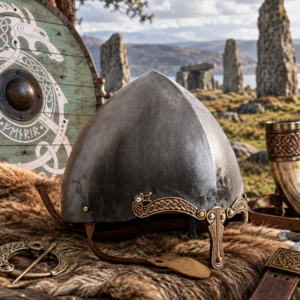 Medieval Celtic Helmet – Blackened Steel and Engraved Brass
92,40 €
Medieval Celtic Helmet – Blackened Steel and Engraved Brass
92,40 €
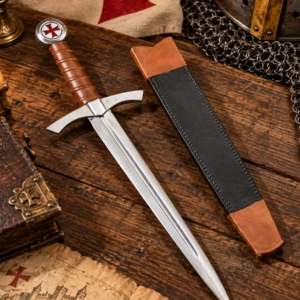 Forged Templar Dagger with Red Cross on the Pommel and Leather Sheath
72,00 €
Forged Templar Dagger with Red Cross on the Pommel and Leather Sheath
72,00 €
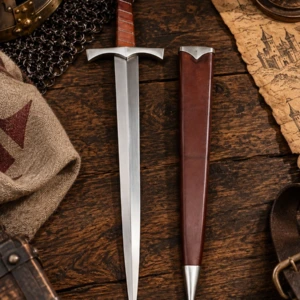 Forged Medieval Dagger with Thick Unsharpened Blade and Leather Sheath
66,00 €
Forged Medieval Dagger with Thick Unsharpened Blade and Leather Sheath
66,00 €
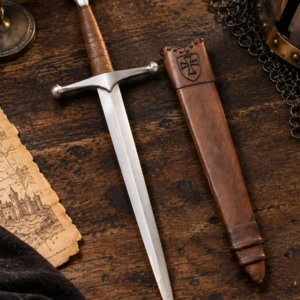 Forged German Combat Dagger with Engraved Leather Sheath
72,00 €
Forged German Combat Dagger with Engraved Leather Sheath
72,00 €
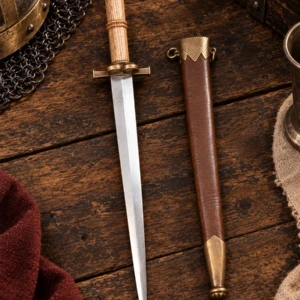 Forged German Dagger with Wooden Handle and Bronze-Tone Fittings
87,60 €
Forged German Dagger with Wooden Handle and Bronze-Tone Fittings
87,60 €
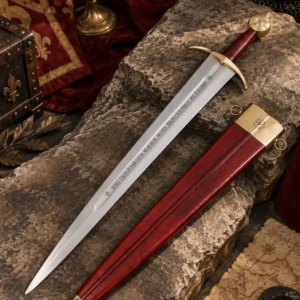 Medieval Type XIV Sword with Engraved Blade
200,40 €
Medieval Type XIV Sword with Engraved Blade
200,40 €
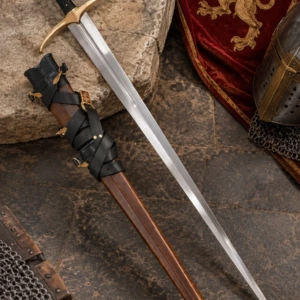 Medieval Knight's Sword with Wheel Pommel and Curved Guard
224,40 €
Medieval Knight's Sword with Wheel Pommel and Curved Guard
224,40 €
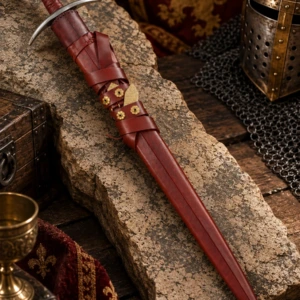 Medieval Type XIV Sword from the 13th Century with Garnet Leather Scabbard
219,60 €
Medieval Type XIV Sword from the 13th Century with Garnet Leather Scabbard
219,60 €
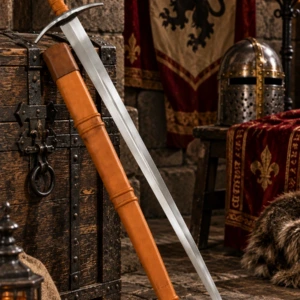 Medieval Sword Type XV from the 14th Century with Wheel Pommel and Curved Crossguard
176,40 €
Medieval Sword Type XV from the 14th Century with Wheel Pommel and Curved Crossguard
176,40 €
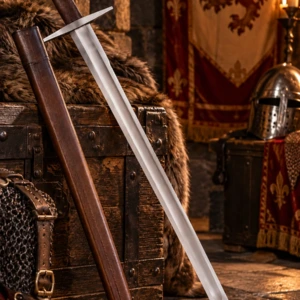 Medieval Combat Sword "William the Marshal" from the 12th Century
176,40 €
Medieval Combat Sword "William the Marshal" from the 12th Century
176,40 €
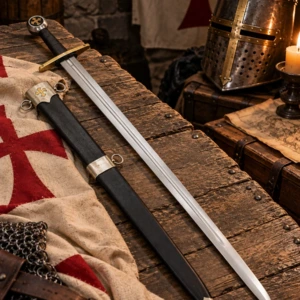 "Militia Templi" sword of the Order of the Temple with Templar Cross and Black Sheath
200,40 €
"Militia Templi" sword of the Order of the Temple with Templar Cross and Black Sheath
200,40 €
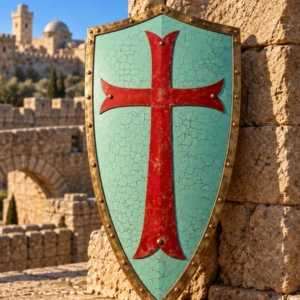 Templar Steel Shield – Red Cross on White
126,00 €
Templar Steel Shield – Red Cross on White
126,00 €
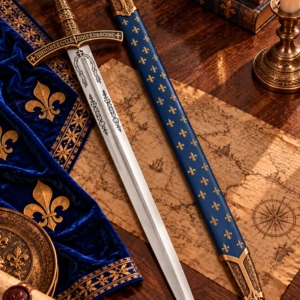 French medieval sword from the 14th century with fleur-de-lis and blue scabbard, 109 cm
120,96 €
French medieval sword from the 14th century with fleur-de-lis and blue scabbard, 109 cm
120,96 €
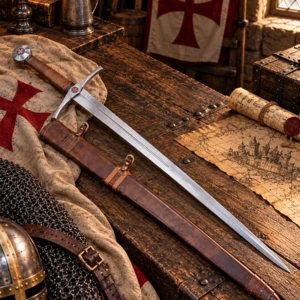 Medieval two-handed greatsword - Forged steel and leather
152,40 €
Medieval two-handed greatsword - Forged steel and leather
152,40 €
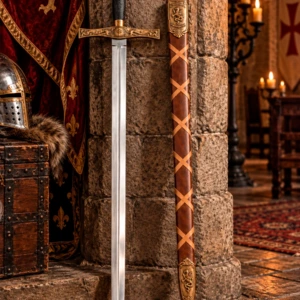 Excalibur sword with braided brown scabbard, 111 cm
149,94 €
Excalibur sword with braided brown scabbard, 111 cm
149,94 €