


Jerusalem, around 1119.
The city has been in Crusader hands for twenty years, but reaching it remains dangerous. Pilgrims travel along paths where a journey can turn into an ambush.
Into this world appears a small group of knights.
Their leader is Hugh de Payns.
They are not yet a great military order. They are few in number and their resources are scarce. Their purpose is simple: to protect the pilgrims travelling to the holy sites.
According to tradition, they became so poor that the seal they would later use depicted two knights sharing a single horse.
The image would eventually become one of the most well-known symbols of the Templars.
But that poverty would not last long.
In 1129, the Council of Troyes officially recognised the Order and approved its rule, drafted under the influence of Bernard of Clairvaux.
From then on, donations began to arrive.
Land.
Money.
Horses.
Weapons.
Men.
And with them appeared an image that would become inseparable from the Templars.
The white mantle.
In 1147, Pope Eugene III authorised the Templars to wear a red cross on it.
White and red.
Two colours that, centuries later, would still be enough to recognise a Templar even before seeing his face.
But beneath that mantle he was no different from the other knights of his time.
He wore chainmail.
Shield.
Lance.
Sword.
And, above all, discipline.
Therein lay his true strength.
A Templar was not to leave formation to pursue an enemy on his own. He did not fight seeking individual glory. His behaviour was subject to the rules of the Order.
On the battlefield, that discipline could make all the difference.
In 1177, a Crusader army led by the young King Baldwin IV of Jerusalem clashed with Saladin's forces near Montgisard.
Baldwin's army was vastly outnumbered.
Among his men were eighty Templar knights.
The battle ended in an unexpected defeat for Saladin.
The victory made Montgisard one of the great episodes in the military history of the Kingdom of Jerusalem.
But the balance in the Holy Land was shifting.
Ten years later, the Crusaders would meet Saladin again.
This time, at Hattin.
And the outcome would be completely different.
In July 1187, the Crusader army advanced through Galilee in sweltering heat. Water was scarce. Fatigue was mounting.
Saladin knew he didn't need to face a rested army.
He needed to ensure they arrived exhausted.
When the battle finally began, the Crusaders were in a desperate situation.
The defeat was total.
The relic of the True Cross, which the Christians had carried into battle, fell into Saladin's hands.
Many knights were captured.
Among them were Templars and Hospitallers.
The loss of Hattin opened the way to Jerusalem.
The city fell a few months later.
The Order survived.
But nothing would ever be the same again.
During the next century, the Templars would continue fighting in the Holy Land and accumulating properties in Europe.
Because while the war continued, the Order had become much larger than a group of knights.
It had castles.
Lands.
Farms.
Churches.
Trade routes.
And a network of properties that stretched across numerous European territories.
Pilgrims could deposit money in one place and withdraw it in another. The organisation and security of the network meant that the Templars also performed financial functions.
The small group of knights who had begun by protecting pilgrims had become an international institution.
And then came 1291.
Acre fell to Muslim forces.
It was the last great Crusader stronghold in the Holy Land.
The Templars abandoned the region and settled mainly in Cyprus and their European possessions.
The original reason for their existence had disappeared.
But the Order remained powerful.
Too powerful for some.
In France, King Philip IV had a problem.
He was deeply in debt and needed money.
The Templars possessed wealth.
And on Friday 13 October 1307, Philip ordered the simultaneous arrest of the Templars in France.
The accusations were terrible: heresy, blasphemy, and other crimes.
Many were tortured to obtain confessions.
The trial dragged on for years.
Finally, in 1312, Pope Clement V decreed the dissolution of the Order.
The institution that had survived battles, crusades, and the loss of Jerusalem officially disappeared.
Two years later, on 18 March 1314, Jacques de Molay, the last Grand Master of the Templars, was burned at the stake in Paris.
With him disappeared the last Grand Master of an order that had begun almost two centuries earlier with a few knights and a very specific purpose.
But the story didn't end there.
Because when an institution disappears so abruptly, it leaves something behind.
Stories.
Rumours.
Treasures that no one found.
Secrets that no one could prove.
And, as the centuries passed, a legend ever greater than the Order itself.
The Templars were dead.
But their name had just begun another life.
Long afterwards, in lodges of men who were no longer knights nor fought in the Holy Land, their crosses, their swords, and their name would reappear.
The history of the Temple had ended.
The Templar legend had just begun.
Pieces from this story
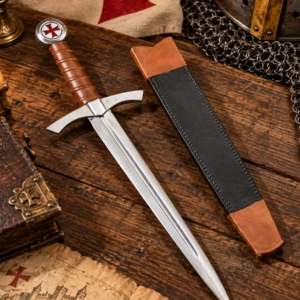 Forged Templar Dagger with Red Cross on the Pommel and Leather Sheath
72,00 €
Forged Templar Dagger with Red Cross on the Pommel and Leather Sheath
72,00 €
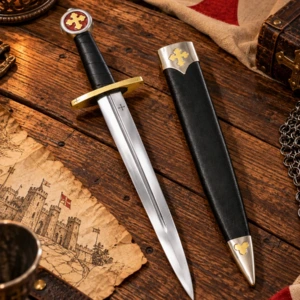 Templar Dagger Veritas Crucis with Golden Cross
82,80 €
Templar Dagger Veritas Crucis with Golden Cross
82,80 €
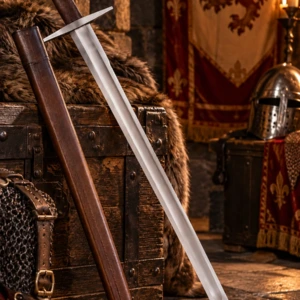 Medieval Combat Sword "William the Marshal" from the 12th Century
176,40 €
Medieval Combat Sword "William the Marshal" from the 12th Century
176,40 €
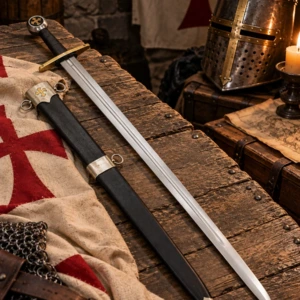 "Militia Templi" sword of the Order of the Temple with Templar Cross and Black Sheath
200,40 €
"Militia Templi" sword of the Order of the Temple with Templar Cross and Black Sheath
200,40 €
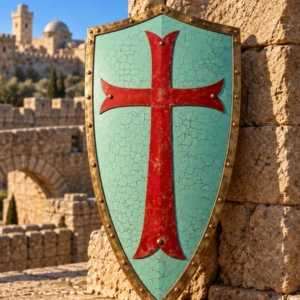 Templar Steel Shield – Red Cross on White
126,00 €
Templar Steel Shield – Red Cross on White
126,00 €
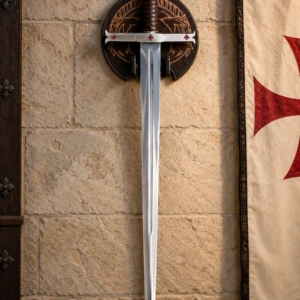 Templar sword of Jacques de Molay
140,40 €
Templar sword of Jacques de Molay
140,40 €
Next story: 7. Freemasonry — From stonemason's tools to the Templar legend →