For centuries, Japanese warriors did not have a single "samurai code" called bushidō. The norms, values, and forms of behaviour of the warrior class changed according to the era, region, and political circumstances. Long before the word bushidō acquired its modern meaning, expressions such as kyūba no michi (弓馬の道), "the way of the bow and horse", appeared, related to the warrior tradition of the medieval elites.
The word bushidō (武士道), "the way of the warrior", gained much greater prominence during the Edo period (江戸時代, 1603-1868). The long period of peace under the Tokugawa shogunate profoundly changed the lives of the samurai. Many no longer lived in a world defined by battle, and various thinkers began to reflect on what it meant to be a warrior when war ceased to occupy the centre of their existence.
One of them was Yamaga Sokō (山鹿素行), a 17th-century thinker who reflected on the role and obligations of the warrior class. Another was Yamamoto Tsunetomo (山本常朝), whose reflections were compiled in the early 18th century in the Hagakure (葉隠). These texts do not constitute a single universal code, but rather different expressions of a tradition of thought on conduct, duty, discipline, and the relationship between the warrior and his lord.
Various intellectual and religious currents also contributed to this thinking, including Confucianism, Shintoism, and Buddhism. In particular, certain ideas from Zen had a significant influence on some traditions related to martial arts.
Among the concepts that appear in this context is fudōshin (不動心), which can be translated as "immovable mind" or "imperturbable mind". The term expresses a mental state in which a person is not trapped by fear, doubt, or excessively focused attention on a single point.
One of the figures associated with this tradition was the Zen monk Takuan Sōhō (沢庵宗彭, 1573-1645), who maintained an intellectual relationship with Yagyū Munenori (柳生宗矩), a swordsmanship master of the Yagyū Shinkage-ryū school. Writings associated with Takuan reflect on the relationship between the mind, attention, and swordsmanship.
The fundamental idea is simple to explain: when the mind is completely trapped by a thought—fear, the opponent, the desire to win, or even the sword itself—the ability to respond freely diminishes. Practice, on the contrary, seeks an attention that can adapt to what is happening without being paralysed by a single thought.
But the image we have of bushidō today also owes much to a much more recent era.
In 1900, Nitobe Inazō (新渡戸稲造) published Bushido: The Soul of Japan in English. His book presented Western audiences with an interpretation of the Japanese warrior ideal and had an enormous influence on how bushidō was explained outside of Japan.
Nitobe organised this ideal around different virtues, including gi (義), righteousness or justice; yū (勇), courage; jin (仁), benevolence; rei (礼), courtesy; makoto (誠), sincerity; meiyo (名誉), honour; and chūgi (忠義), loyalty.
But there is a fundamental distinction: these seven virtues should not be presented as if they formed an official set of rules that all samurai followed for centuries. These are part of Nitobe's interpretation of bushidō at the beginning of the 20th century. The historical reality of Japanese warriors was much more diverse, and ideas about duty, honour, and loyalty varied according to the era and context.
The sword, however, did occupy an extraordinary place within that culture.
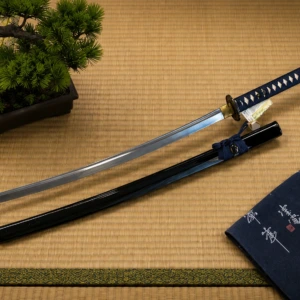
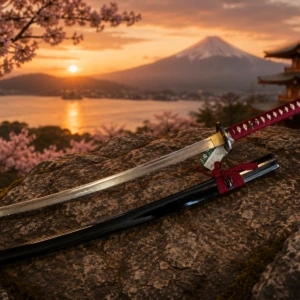
During the Edo period, carrying swords was one of the visible manifestations of samurai status. The katana and wakizashi formed the daishō, and their mounts could become true works of art. The blades, guards, menuki, fuchigashira, and scabbards could demonstrate the extent to which the sword was also an expression of identity and social position.
This is the source of some of the enormous symbolic weight that the Japanese sword would eventually acquire. The katana could represent the warrior, but also his position, his family tradition, and his identity. It wasn't simply an object that was used: it was an object that was carried, cared for, and presented according to social norms.
And there is another custom that is particularly fascinating: naming a sword.
In Japanese tradition, there are famous swords that have received proper names. Some names refer to their appearance, a story related to them, their owner, or some episode in their history. This is the case with famous names like Kogarasumaru, Dōjigiri Yasutsuna, or Heshikiri Hasebe. In these cases, the name transforms the sword into something more than a piece identifiable by its maker: it gives it its own identity within history and tradition.
Today we also find contemporary swords whose names are related to concepts like Seigi (正義), "righteousness" or "justice", or Fudōshin (不動心), "imperturbable mind". But here we must distinguish between a documented historical name and a modern name inspired by concepts from Japanese tradition.
And perhaps there we find one of the most interesting things about this whole story.
A sword can have a name.
It can represent a virtue.
It can recall a legend.
It can bear an engraving of a dragon, a flower, or a scene from centuries past.
It can even be a modern piece inspired by that entire universe.
But in all cases, there is an idea behind it: the sword doesn't have to speak only of what it can do; it can also speak of what it represents.
The steel can tell how it was made.
The hamon can reveal how it was hardened.
The tsuba can show us an artistic tradition.
The name can tell us a story.
And behind it all lies a question that has accompanied the Japanese sword for centuries:
What does it mean to carry a sword?
Perhaps that's why we chose such a simple word for our own name: Hagane (鋼).
In Japanese, hagane means steel.
It is the material at the heart of this entire story. Before there is a katana, before the hamon, before the tsuba, before the symbols, before even a sword can be given a name, there is steel.
Hagane is the beginning.
And everything else is the story built around it.
Maison Hagane.
A house dedicated to discovering these stories, preserving them, and sharing them.