


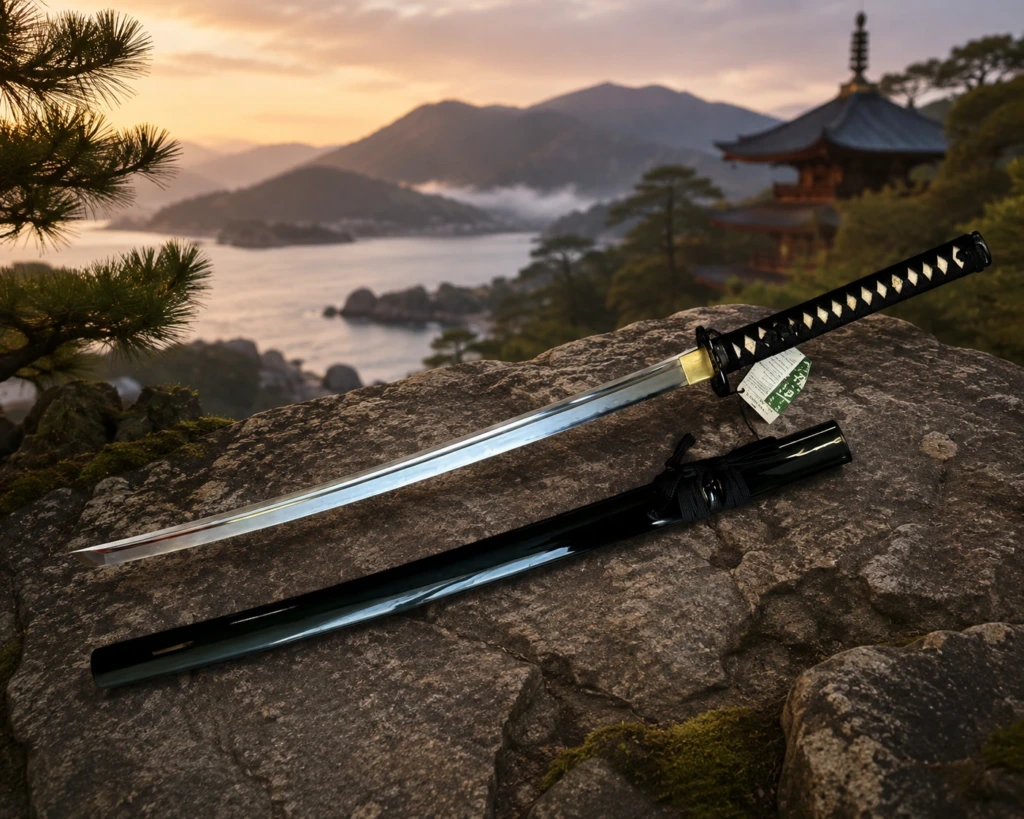
Other items shown in the photos are not included.
Japanese Black Kobuse Katana in Dual Steel – Laminated Blade
Availability: 7 in stock
SKU: KAT-011During the Kamakura period (1185-1333), the need for more durable swords led Japanese swordsmiths to combine two types of steel in a single blade instead of relying on just one: the kobuse technique (甲伏せ) encases a hard steel, capable of maintaining a sharp edge, around a softer, more flexible steel core that absorbs impacts without breaking. This logic—hardness on the outside, flexibility on the inside—was later complemented by differential tempering, which gives the blade its characteristic curve.
In addition to this historical foundation, the maker has created a unique legend for this piece: it is said that this katana, called Kurotsume, belonged to a wandering warrior from the eastern lands known as Takeshi, the Silent Shadow, and that its kobuse blade was secretly forged to unite two spirits: the gentleness of the wind and the strength of the mountain. The light diamonds on the hilt are said to represent the phases of the moon, reminding its wielder to act with patience and precision, while the openwork guard evokes the shadows into which Takeshi vanished before each duel. This is a fictional story created as part of the product's identity, not a documented historical fact.
Identification
- Type of piece
- Katana (刀) - Japanese long sword
- Model
- Black Kobuse Katana - Laminated Blade
- Historical period depicted
- Kamakura period inspiration (鎌倉時代, 1185-1333), kobuse technique
Blade (Ha)
- Steel type
- Kobuse steel (甲伏せ), combination of two steels (1045 and 1095)
- Overall length
- 106 cm
- Blade length
- 76 cm (長さ, nagasa)
- Blade width
- 3 cm
- Spine thickness
- 6 mm
- Tip type (kissaki)
- Chu-kissaki (中切先)
- Hamon type
- Suguha (直刃), discreet temper line
- Hardening method
- Differential hardening (焼き入れ, yaki-ire), polished finish
- Blade finish
- Polished, elegant curve
- Edge condition
- Sharpened, with a real, lasting edge (刃, ha)
Grip (Tsuka)
- Tsuka length
- 28 cm (柄, tsuka)
- Core material
- Magnolia wood (朴の木, honoki)
- Samegawa (rayskin)
- Light-coloured synthetic samegawa (鮫皮)
- Tsuka-ito (wrap cord)
- Intense black cord, diamond-wrapped (柄糸)
- Menuki (ornaments under the wrap)
- Discreet, integrated under the wrap (目貫)
- Fuchi and kashira
- Fuchi (縁) in gilded brass, black kashira (頭)
Guard and mounting (Koshirae)
- Tsuba (guard)
- Round, openwork with decorative motif, in black iron (鍔)
- Tsuba material
- Openwork black iron
- Habaki
- Gilded brass (鎺)
- Seppa (spacers)
- Gilded brass (切羽)
- Mekugi (peg)
- Black lacquered bamboo (目釘)
Scabbard (Saya)
- Scabbard material
- Lacquered wood (鞘)
- Colour and finish
- Gloss black
- Sageo (scabbard cord)
- Matching black cord (下緒)
- Koiguchi (scabbard mouth)
- Black lacquered, integrated with the saya (鯉口)
General information
- Predominant colour
- Black
- Materials
- Kobuse steel (1045 and 1095), lacquered wood, iron, brass, textile cord
- Total weight
- 750 g
- Blade weight
- 500 g
- Balance point
- 7 cm above the tsuba (鍔)
- Recommended use
- Collecting, decoration, martial arts practice
- Practitioner level
- Intermediate (blade with a real edge, requires experienced handling)
This katana combines two different steels using the kobuse technique: a harder steel that encases the blade and maintains its edge, and a softer steel in the core, which provides flexibility. The entire piece is forged, folded, and polished to achieve the elegant curve and polished finish seen here, with a subtle temper line along the edge. The handle (柄, tsuka) is covered and wrapped with braided black cord, revealing the pattern of light-coloured diamonds underneath. The guard (鍔, tsuba), pierced with a decorative motif, and the remaining metal parts are assembled individually before being attached to the black lacquered wooden scabbard (鞘, saya). The piece is presented in a presentation case.
- Katana (刀) forged with the kobuse (甲伏せ) technique, combining two steels (1045 and 1095).
- Curved blade with a polished finish, with a real and durable edge.
- Black tsuka-ito (柄糸), diamond-wrapped over light samegawa (鮫皮).
- Openwork tsuba (鍔) in black iron, of delicate design.
- Saya (鞘) of black lacquered wood, sober finish.
- Includes the legend of Kurotsume and the warrior Takeshi, the Silent Shadow, a story created especially for this piece.
- Comes in a presentation case.
No questions about this piece yet. Not sure about something? Ask us.