


In 1600, the Battle of Sekigahara (関ヶ原の戦い) took place, one of the decisive events in the process that brought Tokugawa Ieyasu to power. Shortly after, in 1603, the Tokugawa shogunate was established, and the Edo period (江戸時代, 1603-1868) began, a long era of political stability and internal peace. For more than two centuries, samurai continued to be part of the Japanese social order, but for many of them, the sword gradually ceased to be a tool commonly used on the battlefield and also acquired a strong significance of rank and status. The Metropolitan Museum points out that swords and their accessories became indispensable symbols of authority and important means of personal expression during the Edo period.
But that relationship between the samurai and the sword changed radically with the arrival of the Meiji era (明治時代, 1868-1912). In 1876, the government enacted the Haitōrei (廃刀令), a law prohibiting certain individuals from publicly carrying swords. This change profoundly affected the old warrior class and also the artisans who had lived for generations from the manufacture and decoration of swords. The Metropolitan Museum itself houses works created after 1876 by masters who continued working, in some cases reproducing styles of ancient blades.
The sword, however, did not disappear. It changed its place.
During Japan's modernisation, the old traditions of weapons training gave way to new ways of understanding martial practice. Some disciplines retained techniques passed down from ancient schools, but also began to acquire an educational and personal development dimension. In this context, the modern conception of budō (武道) developed, understood as a "path" of practice and refinement through a martial discipline.
One of the disciplines that kept the tradition of drawing the sword alive was iaidō (居合道). Its practice is based primarily on the individual execution of kata (型), established forms that begin and end with the sword sheathed. The practitioner recreates an imaginary combat situation and precisely works on posture, movement, drawing, cutting, chiburi (血振り), related to the traditional gesture of symbolically cleaning the blade, and finally nōtō (納刀), the process of returning it to the scabbard. It is not a free fight between two people, but rather a technical practice based on forms.
There are numerous schools and traditions of iaidō. Some traditions preserve lines of transmission that go back several centuries. Among them is Musō Jikiden Eishin-ryū, one of the ancient iaijutsu traditions that continues to be practised today. This helps us understand an important difference: modern iaidō did not emerge from nothing after 1876, but rather incorporates and reorganises much older traditions within a contemporary framework.
Alongside iaidō, we also find battōdō (抜刀道), a term used for practices focused on drawing and cutting techniques. Depending on the school and tradition, these disciplines may have different objectives and methods, so they should not be considered simply interchangeable names for the same activity.
And here a fundamental question arises: with what sword is training done?
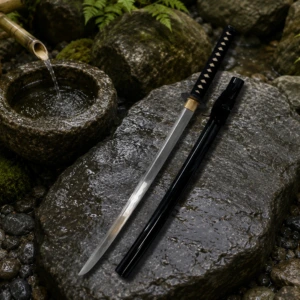
Using a truly sharp Japanese blade to practise iaidō movements thousands of times would pose an unnecessary risk. That's why iaitō (居合刀) exist; these are training swords that typically don't have a cutting edge. They allow users to practise handling, drawing, and sheathing a sword without turning every technical error into a real cut. Their construction can vary depending on the manufacturer and the type of piece, so it shouldn't be assumed that all iaitō have exactly the same weight, balance, or materials.
It is also important to distinguish between a "training sword" and an "iaitō". A training sword is a broader concept: it can refer to different pieces intended for practising specific techniques, while the term iaitō is specifically used for swords primarily intended for the practice of iaidō and other forms of sword training. Therefore, not every commercially available piece presented as a training sword should automatically be identified as a traditional iaitō.
The situation is different when practising tameshigiri (試し斬り), the test cut. In this discipline, a blade with real cutting ability is used to work on appropriate targets, traditionally including the rolled-up tatami omote. Here, the technique ceases to be merely a formal representation: the blade must physically pass through the target, and the practitioner must precisely control the angle, trajectory, and execution of the cut.
Thus, the history of the Japanese sword does not end when it ceases to be a common weapon of war.
It was first a tool of combat. Later, it also became a status symbol. And, over time, some of the techniques associated with it found a new life as training disciplines.
The sword changed its setting, but it didn't disappear.
It moved from the battlefield to the dōjō.
And there, facing an opponent who is no longer present, the objective ceased to be solely to defeat another.
It also became about learning to control one's own movement.
Pieces from this story
Next story: 6. Symbols on steel: flowers, dragons and skulls →