


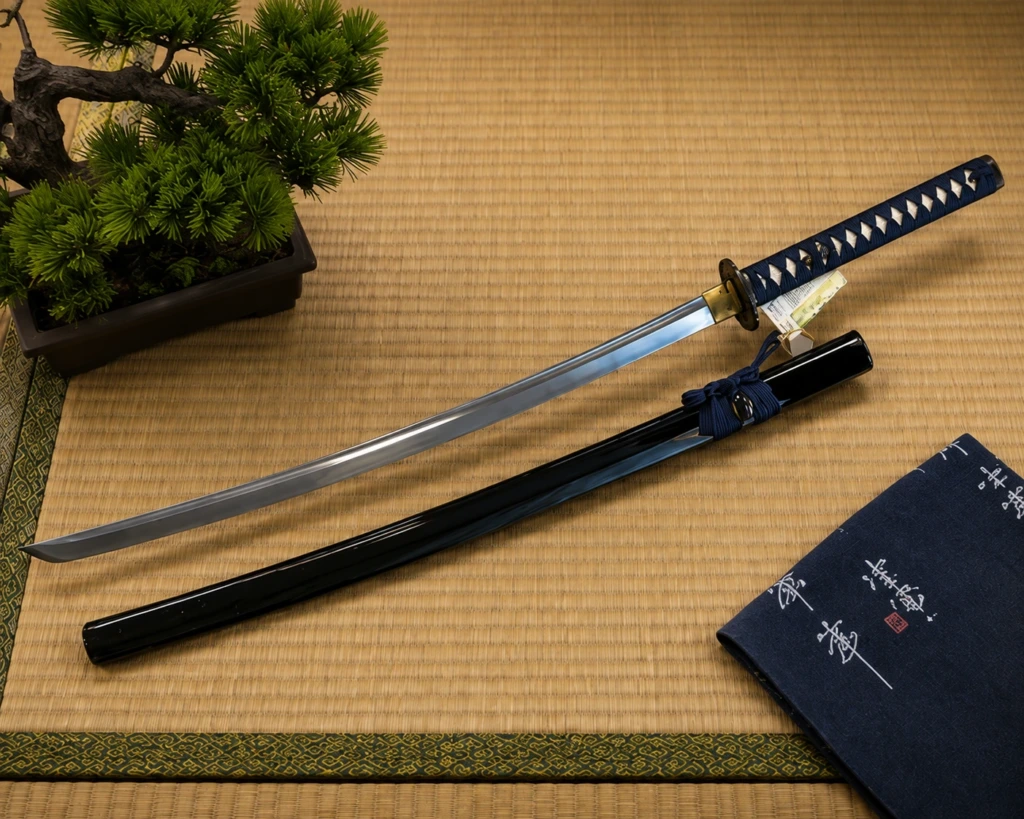
Other items shown in the photos are not included.
Japanese Sōshū Kitae Katana in Blue with Laminated Steel Blade
Availability: 2 in stock
SKU: KAT-010The sōshū kitae (相州鍛え) is the most elaborate of the traditional methods of combining various steels into a single blade. It originated during the Kamakura period (鎌倉時代, 1185-1333) in the Sagami school (相模国), associated with the master swordsmith Masamune. It combines different steels to achieve both hardness at the edge and flexibility in the rest of the blade, typically leaving a distinctive, shiny, granular texture (nie, 沸) on the surface, considered the signature of this school.
In addition to this historical basis, the manufacturer has created its own legend for this piece: it is said that this katana, called Seiryu no Kokoro ("the Heart of the Blue Dragon"), was born in a forge buffeted by sea winds, seeking balance between sky, land, and sea, and that only warriors of pure heart could wield it without awakening its wrath. The blue braiding of the hilt represents the calm waters of the ocean, and the irregular reliefs of the guard, the scales of an ancient dragon, guardian of forgotten knowledge. This is a fictional tale created as part of the product's identity, not a documented historical fact.
Identification
- Type of piece
- Katana (刀) - Japanese long sword
- Model
- Blue Sōshū Kitae Katana - Laminated Blade
- Historical period depicted
- Kamakura period (鎌倉時代, 1185-1333), Sōshū school (相州) associated with Masamune
Blade (Ha)
- Steel type
- Sōshū kitae steel (相州鍛え), combination of three different steels
- Overall length
- 106 cm
- Blade length
- 76 cm (長さ, nagasa)
- Blade width
- 3 cm
- Spine thickness
- 6 mm
- Tip type (kissaki)
- Chu-kissaki (中切先)
- Hamon type
- Notare (湾れ), visible temper line with nie (沸) texture
- Hardening method
- Differential hardening (焼き入れ, yaki-ire), with visible nie (沸) texture
- Blade finish
- Satin, elegant curve
- Edge condition
- Sharpened, with a real, precise edge (刃, ha)
Grip (Tsuka)
- Tsuka length
- 28 cm (柄, tsuka)
- Core material
- Magnolia wood (朴の木, honoki)
- Samegawa (rayskin)
- Ivory synthetic samegawa (鮫皮)
- Tsuka-ito (wrap cord)
- Deep blue cord, diamond-wrapped (柄糸)
- Menuki (ornaments under the wrap)
- Discreet, integrated under the wrap (目貫)
- Fuchi and kashira
- Fuchi (縁) in gilded brass, dark blue kashira (頭)
Guard and mounting (Koshirae)
- Tsuba (guard)
- Sober, with discreet relief and hammered texture (鍔)
- Tsuba material
- Hammered iron, natural appearance
- Habaki
- Gilded brass (鎺)
- Seppa (spacers)
- Gilded brass (切羽)
- Mekugi (peg)
- Black lacquered bamboo (目釘)
Scabbard (Saya)
- Scabbard material
- Lacquered wood (鞘)
- Colour and finish
- Gloss black
- Sageo (scabbard cord)
- Matching blue cord (下緒)
- Koiguchi (scabbard mouth)
- Black lacquered, integrated with the saya (鯉口)
General information
- Predominant colour
- Black and blue
- Materials
- Sōshū kitae steel (three steels), lacquered wood, iron, brass, textile cord
- Total weight
- 750 g
- Blade weight
- 500 g
- Balance point
- 7 cm above the tsuba (鍔)
- Recommended use
- Collecting, display
- Practitioner level
- Intermediate (blade with a real edge, requires experienced handling)
This katana combines three different steels using the sōshū kitae technique, seeking a balance between strength, flexibility, and a precise edge. The blade is forged, folded, and polished to achieve the satin finish and elegant curve seen in this piece, leaving the temper line visible along the edge. The handle (柄, tsuka) is wrapped with a braided blue cord that reveals the ivory diamond pattern underneath. The guard (鍔, tsuba), with its subtle relief and hammered texture, and the remaining metal parts are assembled one by one before being attached to the black lacquered wooden scabbard (鞘, saya), complete with a matching cord (下緒, sageo). It is presented in a case lined with gold fabric.
- Katana (刀) forged with the sōshū kitae (相州鍛え) technique, combining three different steels.
- Curved blade with satin finish, with visible temper line (刃文, hamon).
- Real, precise edge, with a good balance between strength and cutting ability.
- Deep blue tsuka-ito (柄糸), diamond-wrapped over ivory samegawa (鮫皮).
- Tsuba (鍔) with discreet relief and hammered texture.
- Saya (鞘) of black lacquered wood, with matching blue cord (下緒, sageo).
- Includes the legend of Seiryu no Kokoro, the Heart of the Blue Dragon, a story created especially for this piece.
- Comes in a case lined with gold fabric.
No questions about this piece yet. Not sure about something? Ask us.