


A Japanese sword can survive for centuries, but it doesn't survive on its own.
When a blade ceases to be used as a weapon, another stage of its history begins: preservation. And in Japan, specific methods were developed to store, protect, and maintain these pieces so that the steel could reach future generations.
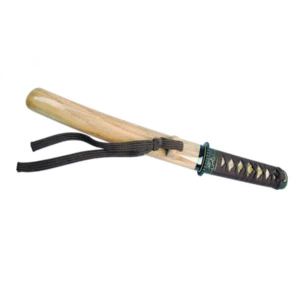
A complete sword can be mounted in a koshirae (拵え), with its hilt, tsuba, scabbard, and all its decorative elements. This is the image we normally associate with a finished katana. But when the priority is preserving the blade, there is another, much simpler solution: the shirasaya (白鞘).
The word literally means "white scabbard" and refers to a simple wooden mount, without the characteristic decoration of a koshirae. Its main function is to provide the blade with a suitable environment for preservation when it doesn't need to be mounted for use or display. The Metropolitan Museum, for example, houses a wakizashi and a tantō in wooden shirasaya and explicitly identifies them as storage scabbards.
The difference between the two mounts is important. A koshirae is designed as a functional and artistic whole: it incorporates the handle, the guard, the fittings, and a decorated scabbard. The shirasaya, on the other hand, seeks simplicity. It does not aim to compete with the beauty of an artistic mount; its focus is the blade itself.
The shirasaya also does not, by itself, determine how the blade it contains is constructed. It can house blades of different characteristics, constructions, and finishes. Therefore, in a catalogue, we might find, for example, a piece presented in a shirasaya and also described by the type of steel or by a Damascus pattern. One primarily describes the mount and its function of preservation; the other describes a characteristic of the blade.
And that makes perfect sense when we recall what we have seen in the previous chapters.
A Japanese sword blade is not simply a piece of steel. Its surface can preserve the hada (steel grain), the hamon (temper line), the geometric shape, and other details that allow for the study of its manufacture, school, and history. Traditional polishing has the precise function of revealing and maintaining these characteristics. Poor conservation can damage them.
Therefore, maintaining a Japanese sword requires care. The steel must be kept clean and protected from moisture and oxidation, and the blade must be handled correctly. Never touch the polished surface directly with your fingers: the oils and moisture from your skin can leave residue on the steel.
It is also important to remember that a traditional Japanese sword is not a piece that should be constantly handled for display. Every time it is removed from its mounting, the blade is exposed to the environment and potential accidental damage. In a collection, the goal is not simply for the sword to be beautiful, but for it to remain in good condition for many years.
And then there is the question of how it is presented.
A katana can be placed on a katana-kake (刀掛け), the traditional stand designed to hold the sword. The position and method of placement can vary depending on the type of mounting, the context, and the conventions used. Museums and collections also have specific boxes and storage systems for swords and daishō sets. The Metropolitan Museum, for example, houses lacquered wooden boxes specifically designed for storing pairs of swords.
Here we see an idea that has been repeated throughout this series: the Japanese sword was never just the blade.
A single sword can have an old blade and a much more recent mount. The Metropolitan Museum holds examples where the blade dates from the 16th or 17th century, while the koshirae was made centuries later.
This means that a sword can accumulate different moments in its own history.
The swordsmith created the blade.
The polisher revealed its characteristics.
Other artisans crafted the tsuba, the handle, and the saya.
An owner may have changed the mount decades or centuries later.
And finally, someone decided to preserve it so that another person could admire it long afterwards.
Therefore, when we look at an antique katana, we are not simply seeing a weapon that has survived the passage of time. We are seeing an object that has passed through different hands, different eras, and different ways of understanding its value.
Perhaps that is why the Japanese sword continues to inspire such fascination.
Because the story of a sword doesn't end when it stops cutting.
From that moment, another story begins: the story of ensuring that someone, centuries later, can still contemplate it.
Pieces from this story
Next story: 8. The samurai code: bushidō, virtues and named swords →