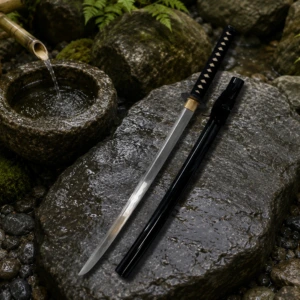
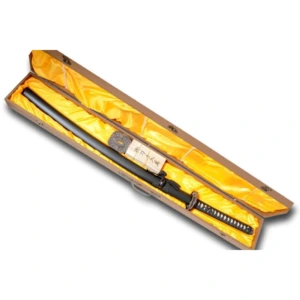
A Japanese sword doesn't end when the swordsmith finishes the blade. Around that core of steel, a whole set of parts is built that allows it to be carried, used, protected, and, over time, transformed into an object of great artistic value. This set is called koshirae (拵え), the sword's fittings.
During the Muromachi period (室町時代, 1336-1573), with the country fragmented by wars between feudal lords during the Sengoku era (戦国時代, "Warring States period"), sword making reached a high degree of specialisation. A finished sword could pass through the hands of different artisans, each dedicated to a specific part of the assembly.
It all began with the tang, the nakago (茎), the section of steel that remains hidden inside the handle. It is one of the most important parts of the sword because it preserves information about the blade and may bear the smith's signature and other inscriptions. The habaki (鎺), a small metal collar that fitted into the mouth of the saya—the koiguchi (鯉口)—was placed at the base of the blade and helped to keep the blade properly seated. Next came the seppa (切羽), metal washers that helped to adjust and hold together the various parts of the assembly.
Then came one of the most recognisable parts: the tsuba (鍔), the guard located between the blade and the handle. Its main function was to protect the hand and separate the fingers from the edge. Over time, in addition to its practical function, the tsuba became one of the most important artistic elements of the Japanese sword. Craftsmen could work it in iron, copper, and other alloys, incorporating scenes, animals, plants, and symbols. Some came to be valued as small works of art in their own right.
The most intricate part was the handle, the tsuka (柄). Inside was the nakago, while the exterior was constructed using several layers and elements. Beneath the covering, the samegawa (鮫皮), ray skin, could be placed, its surface adding texture to the overall piece. On top of this, the menuki (目貫), small decorative elements placed strategically on the handle, could be added. Besides their ornamental function, these elements could contribute to the feel and comfort of the grip.
The traditional samegawa (鮫皮) came from ray skin, valued for its hardness and the grip it provided beneath the braiding. Today, it coexists with synthetic reproductions that imitate that same grained texture, while other pieces continue to use genuine ray skin—sometimes dyed in colours like red—both under the braiding of the tsuka (handle) and, in some mounts, directly covering the saya (scabbard). Neither solution is more "correct" than the other in a modern piece, but they should not be considered interchangeable: not every surface with that grain necessarily comes from the same material.
Everything was finished with the tsuka-ito (柄糸), the silk or other material cord that was braided around the hilt following precise patterns. The result was not only decorative: it provided a firm surface for holding the sword. At the ends of the tsuka were the fuchi (縁), the collar located next to the tsuba (handguard), and the kashira (頭), the pommel cap at the end of the hilt.
And running through it all was a small piece with a fundamental function: the mekugi (目釘), a peg that passed through the hilt and the nakago and helped to keep them together. Thanks to this system, the sword could be disassembled and reassembled, which also made it possible to change the elements of the mounting.
Outside the hilt was the saya (鞘), the wooden scabbard fitted to the blade. Its manufacture was the responsibility of the sayashi (鞘師), the craftsman specialising in this work. The saya was not a simple generic sheath: it was fitted to the specific blade so that it would be correctly housed inside. From it could hang the sageo (下緒), a cord used to attach the sword to the belt and secure the saya during use.
Not all blades are mounted following this exact same complete scheme. Some tantō, in particular, are presented in an aikuchi (合口) mount, literally "tight mouth": a variant without a tsuba, in which a metal collar directly connects the hilt to the mouth of the saya. This mount is distinct from both the complete koshirae we have just discussed and the shirasaya we will talk about later: it retains the braiding and decoration typical of a functional piece, but deliberately omits the guard.
And here we find one of the most interesting features of the Japanese sword: many of these parts could be changed. The mount was not necessarily a permanent and unalterable structure, but rather a set of elements that could be disassembled, replaced, and combined. The Met specifically points out that the hilt components could be removed and replaced with other sets, and that the mounting elements could also be appreciated as independent works of art.
Therefore, when we look at a complete Japanese sword, we are not just seeing a blade with a hilt and a scabbard. We are seeing the result of the coordinated work of several crafts: the swordsmith who forged the blade, the artisan who made the guard, the one who assembled the hilt, the one who braided the cord, and the one who fitted the saya. Each piece serves a function, but many of them also tell their own story.
Recognising them helps us understand any sword: a tsuka with samegawa, a decorated tsuba, a carefully fitted habaki, or a braided sageo cease to be mere details and become part of a language of their own. A Japanese sword is, in reality, the sum of many hands that worked around the same blade.