


A newly forged blade did not yet possess the properties that would allow its edge to achieve the hardness needed to keep a good cutting edge. The right steel can acquire great hardness when heated to the required temperature and then rapidly cooled; in a Japanese sword, the real challenge lay in concentrating that hardness especially at the edge, while the rest of the blade retained a greater capacity to absorb stress.
During the Kamakura period (鎌倉時代, 1185-1333), when sword making reached a high degree of specialisation, smiths perfected techniques aimed at achieving precisely this balance. The hardening process is known as yaki-ire (焼き入れ), and it was one of the most delicate moments in the entire manufacturing process: a blade that had survived weeks of forging could crack or warp during quenching.
Before heating it in the fire, the smith coated the blade with a mixture of clay and other materials, in a process known as tsuchioki (土置き). The application was not uniform: a much thinner layer was left on the edge and a thicker layer on the spine. When the blade reached the appropriate temperature, it was cooled rapidly, usually in water. The edge, protected by a thin layer, lost heat more quickly; the areas covered with more clay cooled more slowly.
This difference in cooling modifies the structure of the steel. In the area that cools quickly, martensite, a very hard structure, can form, while the parts that cool more slowly retain softer and tougher structures. The desired result was a blade whose edge could achieve great hardness without making the entire body of the sword equally brittle.
Within the hardened zone, structures may appear that, after polishing, become visible as nie (沸) and nioi (匂), terms used to describe different aspects of the microscopic texture associated with hardening. Along with the other characteristics of the blade, these form part of what the polisher reveals through their work.
And a visible mark remains: the line that visually separates the hardened zone from the rest of the blade is the hamon (刃文). It is not a decoration added later, but the visible result of the hardening process and the way the smith applied the clay. Depending on this application and the tradition of each school, the hamon can take very different forms: from a practically straight line, suguha (直刃), to wavy patterns, like notare (湾れ), or irregular ones, like gunome (互の目).
But fire could still change one more thing. During quenching, the different cooling rates and transformations that the steel undergoes generate stresses within the blade. The result can be a characteristic curve, the sori (反り), whose shape depends on the blade's geometry and the conditions of the hardening process itself. The curve that we immediately associate with many Japanese swords today is therefore not merely an aesthetic matter: it is also the result of how the steel responds to heat treatment.
In addition to the hamon and the sori, some blades incorporate another recognisable element: the bō-hi (棒樋), a longitudinal groove that runs along part of the blade. Different functions are attributed to it depending on the era and school—lightening the blade, reinforcing certain lines of the forging—without any of them being considered the only valid explanation for each case. Nor are all the sori resulting from quenching the same: within that general curvature, there are profiles described with their own names, such as the torii-zori, with a more symmetrical curvature centred on the body of the blade, compared to other profiles where the curvature is concentrated closer to the handle. And at the opposite end of the blade, the point itself also has its own name and its own variations: the kissaki (切先). The chū-kissaki, of medium size, is the most common, although there are also longer or more compact points, each associated with different styles and periods.
Today, differential hardening is still practised on modern blades, even though the steels used are different from traditional ones. With steels like 1045 or 1065, which have a much more consistent composition, the result can be more predictable. When the process is carried out correctly, it can also produce a visible hamon, allowing the effect of the hardening on the blade to be appreciated.
Therefore, when a modern blade has a pronounced hamon, we are not simply seeing a decorative line. We are seeing the mark left by the fire on the steel: the place where the smith decided how the blade should be hardened and where it should retain greater toughness.
Pieces from this story
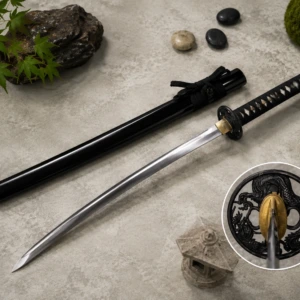 Japanese 1065 Steel Katana with Dragon Tsuba – 76 cm Blade
350,40 €
Japanese 1065 Steel Katana with Dragon Tsuba – 76 cm Blade
350,40 €
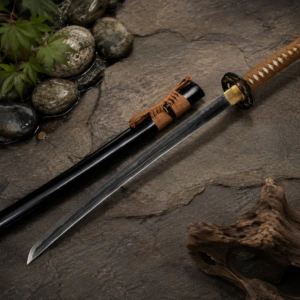 Japanese Shihōzume Katana in Laminated Steel – 76 cm Blade
700,80 €
Japanese Shihōzume Katana in Laminated Steel – 76 cm Blade
700,80 €
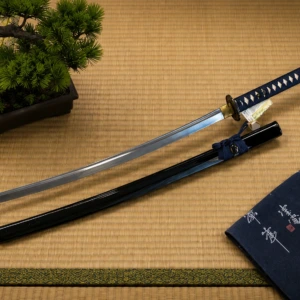 Japanese Sōshū Kitae Katana in Blue with Laminated Steel Blade
800,40 €
Japanese Sōshū Kitae Katana in Blue with Laminated Steel Blade
800,40 €
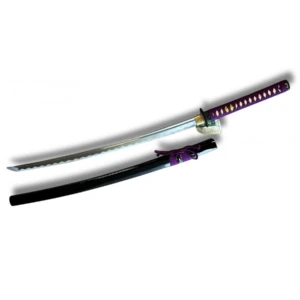 Japanese Maru 1060 Katana in Violet - Genuine Wavy Hamon
280,80 €
Japanese Maru 1060 Katana in Violet - Genuine Wavy Hamon
280,80 €
 Japanese Red and Gold Tantō with Violet Blade – 1045 Steel
150,00 €
Japanese Red and Gold Tantō with Violet Blade – 1045 Steel
150,00 €
Next story: 3. Anatomy of a sword: the mounting, piece by piece →