


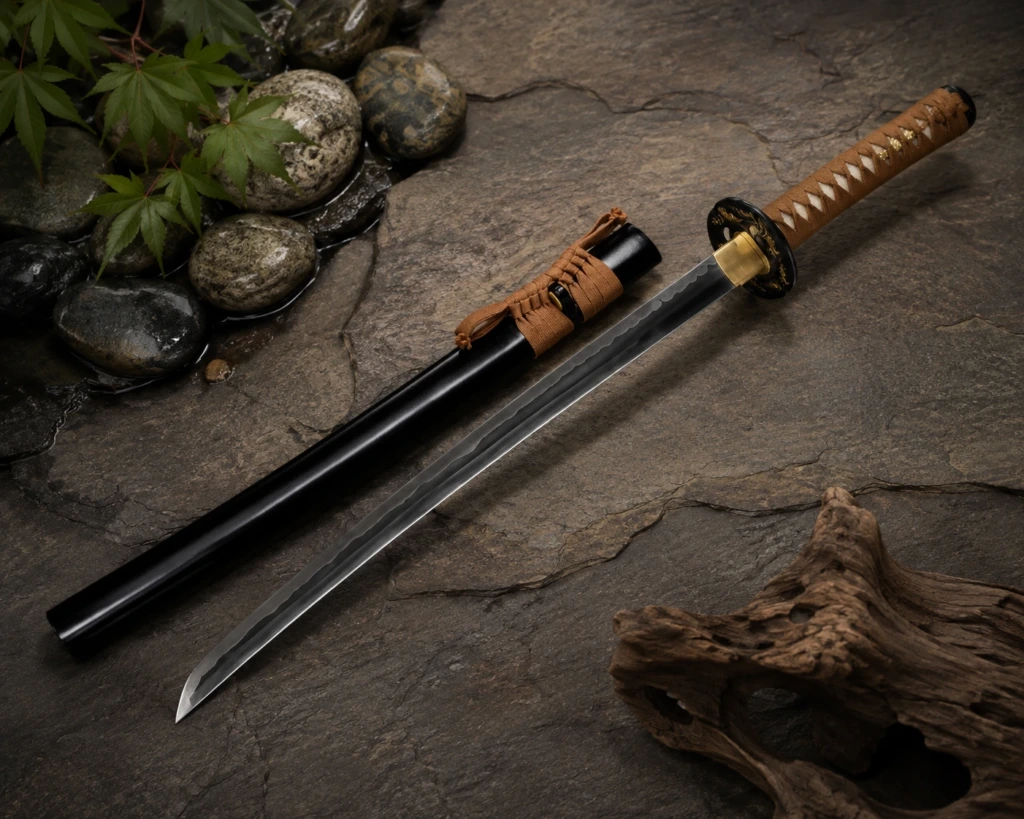
Other items shown in the photos are not included.
Japanese Shihōzume Katana in Laminated Steel – 76 cm Blade
Availability: 10 in stock
SKU: KAT-009During the Kamakura period (1185-1333), when the samurai consolidated their power as the ruling class and swords had to withstand increasingly brutal combat, Japanese swordsmiths devised the shihōzume construction: a blade made from separate pieces of different steels for the edge, core, and sides, seeking a balance between hardness and flexibility that a single steel could not provide. The dragon (龍, ryū) that decorates the guard of this piece also has a long tradition: originating in China, it became a common motif on Japanese swords during periods of war, associated with water, the sky, and a power capable of both protection and destruction; engraved on the guard, it served as a warning to the enemy even before the sword was drawn.
Identification
- Type of piece
- Katana (刀) - Japanese long sword
- Model
- Black and Brown Shihōzume Katana - Laminated Steel
- Historical period depicted
- Kamakura period inspiration (鎌倉時代, 1185-1333), shihōzume technique
Blade (Ha)
- Steel type
- Shihōzume steel (四方詰め), several steels combined
- Overall length
- 106 cm
- Blade length
- 76 cm (長さ, nagasa)
- Blade width
- 3 cm
- Spine thickness
- 6 mm
- Tip type (kissaki)
- Chu-kissaki (中切先)
- Hamon type
- Notare-Gunome (刃文: 湾れ・互の目), very visible along the whole blade
- Hardening method
- Differential hardening (焼き入れ, yaki-ire), marked temper line
- Blade finish
- Polished, pronounced curvature
- Edge condition
- Sharpened, with a real edge (刃, ha)
Grip (Tsuka)
- Tsuka length
- 28 cm (柄, tsuka)
- Core material
- Magnolia wood (朴の木, honoki)
- Samegawa (rayskin)
- Light-coloured synthetic samegawa (鮫皮)
- Tsuka-ito (wrap cord)
- Brown/ochre cord, diamond-wrapped (柄糸)
- Menuki (ornaments under the wrap)
- Discreet, integrated under the wrap (目貫)
- Fuchi and kashira
- Fuchi (縁) in gilded brass, black kashira (頭)
Guard and mounting (Koshirae)
- Tsuba (guard)
- Round, black, with a relief of golden dragons (龍) (鍔)
- Tsuba material
- Darkened iron with gilt inlays
- Habaki
- Gilded brass (鎺)
- Seppa (spacers)
- Gilded brass (切羽)
- Mekugi (peg)
- Black lacquered bamboo (目釘)
Scabbard (Saya)
- Scabbard material
- Lacquered wood (鞘)
- Colour and finish
- Gloss black
- Sageo (scabbard cord)
- Matching brown/ochre cord (下緒)
- Koiguchi (scabbard mouth)
- Black lacquered, integrated with the saya (鯉口)
General information
- Predominant colour
- Black and brown/gold
- Materials
- Shihōzume steel, lacquered wood, iron, brass, textile cord
- Total weight
- 750 g
- Blade weight
- 500 g
- Balance point
- 7 cm above the tsuba (鍔)
- Recommended use
- Collecting, decoration
- Practitioner level
- Intermediate (blade with a real edge, requires experienced handling)
This katana combines several steels into a single blade following the shihōzume method, assembling different pieces for the edge, core, and sides before forging them together, which allows for a good balance between cutting power and strength. The blade is then polished and tempered to achieve the pronounced curve and well-defined temper line visible on the edge. The handle (柄, tsuka) is wrapped with a brown/ochre cord in a diamond pattern, and the guard (鍔, tsuba), decorated in gilt relief with dragon motifs, is assembled along with the other metal parts—the collar next to the blade (鎺, habaki) and the pommel (頭, kashira)—before the whole assembly is attached to the black lacquered wooden scabbard (鞘, saya) with its matching cord (下緒, sageo).
- Katana (刀) forged with the shihōzume (四方詰め) technique.
- Curved blade with a notare-gunome-type hamon (刃文), clearly visible along its entire length.
- Tsuba (鍔) decorated in gilt relief with dragon (龍) motifs.
- Brown/ochre tsuka-ito (柄糸), diamond-wrapped over light samegawa (鮫皮).
- Saya (鞘) of black lacquered wood, with matching cord (下緒, sageo).
- Fittings in gilt brass; black kashira (頭).
No questions about this piece yet. Not sure about something? Ask us.