


There's an image that seems strange if you know the history of samurai Japan. A swordsman walks through a modern city, among trams, newspapers, cafés, and men dressed in Western clothing. And he carries a sword that, according to the law, shouldn't be there.
It's one of the most characteristic images of Demon Slayer (Kimetsu no Yaiba, 鬼滅の刃). The story of demons and slayers belongs to the realm of fantasy, but the world in which it takes place has a very specific historical basis: the Taishō era (大正時代), between 1912 and 1926. And to understand why those swords had to be hidden, we have to go back a few decades.
In 1876, the Meiji government (明治) enacted the Haitōrei (廃刀令), an edict that prohibited carrying swords in public. For the former samurai, this meant much more than losing a weapon: the most visible symbol of their social standing was disappearing from the streets. Many did not accept it. In 1877, the Satsuma Rebellion (西南戦争) broke out, led by Saigō Takamori (西郷隆盛), and the new imperial army, armed with modern rifles, had to face men who still fought with swords. Japan was entering the future, but it carried the past with it.
The sword did not disappear; it changed its place. In the following decades, the old fighting traditions began to be organised, and in 1895 the Dai Nippon Butoku Kai (大日本武徳会) was founded, which played a key role in the preservation and organisation of Japanese martial arts. The sword moved from the battlefield to the dōjō (道場), to ceremonies, and to collections. And sometimes, to objects designed to conceal it: shikomizue (仕込み杖) were walking sticks that hid a blade inside.
When the Taishō era arrived, Japan was a land of contrasts. Western clothing coexisted with kimonos, modern cities with temples, and the sword arts continued to be passed down. This is the Japan that Demon Slayer chooses as the setting for Tanjirō and the Demon Slayer Corps. Fiction adds something that never existed—demons—and swords, the Nichirin (日輪刀), that change colour depending on who wields them. But many of the things its swordsmen do echo real tradition.
In Japan, swordsmanship was transmitted within schools or ryūha (流派), where students learned techniques through forms or kata (型), and each school had its own style and secrets. Some became famous for a specific trait: the Jigen-ryū (示現流) of Satsuma taught how to decide a fight with a single devastating blow, and the iai (居合) tradition was based on drawing and cutting in the same movement. When Zenitsu draws and cuts in a single flash, or when each Hashira masters their own "breathing" learned from a master, the series is bringing something very real into the realm of fantasy: the master didn't just teach how to handle a sword, they transmitted an entire school.
Even the parts of the sword could have a family history. The tsuba (鍔), the guard that protects the hand, could be disassembled and kept to be mounted on another blade. Thus, a part of an ancestor's sword could accompany someone who wasn't even born when it was forged. In the series, Tanjirō mounts Kyōjurō Rengoku's flame-shaped guard on his sword after his death: a fictional gesture that any samurai family would have understood. Some guard shapes, like the four-lobed mokkō (木瓜), were repeated for centuries precisely because of this custom of preserving and reusing.
The sword had ceased to dominate the battlefields, but it remained alive in dōjō, in collections, and in family traditions. Demon Slayer only had to imagine what would happen if, in that Japan trying to leave its past behind, someone still needed a real sword.
Fantasy invented the demons. History provided the swords.
Pieces from this story
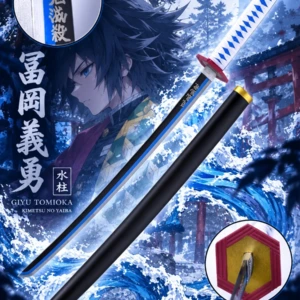 Giyū Tomioka's Nichirin Katana, Water Hashira – Demon Slayer (Unsharpened)
60,00 €
Giyū Tomioka's Nichirin Katana, Water Hashira – Demon Slayer (Unsharpened)
60,00 €
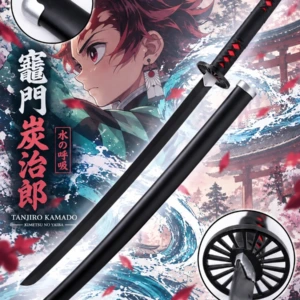 Tanjirō Kamado's Black Nichirin Katana – Demon Slayer (Unsharpened)
60,00 €
Tanjirō Kamado's Black Nichirin Katana – Demon Slayer (Unsharpened)
60,00 €
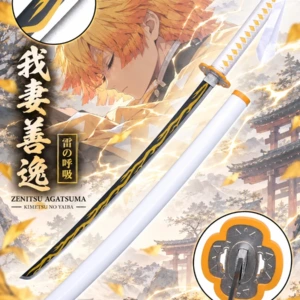 Zenitsu Agatsuma's White and Orange Nichirin Katana – Demon Slayer (Unsharpened)
60,00 €
Zenitsu Agatsuma's White and Orange Nichirin Katana – Demon Slayer (Unsharpened)
60,00 €
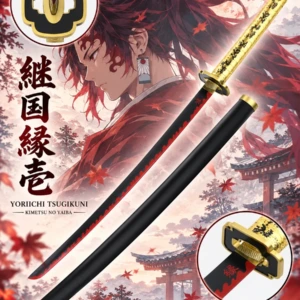 Decorated Black and Gold Nichirin Katana – Demon Slayer (Unsharpened)
60,00 €
Decorated Black and Gold Nichirin Katana – Demon Slayer (Unsharpened)
60,00 €
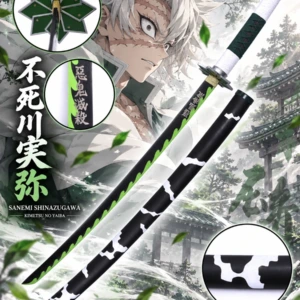 Sanemi Shinazugawa's Nichirin Katana, Wind Hashira – Demon Slayer (Unsharpened)
60,00 €
Sanemi Shinazugawa's Nichirin Katana, Wind Hashira – Demon Slayer (Unsharpened)
60,00 €
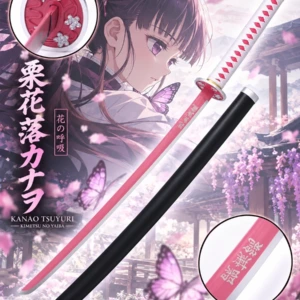 Kanao Tsuyuri's Pink Nichirin Katana – Demon Slayer (Unsharpened)
60,00 €
Kanao Tsuyuri's Pink Nichirin Katana – Demon Slayer (Unsharpened)
60,00 €