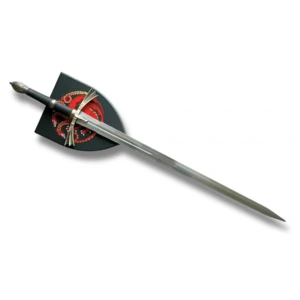
There are swords for fighting. And there are others that seem made for something more.
In the old European stories, some swords held relics, were linked to saints, or could only be wielded by the one who proved to be the chosen one. Modern fantasy turned this idea into a classic, but the seed was already planted in the Middle Ages. In the Song of Roland, the hero lists the relics he keeps in Durendal's pommel: objects associated with Saint Peter, Saint Basil, Saint Denis, and the Virgin Mary. The sword ceases to be just a weapon and becomes a sacred object.
There is another image that almost everyone knows: a sword stuck in a stone, waiting for the person destined to wield it. At the end of the 12th century, the works of Robert de Boron helped to establish the tradition of the sword that proves Arthur's legitimacy. And there is something even more surprising: in the chapel of Montesiepi, in Tuscany, a sword is preserved embedded in the rock, which tradition attributes to Saint Galgano, a knight who, according to legend, gave up arms and plunged his sword into the stone around 1180. He didn't pull it from the rock to begin an adventure; he stuck it in to end a life of war.
Many centuries later, the same image reappeared in The Legend of Zelda, the series Nintendo launched in 1986: the Master Sword, a sacred weapon that repels evil, rests on a pedestal awaiting a pure-hearted hero. The story had changed, but the image remained recognisable.
And if a sword could be sacred, it could also become a weapon against that which men feared. European folklore abounds with beliefs about materials capable of protecting against the supernatural. In the British Isles, it was said that iron scared away fairies, and that is why horseshoes were hung above doors. Silver, the metal of the moon and of purity, became associated with something even more powerful: harming creatures like werewolves. From this came one of the most famous weapons in fiction, the silver bullet. And from this also largely stems one of the best-known traits of Geralt of Rivia, the witcher created by Andrzej Sapkowski: a steel sword for men and a silver one for beasts. The enemy determines the weapon.
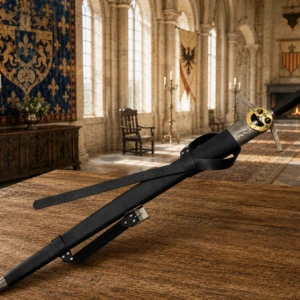
However, Geralt carries his swords on his back, and here fiction takes a liberty: a longsword is not easily drawn from that position, and in the Middle Ages it was almost always worn at the belt.
Finally, there is a type of legendary sword that needs no magic. It only needs metal. For centuries, blades from the Near East were famous in Europe for their wavy surface, like flowing water, and for an edge that seemed never to wear down: the so-called Damascus steel. The name is somewhat misleading. The authentic Damascus steel was made from crucible steel, wootz, produced in southern India and traded in ingots, and has nothing to do with the blades forged today by welding layers of steel together to create a similar pattern. When the original technique was lost, around the 18th century, Damascus blades went from being a product to a legend.
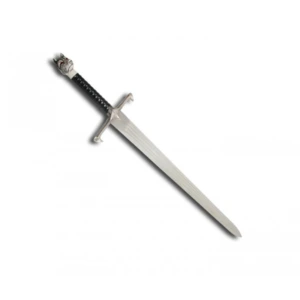
George R. R. Martin took that image and transformed it into the Valyrian steel of A Song of Ice and Fire: a metal of legendary hardness, recognisable by its ripples, whose secret was lost with ancient Valyria. In Westeros, such a sword is worth more than a castle. Longclaw, the ancestral sword of House Mormont, comes into Jon Snow's hands with a new pommel in the shape of a direwolf, and what he receives is not just a blade: it is antiquity, prestige, and knowledge that no one knows how to reproduce any more.
Relics, stones, silver, and lost steels. Fantasy has taken them further, but they were all already in the stories that were told eight hundred years ago.