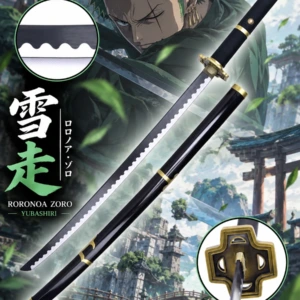
Some swords have names. And some swords have names that are enough to tell a story.
In Japan, the most famous blades were given the title meitō (名刀), "celebrated swords." Their prestige could stem from their age, their beauty, their smith, or the stories that had survived around them. One of the best known is Dōjigiri Yasutsuna (童子切安綱): according to tradition, this sword from the Heian period (平安時代, 794-1185) was the one used by the warrior Minamoto no Yorimitsu (源頼光) to kill the demon Shuten-dōji (酒呑童子). Over time, it became part of the Tenka Goken (天下五剣), the "Five Swords Under Heaven," the most celebrated group of blades in Japan.
But if any Japanese sword is associated with the idea of a curse, it is the Muramasa (村正). Muramasa was a real swordsmith, active in Ise Province (伊勢国) in the 16th century, whose blades had an extraordinary reputation. The problem was that his name became linked to several episodes in which members of the Tokugawa (徳川) family were injured or killed. When the Tokugawa ruled Japan, the belief spread that these swords brought them misfortune, and many owners preferred to erase the signature.
The legend also needed an opposing sword, and it found it in Masamune (正宗), the most illustrious name in Japanese swordsmithing. In the most well-known version, both blades are plunged into a stream: Muramasa's blade cuts all the tree leaves that the current carries towards it; before Masamune's blade, however, the leaves pass by unharmed, because it only cuts what it should. It is a beautiful story, and also impossible: the two masters did not live at the same time. But it summarises an idea that has endured to this day: the bloodthirsty sword versus the just sword.
In the Edo period (江戸時代, 1603-1868), moreover, swords began to be evaluated by something very specific: their cutting ability. In 1797, the Kaihō Kenjaku (懐宝剣尺) was published, a work that classified swordsmiths into grades according to the sharpness of their blades: saijō ō-wazamono (最上大業物), the supreme ones; then came ō-wazamono (大業物), ryō-wazamono (良業物), and wazamono (業物). Among the most highly regarded is a name very familiar to fans: Nagasone Kotetsu (長曽祢虎徹). His blades were so coveted that forgeries circulated in droves, to the point that a saying arose: if you see a Kotetsu, assume it's fake.
Exactly two centuries after that classification, in 1997, Eiichirō Oda began publishing One Piece (ワンピース), and brought all these ideas into his world. His swords are also ordered by grades. The Sandai Kitetsu (三代鬼徹), with a name reminiscent of Kotetsu, is a cursed sword that only accepts those who dare to challenge it. The Wadō Ichimonji (和道一文字), Zoro's most beloved sword, is named after the Ichimonji (一文字), a real school of swordsmiths active since the Kamakura period (鎌倉時代, 1185-1333). The Yubashiri (雪走), "the one that runs over the snow," and the Shūsui (秋水), "autumn water," follow the Japanese custom of giving fine blades poetic names. And the Enma (閻魔) is named after the king of the Buddhist underworld. Names, grades, curses: the entire tradition, in the hands of a pirate swordsman.
The most curious case, however, is that of Hattori Hanzō (服部半蔵). In Kill Bill, Quentin Tarantino portrays him as a legendary retired swordsmith in Okinawa who breaks his oath never to forge again in order to give a sword to the protagonist. The historical Hattori Hanzō was quite different. Hattori Hanzō Masanari (服部正成, 1542-1596) was a samurai in the service of Tokugawa Ieyasu (徳川家康), known as "Oni Hanzō" (鬼半蔵), "Hanzō the Demon," who helped his lord escape after the death of Oda Nobunaga (織田信長) in 1582. One of the gates of the Imperial Palace in Tokyo still bears his name. He wasn't a swordsmith, but the Hanzō in the film didn't appear out of nowhere either: the actor who plays him, Sonny Chiba, had already portrayed Hattori Hanzō in the 1980 Japanese series Kage no Gundan (影の軍団). One legend feeding another.
Cursed or celebrated, counterfeit or turned into a character, each of these swords has something in common: its fame weighs as much as its steel. In Japan, a blade has never been just what it cuts. It's also what is said about it.