During the Seven Years' War, a French officer named Jean-Baptiste Vaquette de Gribeauval spent several years serving in the Austrian army, then an ally of France. There he discovered something that would forever change his understanding of artillery.
The Austrian cannons were lighter and better organised. They could keep pace with the army instead of crawling slowly behind it. Gribeauval returned to France convinced that his compatriots needed to do the same, and in 1765 he had his opportunity: a royal decree of 15 October put his new artillery system into effect.
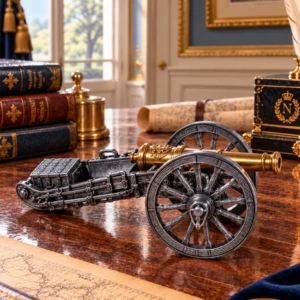
The changes didn't seem spectacular at first glance, but together they represented a true transformation. Field cannons were reduced to three main calibres, 4, 8, and 12 pounds, in addition to a howitzer. The barrels were made shorter and lighter, and a screw for adjusting elevation and a graduated sight for improved aiming were incorporated.
But the most important change lay in something much less visible. Gun carriages, wheels, axles, and limbers began to be manufactured with standardised dimensions. A broken wheel could be replaced with one from another cannon, and maintenance during a campaign ceased to be a headache. The idea was simple: lighter, more manageable, and easier-to-maintain artillery.
However, changing a military tradition is never easy. The new system encountered strong resistance within the artillery corps itself, and its implementation was stalled for several years. Only from 1776 onward, when Gribeauval became inspector general of artillery, did his reforms finally take hold.
And while that system was transforming French cannons, a young man was beginning his training within that world.
His name was Napoleon Bonaparte.
In 1785, he graduated from the École Militaire in Paris as a second lieutenant of artillery. He was not yet the man who would eventually dominate much of Europe, but he had chosen a speciality that would define his career. In December 1793, during the siege of Toulon, then in British hands, he had his first major opportunity: he organised the French batteries until they dominated the harbour and forced the enemy fleet to retreat. The success had immediate consequences. At only 24 years old, he was promoted to brigadier general.
When he came to power, Napoleon began to use cannons in an increasingly aggressive manner. Instead of distributing them evenly along the front, he concentrated them at a decisive point and amassed enormous firepower there. If an enemy position was too strong to attack directly, it had to be hit first with artillery; once the breach was opened, the infantry and cavalry could exploit it. In 1809, at the Battle of Wagram, he managed to assemble nearly a hundred pieces in a single battery.
The cannon was no longer just a support weapon. It was the hammer that broke the enemy line.
Napoleonic artillery also evolved throughout his campaigns. In 1803, the so-called Year XI system appeared, introducing new guns, including the 6-pounder cannon, and during the Napoleonic Wars, these models coexisted with those of Gribeauval.
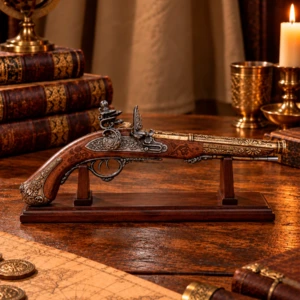
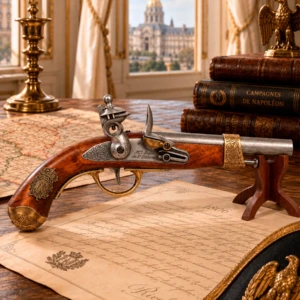
While large cannons dominated the battlefield, officers and cavalry carried much smaller weapons. Flintlock pistols were the standard sidearm of the cavalry, carried in holsters on either side of the saddle, and shared a fundamental limitation with muskets: after each shot, they had to be reloaded from the muzzle, something almost impossible on horseback. For this reason, some were manufactured with two barrels, allowing for an immediate second shot. In the hands of officers and high-ranking officials, the weapon could also become a symbol of authority. Gunsmiths like Nicolas-Noël Boutet, head of the Versailles manufactory, produced richly decorated pieces for the Empire that are now preserved in museums.
Gribeauval had worked to solve a problem that seemed purely technical: enabling cannons to move with the army. Napoleon took that solution much further, transforming artillery into the weapon that decided where and when to strike.
Gribeauval built the tool. Napoleon learned how to use it.