


A Japanese sword could not only showcase the skill of the one who forged its blade. It could also become a surface for depicting flowers, animals, landscapes, figures, and symbols. Especially on the fittings—the tsuba, fuchi, kashira, menuki, and other elements of the tōsōgu—artisans developed an extraordinarily rich artistic language.
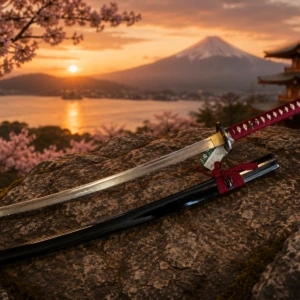
One of the most recognisable motifs is the sakura (桜), the cherry blossom. In Japanese culture, the cherry blossom is deeply connected to the beauty of the ephemeral and the awareness that seasons, people, and things change. This sensibility appears in Japanese art from very ancient times and can also be found represented in the decorative arts related to swords. The Metropolitan Museum points out precisely how cherry blossoms were used in Japanese art to express this awareness of the passage of time and the fleeting nature of beauty.
On sword fittings, the sakura was not simply an abstract symbol. There are historical tsuba in which cherry blossoms become the main motif of the design. Some were made using openwork—sukashi (透かし)—, relief, or inlays of other metals. The Metropolitan Museum, for example, holds several tsuba from the 17th to the 19th centuries decorated with cherry blossoms and branches, some embellished with gold, copper, or other decorative techniques.
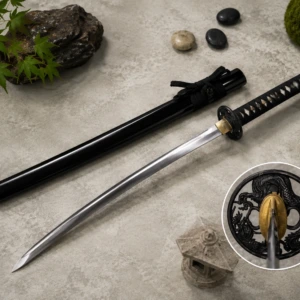
Another frequently appearing motif is the dragon, ryū (龍). Its presence in Japanese art is related to a long iconographic tradition of Asian origin, and dragons appear represented in different forms and contexts. On swords, they can be found engraved on the blade itself or depicted on the fittings of the mount. The Metropolitan Museum, for example, houses an Edo-period nanban tsuba (南蛮鐔) carved in openwork (sukashi, 透かし) with two dragons chasing a jewel, a style clearly marked by foreign influence on a profoundly Japanese object.
Alongside the dragon, another related motif sometimes appears: the carp, koi (鯉), depicted swimming upstream or over a waterfall. This motif incorporates a legend of Chinese origin—the carp's passage through the Dragon Gate (龍門, Longmen)—which also reached Japan: the carp that manages to swim upstream transforms into a dragon. Therefore, when a tsuba or saya combines the carp and the dragon in the same composition, along with other motifs such as the lotus, these are not isolated symbols, but rather two halves of the same story: the effort and the transformation that can follow.
But here it's important to make a distinction: a motif doesn't necessarily have a single meaning. A dragon can be associated with certain ideas of power, protection, water, or supernatural forces within the Asian artistic tradition, but we cannot say that every dragon depicted on a sword had exactly the same intention. To interpret a specific piece, one must consider its era, the artisan, the school, the other elements represented, and the context in which it was made.
The sakura and the dragon do not exhaust the repertoire of natural motifs that can be found on a sword mount. Bamboo (竹, take), associated with flexibility and resistance to the wind, and birds—cranes or other species traditionally linked to good fortune or longevity—also appear, especially in techniques like inlaid mother-of-pearl (螺鈿, raden), as decorative motifs with their own meaning within the same tradition that gave rise to the sakura or the dragon.
During the Edo period (江戸時代, 1603-1868), this artistic dimension reached extraordinary sophistication. Craftspeople specialising in sword fittings developed their own techniques and styles, and tsuba could incorporate entire scenes, animals, plants, landscapes, and literary or theatrical references. Some pieces are veritable miniature works of art. The Metropolitan Museum's collections showcase the enormous variety of these works and document numerous specialists who worked in Edo and other cities during the 18th and 19th centuries.
A good example of this complexity is an 18th-century tsuba in the Metropolitan Museum depicting a shishi, the guardian lion, amidst peonies, referencing a scene from the Noh play Shakkyō. Here, the decoration is not merely a pretty drawing: it contains a cultural reference that could be recognised and appreciated by anyone familiar with the represented tradition.
And then we come to contemporary swords.
Today we can find tsuba and mounts directly inspired by traditional Japanese motifs, but also designs that clearly belong to the modern imagination. Dragons, demons, fantastical warriors, or skulls may appear on current pieces intended for collecting or decoration. In these cases, we must distinguish between a documented historical motif and a contemporary creation inspired by Japanese aesthetics.
The skull is a good example. Although skulls may currently appear in designs for katanas and other decorative weapons, we should not automatically present them as a traditional symbol equivalent to the sakura or the dragon. If a contemporary piece uses a skull, it is most accurate to describe it as a modern design element, unless there is a specific source that allows us to attribute a particular historical meaning to it.
And there is one last point that often goes unnoticed: a tsuba does not have to be simply a piece of iron. Historical collections show examples made of iron, copper, shakudō, shibuichi, gold, silver, and combinations of different materials. The artistic value of these pieces could lie precisely in the combination of materials, techniques, textures, and colours.
Therefore, when we observe a tsuba, we are not only seeing a piece placed between the blade and the handle.
We are looking at a small surface on which an artisan could condense nature, literature, religion, tradition, imagination, and personal taste.
A cherry blossom can speak of the ephemeral.
A dragon can belong to a millennia-old iconographic tradition.
A scene can conceal a literary or theatrical reference.
And a skull can tell us that we are looking at a contemporary interpretation.
The sword remains; what changes is the story we choose to tell about it.
Pieces from this story
Next story: 7. The unused sword: conservation, care and legacy →