For the revolver to exist, the flintlock first had to disappear.
At the beginning of the 19th century, firearms began to abandon the old flintlock. In 1807, a Scottish clergyman and hunting enthusiast, Alexander Forsyth, patented an ignition system based on fulminates, compounds that detonate when simply struck. Shortly afterwards, the percussion cap appeared, a small copper cap that could be placed in the weapon in a second and was much more reliable in humid conditions. It seemed like a small change, but it opened the door to a new generation of weapons.
Before Samuel Colt, there had already been multi-barrelled firearms and some with rotating cylinders. The problem was making the mechanism work practically and reliably. Colt, a young man from Connecticut, would recount years later that the idea came to him aboard a ship, observing the movement of the ship's wheel, and that he carved his first model in wood during the voyage. Whether it was true or part of the legend he himself cultivated, we don't know. What we do know is the solution he found: when the weapon was cocked, the mechanism itself rotated the cylinder, perfectly aligning it with the barrel.
Colt patented his system in England in 1835 and in the United States the following year. But inventing a mechanism didn't guarantee a business, and his first factory, in Paterson, New Jersey, went bankrupt in 1842.
It seemed the story might end there. But then war broke out.
During the conflict between the United States and Mexico, Texas Ranger Captain Samuel Walker was looking for a powerful weapon capable of firing several shots in quick succession. He contacted Colt, and from that collaboration, a massive revolver was born in 1847, restoring the inventor's fortune and allowing him to build his large factory in Hartford.
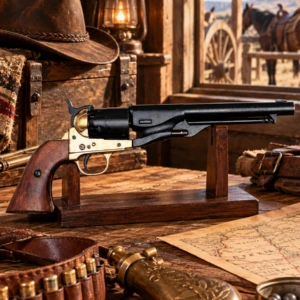
The evolution culminated in the Colt Army Model 1860, a .44 calibre revolver with six chambers and an eight-inch barrel. It was lighter than the larger models that came before and could be carried in a belt holster. But it was still not a cartridge weapon. Each chamber was loaded separately: first the gunpowder, then the bullet, which was seated using the lever located under the barrel, and finally a percussion cap on each nipple. It was a slow process, but once loaded, that cylinder held something that just a few decades earlier would have seemed extraordinary: six shots ready to be used one after the other.
In 1861, the American Civil War began, and the Army 1860 became one of the Union's main revolvers. The Federal army acquired more than one hundred thousand units, primarily for the cavalry. For a rider, being able to fire several times without stopping to reload made a huge difference. The weapon also appeared on the Confederate side, with examples purchased before the war or captured from the enemy.
Samuel Colt did not live to see the end of that conflict. He died in January 1862, when the war was still far from over. His revolver, however, continued its journey.
After the war, the Army 1860 accompanied soldiers and settlers in their westward expansion. Meanwhile, technology continued to advance, and the next great transformation was hidden in something seemingly simple: a metallic cartridge that combined the bullet, gunpowder, and primer in a single piece. Muzzleloading began to be left behind. Many revolvers were converted to use cartridges, and in 1873, Colt introduced the Single Action Army, which would become one of the great icons of the West. Much later, popular novels and films forever cemented the image of the revolver on the belt, although the films didn't always respect the dates and mixed weapons from different eras.
Colt hadn't invented the revolver from scratch. What he achieved was something more difficult: transforming an idea that others had attempted into a practical, reliable mechanism that could be mass-produced.
And that's what changed history.