


Imagine a sword that has passed through the hands of a grandfather, a father, and a son. It has seen battles, lost some of its lustre, perhaps even broken at some point. But no one throws it away: it is repaired, reassembled, and continues to be passed down from one generation to the next.
For centuries, a sword could be much more than a weapon. It could be an inheritance. And some even acquired something more special: a name.
In medieval tradition, the swords of great heroes and kings became characters in their own stories. Charlemagne's was Joyeuse, "the joyful one"; Roland's, Durendal; and the Poem of the Cid made Tizona and Colada symbols of their owner's fame and honour. Joyeuse is a particularly curious case: the Louvre houses the sword that was used for centuries in the coronation of the kings of France and which tradition identified as that of the emperor, although the piece we see today incorporates elements from different eras. Even when a sword ceases to be a weapon, it can continue to have a life of its own.
The stories of Northern Europe took this idea even further. In Beowulf, the hero wields swords with names of their own. And in the Völsunga saga, Odin plunges a sword into a tree that only Sigmund manages to pull out. The blade will eventually break in battle, but its fragments are preserved so that, some time later, they can be reforged for his son Sigurd. The new sword will be called Gram, and with it Sigurd will slay the dragon Fáfnir.
The image is powerful: a sword breaks, but its story does not end with it.
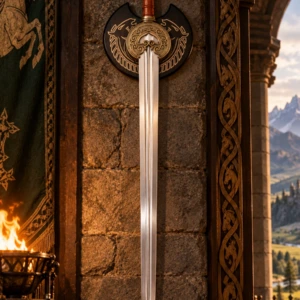
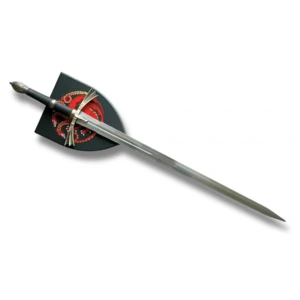
Tolkien knew this world very well. He was a professor of Old English at Oxford, studied Beowulf throughout his life, and dedicated years to rewriting the legend of Sigurd. When he created Middle-earth, he took up the idea almost intact: Narsil breaks in the fight against Sauron and, much later, is reforged for Aragorn with a new name, Andúril, the "Flame of the West". The broken sword awaiting its heir reappears, but this time it doesn't herald just any hero. It heralds the return of a king.
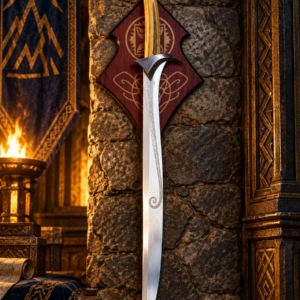
Tolkien didn't simply revive stories of swords. He also revived the way ancient cultures imagined their warriors. Rohan is deeply linked to Anglo-Saxon tradition: the names of its characters, its equestrian culture, and even the sound of its language hark back to Old English. Théoden means "king", and Herugrim, the name of his sword, can be translated as "very fierce". His nephew Éomer's sword is called Guthwinë, "friend of battle", and in the films, it has a pommel in the shape of a horse's head.
This is no coincidence. In Anglo-Saxon tradition, even the names of Hengist and Horsa, the legendary chieftains associated with the arrival of the Angles and Saxons in Britain, mean "stallion" and "horse".
And in 1939, archaeology unearthed something that seemed straight off a page of Tolkien. At Sutton Hoo, in Suffolk, a massive Anglo-Saxon burial site from the early 7th century was excavated. Beneath the mound, the impression of a ship some 27 metres long was discovered, and inside, a burial chamber filled with treasures: weapons, jewellery, tableware from distant lands, a famous helmet decorated with warriors and interlaced animals, and a prestigious sword with a richly decorated hilt. We don't know for sure who was buried there, but the assemblage as a whole leaves little doubt about its importance.
That's why, when we see a fantasy sword with a pommel in the shape of a horse, interlaced animals on the guard, or a name of its own, it's worth remembering that almost none of it is modern. The swords of old already had names, belonged to a family, were broken and reforged, and outlived their owners. Tolkien simply had to listen to what was already being said.
Pieces from this story
Next story: 2. Elves, dwarves and shadows: design as a language →