In the summer of 1941, Germany invaded the Soviet Union, and within a few months, the Red Army lost a huge number of men and weapons. While the country tried to contain the German advance, Soviet industry faced another challenge: relocating entire factories beyond the Urals while simultaneously continuing to produce weapons for a war that offered no respite.
Under those circumstances, it was no longer enough to design a good weapon. It had to be able to be manufactured quickly, with few tools, and in enormous quantities.
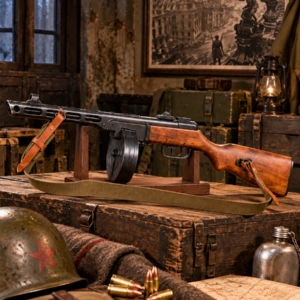
The Red Army was then using the PPD-40, a submachine gun of good quality but expensive and slow to manufacture, with numerous machined parts. The solution came from Georgy Shpagin, who designed a weapon intended from the outset for mass production: the PPSh-41.
Many of its parts were made of stamped sheet steel, and it required approximately half the machining hours of its predecessor. Even the barrel, chrome-lined on the inside, was designed to withstand wear and tear and ammunition of varying quality. The result was a simple, robust, and extraordinarily fast weapon: it fired the 7.62×25mm Tokarev pistol cartridge at a rate of around 1,000 rounds per minute, with a 71-round drum magazine. This came at a price, as it consumed ammunition at an enormous rate, and the drum tended to jam if it was completely full. From 1942 onwards, a lighter and more reliable 35-round curved magazine was added.
Around six million PPSh-41s were manufactured, and the submachine gun became one of the iconic images of the Soviet soldier during the war, from the ruins of Stalingrad to the streets of Berlin. Even the Germans appreciated its qualities: they used captured examples and even adapted some to fire their 9mm ammunition.
But the war continued to teach lessons. The Germans had experimented with a new idea: an intermediate cartridge, less powerful than rifle ammunition but more powerful than pistol ammunition, with which a soldier could fire in automatic mode without losing control of the weapon at actual combat distances. The Soviets took note and in 1943 developed their own, the 7.62×39mm. All that was missing was the right weapon.
It was then that a virtually unknown man appeared.
Mikhail Kalashnikov was a tank sergeant when he was wounded in October 1941, in the fighting around Bryansk. During his convalescence, he began to draw weapons. He wasn't an engineer, but he managed to work his way into the Soviet design bureaus, and in 1947 his rifle won the trials. Two years later, the Soviet army officially adopted it. The AK, the Kalashnikov automatic rifle, was born.
Its design philosophy was inherited from that of the PPSh. It wasn't designed with delicate construction, but rather with few parts, generous clearances, and a mechanism capable of functioning in dirt, mud, and cold. A recruit could learn to use it in a short time. For paratroopers and vehicle crews, where space was limited, a version with a folding metal stock, the AKS, was also created.
The first version had manufacturing problems with the stamped sheet metal receiver, and for some years, machined construction was reinstated. In 1959, the AKM arrived, solving the problem with lighter sheet metal, and it was this version that spread throughout much of the world. Manufactured in numerous countries, with or without licence, the Kalashnikov family achieved a level of distribution unmatched by any other rifle. It even appears on the flag of Mozambique.
The PPSh-41 had pushed industrial production to its limits. The AK applied that same philosophy of simplicity to a new generation of weapons. Between the two of them they demonstrated something that World War II had made clear: the ability to manufacture a weapon by the millions could be as decisive as the weapon itself.