By the end of the 19th century, the infantryman had already left the world of the musket behind. Metallic cartridges had replaced separately loaded gunpowder and bullets, and bolt-action rifles, which had existed since the mid-19th century, had evolved into repeating rifles, with several cartridges stored within the weapon. The problem was no longer how to load.
It was how many shots to carry and at what rate to fire them.
The mechanism seemed simple. The soldier lifted the bolt, pulled it back to eject the spent casing, pushed a new cartridge into the chamber, and closed it again. But small differences in design could completely change the speed and how the weapon was used, and two of those differences ended up clashing in the trenches.
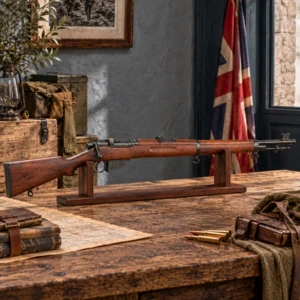
Great Britain found its answer in the system of James Paris Lee, a Scottish inventor based in North America, who designed a bolt with a separate box magazine. Combined with the rifling developed at the Royal Small Arms Factory at Enfield, it resulted in the Lee-Enfield. Its most famous version, the Short Magazine Lee-Enfield Mk III, was adopted in 1907. It was a relatively short rifle, and its magazine held ten rounds, twice as many as many of its rivals.
But capacity wasn't its only advantage. The bolt had a short travel and cocked itself as it closed, so a trained soldier could operate it with remarkable speed without removing the rifle from his shoulder. The British Army turned this feature into a true combat skill. Its soldiers practised the so-called "mad minute": at least fifteen aimed shots in one minute at a target 300 yards away. The best marksmen far exceeded that number.
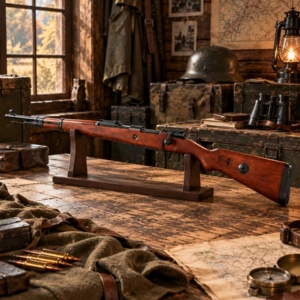
On the other side of the North Sea, a different philosophy was developing. In Germany, Paul Mauser and his brother Wilhelm had spent years perfecting the bolt-action rifle, and in 1898 the German army adopted the Gewehr 98. Its internal magazine held only five cartridges, but its bolt was extraordinarily robust: two large locking lugs at the front and an extractor that held the cartridge in place throughout its travel.
The design had an enormous international influence, and Spain was well acquainted with it. The Spanish army used the Mauser Model 1893, and in 1898, in the hills of San Juan, during the war with the United States, their rifles played a leading role. The figures from that battle have been recounted in many ways, but the performance of the Spanish Mauser impressed the Americans. Shortly afterwards, their new rifle, the 1903 Springfield, incorporated solutions from the Mauser system, and the United States ended up paying the German firm for the use of its patents.
In 1914, the two systems clashed in the Great War. In the early battles at Mons and during the subsequent British retreat, the rate of fire of the British riflemen fuelled one of the great stories of that war. It is said that some Germans believed they were facing machine guns when in reality they were facing the rapid fire of the riflemen. The story became legend, although accounts are scattered and British units also possessed some machine guns.
The rivalry did not end in 1918. In Germany, the Gewehr 98 evolved into the Karabiner 98k, adopted in 1935. Although its name suggested a carbine, it was actually a medium-length rifle. It was the standard weapon of the German soldier during the Second World War and, with a telescopic sight, also that of their snipers. Great Britain, meanwhile, continued to rely on the Lee-Enfield, which from 1926 was officially called the Rifle No. 1 Mk III, and from 1941 onwards was gradually replaced by the No. 4, a modernised and simpler-to-manufacture version.
For almost half a century, two philosophies had followed different paths. The Lee-Enfield focused on the capacity of its magazine and the speed of its bolt; the Mauser, on the robustness of its mechanism. Neither invented the bolt-action rifle, but both brought it to its most refined form.
There was no clear winner in that duel. Both rifles served in two world wars, and even today, in their own way, they remain the benchmark of what a bolt-action rifle can be.