Imagine entering a medieval castle. You don't know any of the men there. They wear armour, helmets, and swords, and their faces may be completely hidden. But you don't need to ask who they are: just look at their shields.
A lion. An eagle. A cross.
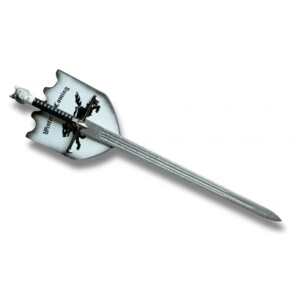
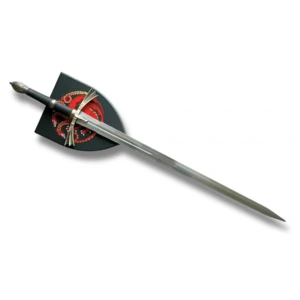
As helmets increasingly covered the knight's face, painted shields acquired a fundamental function: allowing a warrior to be recognised in the heat of battle. Over time, these symbols were transferred to clothing, horses, and banners, giving rise to a complete system, with its colours, rules, and specialists, the heralds: heraldry. Behind each symbol was a family, a lineage, and a story. And when these families settled in their castles, the shields also adorned the walls: crossed swords above the house's coat of arms, hung in the hall to remind everyone who entered to whom that place belonged.
Centuries later, George R. R. Martin used that same idea to construct the great houses of A Song of Ice and Fire. The Starks have their grey direwolf on a white background and the motto "Winter is Coming." The Targaryens, their three-headed red dragon on a black background. Each house has colours, symbols, and a motto that allow it to be recognised even before knowing who is behind the armour.
It is no coincidence that all this is reminiscent of English history. Between 1455 and 1487, the houses of York and Lancaster clashed in a long struggle for the throne, and their most famous emblems ended up being two roses: the white rose of York and the red rose of Lancaster. When Henry VII came to power and married a York heiress, the union was represented by a new image, the Tudor rose. Martin acknowledged the Wars of the Roses as one of his great sources of inspiration.
But in the Middle Ages, symbols did not only identify families. They also accompanied the men who marched to war, and no war saw more embroidered crosses than the Crusades.
In 1187, Saladin recaptured Jerusalem, and a few years later the Third Crusade began, with Richard the Lionheart among its protagonists. In that world of crusaders and fortresses, another group emerged that centuries later would have an enormous presence in popular culture: the Nizari. They controlled castles in mountainous areas of Persia and Syria, such as Alamut and Masyaf, and were feared for a very specific strategy: the targeted assassination of enemy leaders. One of their most famous leaders was Rashid al-Din Sinan, whom the crusaders called the "Old Man of the Mountain." In 1192, two men connected to their organisation killed in Tyre Conrad of Montferrat, who had just been elected King of Jerusalem.
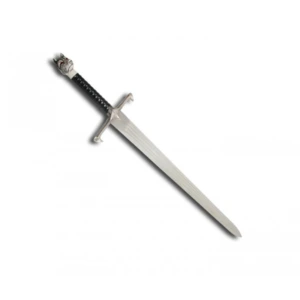
Over time, stories far more extraordinary than the facts grew up around the Nizari: drugs, secret gardens, and men willing to die blindly obeying their master. Today, historians consider many of those accounts exaggerations or propaganda from their enemies. But the legend survived. In 1938, the Slovenian writer Vladimir Bartol published Alamut, a novel inspired by that world, and decades later that image reached video games: Assassin's Creed set its first adventure in the Holy Land of 1191, and its protagonist, Altaïr, travels through Acre, Damascus, and Jerusalem with a sword with a winged guard at his belt, blending historical figures with a fictional plot.
A shield was never simply a shield. It was a way of saying, "This is my house, this is my lineage." That is why, eight centuries later, hanging a sword above a coat of arms still means the same thing as it did in the hall of that castle.