Before a sword was even drawn, it was already telling a story. Just looking at it was enough.
The shape of the blade, the guard, the pommel, or the decoration could reveal who had made it, where it came from, and even who could afford to carry it. In the Middle Ages, a sword was not just a weapon: it was also a form of identity. The famous Ulfberht swords are a good example. Between the 9th and 11th centuries, numerous blades appeared with that name engraved on the metal; some achieved great prestige, while others are imitations with poorly copied inscriptions. The name had become a recognisable mark of quality. The sword, in a way, spoke.
Tolkien understood this idea very well. When he created Middle-earth, he didn't just invent different peoples: he also gave them their own way of understanding beauty, strength, and war.
In The Hobbit, Gandalf finds two ancient Elven swords, Glamdring and Orcrist, in a troll cave. They had been forged in Gondolin, an Elven city that vanished thousands of years before. Glamdring had belonged to King Turgon; Orcrist was known as the "Goblin-cleaver". The city had fallen and its inhabitants had disappeared, but the weapons remained. It's a very medieval idea: a sword can outlive its owner and become the last piece of a story that no one fully remembers any more.
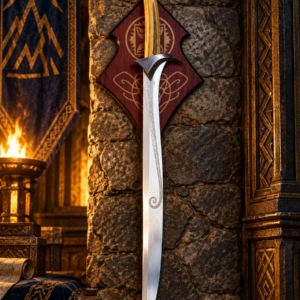
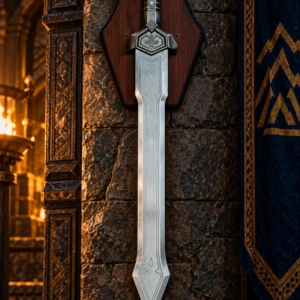
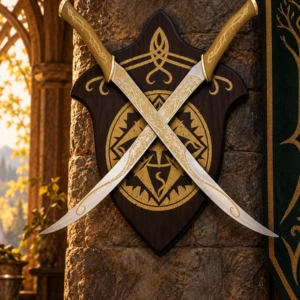
When Peter Jackson brought Middle-earth to the screen, these differences between peoples had to be made visible. The designers couldn't simply say that a sword was Elven or Dwarven: the viewer had to understand it just by looking at it. Elven weapons adopted flowing lines and plant motifs, like Arwen's Hadhafang, with its slightly curved blade, or Legolas's two long knives, whose hilts seem to grow like branches. Dwarven weapons, on the other hand, turned to geometry: angles, straight lines, and solid pieces, like Kíli's short sword, which is reminiscent of architecture carved beneath the mountain. It didn't need explaining. The sword said it all.
Even the names conceal that connection to the ancient world. Many of Tolkien's dwarves, including Fíli, Kíli, and Thorin, and even Gandalf, appear in the catalogue of dwarves in the Völuspá, one of the poems of the Poetic Edda.
For the enemies, the films chose a different language: intimidation. The Witch-king of Angmar, the most fearsome of the Ringwraiths, wields on screen a massive greatsword with a curved guard and a menacing look. However, in the book, his defeat holds a much more interesting idea than any greatsword. Merry carries an ancient blade found in the Barrow-downs, forged centuries earlier by the Men of the North precisely to fight against the power of Angmar. When Merry wounds the Witch-king with it, a forgotten weapon finally fulfils the purpose for which it was created. It's almost as if the past had been waiting.
Real swords also preserved memories long after their maker had passed away: an inscription kept a name alive, a shape revealed a tradition, a decoration identified a people. That's why a fantasy sword deserves a closer look. Behind its curves, angles, and engravings lies a language, and whoever learns to read it discovers the world from which each blade comes before anyone even draws it.